Alpha Particle Scattering and angular momentum

Click For Summary
The discussion revolves around proving that the direction of angular momentum (L) for an alpha particle remains constant during scattering due to a central force. The key point is that since the torque (τ) is zero for a central force, the angular momentum vector (L) is constant, implying its direction is also conserved. Participants express frustration that the question specifically asks to demonstrate the constancy of direction rather than the vector itself. They explore whether it is possible to show that the unit vector of angular momentum (hat L) remains constant using its definition. Ultimately, the conversation highlights the challenge of addressing the question as posed while acknowledging that the constancy of L implies its directional stability.
brotherbobby
Messages
755
Reaction score
170
Statement of the problem :

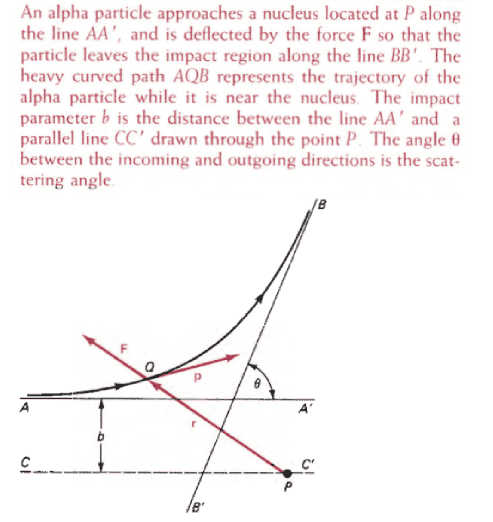
"Using the definition L = r ##\times## p, prove that the direction of L is constant for an alpha (##\alpha##) particle whose scattering is shown in the diagram below. "
alpha.png


Relevant equations :

We are aware that the scattering takes place via a central force F = F(r) ##\hat r##. Angular momentum L = r ##\times## p and torque ##\tau = r \times F## (all vectors)The attempt at a solution

I can solve the problem, but not the way it asks. The torque ##\tau = r \times F \Rightarrow \tau = 0## since the force is central : F = F(r) ##\hat r##. Using ##\tau = \frac{dL}{dt} = 0##, inplies that the angular momentum vector L is constant.

[This is not what the question asks for. It asks to show only the direction of L conserved, from the definition of L : L = r ##\times## p].
 

Attachments

  • alpha.png
    alpha.png
    35.5 KB · Views: 1,098
Physics news on Phys.org
If the vector itself is constant, then its direction must be conserved too ...

Also, where do you think ##\vec \tau = \vec r \times \vec F## comes from? :rolleyes:
 
Orodruin said:
If the vector itself is constant, then its direction must be conserved too ...
Yes, in that sense I have answered the question, but as I said, not in the way they asked for. I suppose they want one to focus on the direction of L and show that it remains the same.
Orodruin said:
Also, where do you think →τ=→r×→Fτ→=r→×F→\vec \tau = \vec r \times \vec F comes from?
I don't know. Torque and angular momentum are definitions, defined as the cross product of the radius vector and the force or the linear momentum, respectively.
 
brotherbobby said:
Torque and angular momentum are definitions, defined as the cross product of the radius vector and the force or the linear momentum, respectively.
So you need to relate those two, which you are going to do by computing the time derivative of the angular momentum.
 
Orodruin said:
So you need to relate those two, which you are going to do by computing the time derivative of the angular momentum.
All I am aware of is the standard : ##\frac{dL}{dt} = \frac{d}{dt}(r \times p) = r \times \frac{dp}{dt} = r \times F##.

It is this that I used to answer why the angular momentum L is constant - viz. the thrque is 0 owing to the fact that the force is central and hence L remains the same.

But the question asks me to show that the direction of L is a constant for a central force like this. (I am aware that I have already shown this in the form of the vector L itself being a constant).

I wonder if there is another way.

For instance, a vector L = ##L\hat L##. Can we show that ##\hat L## is a constant from the definition of L ( = ##r \times p##) for a central force (F(r))?
 
The book claims the answer is that all the magnitudes are the same because "the gravitational force on the penguin is the same". I'm having trouble understanding this. I thought the buoyant force was equal to the weight of the fluid displaced. Weight depends on mass which depends on density. Therefore, due to the differing densities the buoyant force will be different in each case? Is this incorrect?

Similar threads

  • · Replies 9 ·
Replies
9
Views
756
  • · Replies 3 ·
Replies
3
Views
1K
  • · Replies 17 ·
Replies
17
Views
858
  • · Replies 12 ·
Replies
12
Views
2K
Replies
2
Views
759
  • · Replies 5 ·
Replies
5
Views
6K
Replies
3
Views
1K
  • · Replies 2 ·
Replies
2
Views
2K
Replies
335
Views
15K
Replies
15
Views
2K