Amount of nitrogen needed to flush a pipe

  • Context: Undergrad 
  • Thread starter Thread starter rednass
  • Start date Start date
  • Tags Tags
    Nitrogen Pipe
Click For Summary
SUMMARY

The discussion centers on calculating the number of nitrogen (N2) cylinders required to flush a 1050m pipe filled with oil, with a diameter of 0.5 inches. The volume of the pipe is established at 0.133 m3, and the user considers using a pressure reducer set to 10 bar. The calculations involve applying Boyle's Law to determine that one cylinder (50L at 200 bar) can provide sufficient volume at the necessary pressure, with the conclusion that a second cylinder would only be needed if the pipe length exceeds 8000m. The importance of maintaining a pressure slightly above the hydrostatic pressure of the oil column is emphasized.

PREREQUISITES
  • Understanding of Boyle's Law and gas laws
  • Familiarity with pressure measurement units (bar, atm)
  • Basic knowledge of fluid dynamics and hydrostatic pressure
  • Experience with gas cylinder specifications and pressure reducers
NEXT STEPS
  • Research the application of Boyle's Law in practical scenarios
  • Learn about the design and operation of pressure reducers in gas systems
  • Investigate the effects of hydrostatic pressure in fluid systems
  • Explore alternative methods for flushing pipes, including the use of compressed air
USEFUL FOR

Engineers, technicians, and professionals involved in fluid dynamics, gas handling, and pipe maintenance will benefit from this discussion, particularly those focused on optimizing flushing operations in industrial applications.

rednass
Hello,

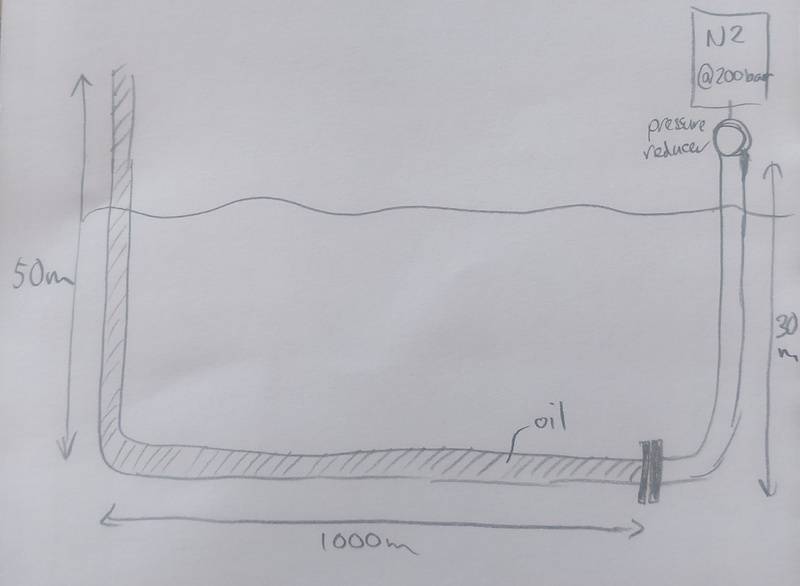
I am trying to solve a problem where I want to know how many cylinders of N2 (50L, 200 bar) are needed to flush a pipe filled with oil.
The pipe diameter is 0.5", so the volume of the pipe is 0.133 m3 (with a length of 1050m) which is filled with oil.
Behind the N2 cylinders is a pressure reducer which can be set from 0-10 bar.
How can I calculate the number of cylinders I need of N2?
I need to overcome the height of 50m + 1 bar, so around 6 bar. Let's say I set the pressure reducer to 10 bar and flush the pipe, then it contains 0.133 m3 @ 10 bar = 1.33 m3 @ 1 bar.
If, let's say the last 15 bar can't be taken out of the cylinder, it contains effectively 9250 L @ 1 bar = 9.25 m3 @ 1 bar.
Can I just compare those two and say 9.25 > 1.33, so only 1 cylinder is enough?
TLLqCI4.jpg


Thanks in advance!
 
Science news on Phys.org
I have never needed to do this but wouldn't it be cheaper to do it with compressed air from a compressor (@6bar+), initially and just clean it out with a few pipe volume's worth of N2 at the end? The N2 would be at low pressure, once the oil is gone.
 
Yes, that is also an option, but now I am actually interested in the case where only N2 is used!
 
Something that struck me. I am a little obsessed with the energy stored in compressed gases. If you try to blow the oil out I think you could have a problem.
 
If you could lower a force pump down to the bottom, you could have a safer situation. It may be cheaper, too.
You must avoid being too committed to one particular solution and look at all possibilities with an open mind. [emoji4]
 
Yes, that is totally true. But for now, I just want to understand my own problem and I am getting stuck in understanding it. I'm not sure whether my steps and calculations are right or that I am missing something ;)
 
Well, the basics of the gas volumes and pressures are straightforward. The pressure at the bottom is from the vertical column of oil. Boyle's Law will tell you the volume of compressed gas at 200 Ats that will occupy the volume of the pipe (one vertical plus the horizontal length) at the necessary pressure (if the temperature stays more or less constant). A small excess pressure will push the oil out of the top. Once the oil starts to be expelled ( if no bubbles have formed), the hydrostatic pressure will go down as the height of the column and the gas pressure will drop according to Boyle's law. It won't change a lot because of the small total volume of the pipe.

The hydrostatic pressure will approach zero (plus 1 At, of course) and the gas pressure in the pipe will not change much if there is 1000m of horizontal section (1030m of gas goes to 1080m. I think the volume that you need to consider which needs to be at 50m of oil hydrostatic pressure is the 1030 length (vertical down pipe plus horizontal run) - the gas will then expand into the upward 50m section of pipe and no more needs to be pumped in.
The 'pressure reducer' would be followed by a simple tap which should be shut off as soon as oil starts to emerge. All that is necessary is for the pressure reducer to output a pressure which is a bit in excess of the 50m + 1 At and nothing too 'exact' and that's only for safety reasons, I think. (You could in principle use the 200 At bottle directly if you were careful about controlling the gas out of it. You wouldn't want to burst the pipe! You should never have 10At of pressure in the pipe; just enough (your 6Ats estimate)
 
Ok, let's break it down. Boyle's law: pV=nRT and let's assume nRT=constant for the N2 quad. That would mean that pV = constant as well and is equal to 200 bar * 50 L = 200 bar * 0.05 m3. So let's assume I want to output the N2 at 10 bar, then I would have p2*V2=p1*V1, so p2=200 bar * 0.05 m3/10 bar = 1 m3?
This would mean that I have enough N2 in 1 cylinder as the volume of the pipe is 0.133 m3?

And so I would need a second cylinder of N2 when the length exceeds 8000m? The volume of the pipe would become 1.013 [m3], so this is larger than the 1m3 calculated and thus I would need a second cylinder?

Am I right in these calculations?
 
rednass said:
Am I right in these calculations?
Boyle's Law says P1V1 = P2V2 (when the temperature is held constant.
About the 10Ats thing. You have to ask yourself if the pressure will ever need to reach 10Ats. If you let the tap open with a bang then yes. But would you want to do that? It would just accelerate the oil at a high value, sending it out of the end of the pipe at an excessively high speed and that is not necessarily a good thing - probably a bad thing (?). The working pressure in the pipe needs to be no more than a little greater than the hydrostatic pressure for 50m of oil. This is why I say that you do not need the volume at 200 At that you think you do.
So I would say that your calculation should be on the lines of
Pressure in Cylinder X Required Volume of Cylinder > Volume of 30m + horizontal run X Hydrostatic Pressure of 50m vertical
Notice I have not included your 10Ats figure because it should/need never apply.
 
Last edited:

Similar threads

  • · Replies 20 ·
Replies
20
Views
3K
Replies
0
Views
2K
Replies
8
Views
2K
Replies
13
Views
4K
  • · Replies 2 ·
Replies
2
Views
2K
Replies
15
Views
3K
  • · Replies 1 ·
Replies
1
Views
2K
  • · Replies 28 ·
Replies
28
Views
3K
  • · Replies 16 ·
Replies
16
Views
3K
  • · Replies 1 ·
Replies
1
Views
3K