Amplifier Circuit Advice -- AF/RF

Click For Summary
SUMMARY

The discussion centers on designing an RF amplifier circuit capable of amplifying signals at 7 MHz. The original design, which worked well for audio frequencies, failed to perform adequately at higher frequencies, yielding an output amplitude of only 1/8th of the input. Key factors affecting performance include load capacitance, collector current, and the choice of transistor type. Suggestions include using a tuned amplifier with an LC tank circuit and considering faster transistors or operational amplifiers for improved performance.

PREREQUISITES
  • Understanding of RF amplifier design principles
  • Familiarity with transistor parameters such as transconductance (gm) and hfe
  • Knowledge of load capacitance and its impact on amplifier performance
  • Basic concepts of tuned amplifiers and LC circuits
NEXT STEPS
  • Research "tuned amplifier design" and its applications in RF circuits
  • Learn about "Miller capacitance" and its effects on amplifier bandwidth
  • Explore the use of "operational amplifiers" for RF applications
  • Study "choke" and "LC tank circuit" configurations in amplifier design
USEFUL FOR

Electronics enthusiasts, RF engineers, and hobbyists looking to enhance their understanding of amplifier design and improve RF signal amplification techniques.

syelnmh
Messages
5
Reaction score
0
Not sure if this is the right place to post, but here we go, my first question:
I've been searching around for a simple circuit for amplifying rf at around 7MHz, and went ahead and followed this guide, 2nd picture down, and built the amplifier. It works, even with some small resistor value shifts (82k->79k and 39k->38.7k), but only in audio frequencies. At 600Hz, the amplitude of the resulting waveform is roughly 3 times the input. However at higher frequencies (7MHz), the resulting amplitude is only about 1/8th of the input. I also tried this design (from another site) using 10k ohm and 4k7 ohm for the voltage divider (which gets roughly the same voltage at the transistor base, but current??)

So my question: is it possible to make this design work at rf? If so, what component values should I use?

Here are two of my attempts,another two I did on my breadboard(class C & AB), which got taken apart:
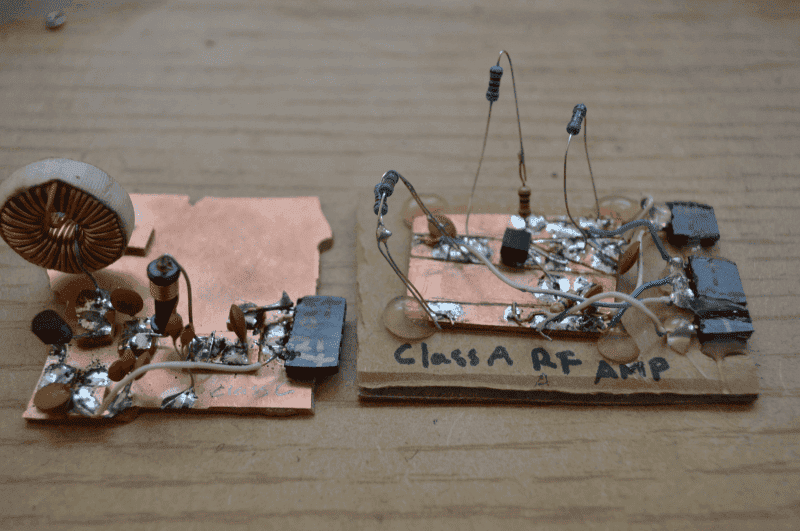
upload_2015-4-9_14-14-9.png

Unsurprisingly, neither the class AB or C worked :smile:.
Thanks!
 
Last edited:
Engineering news on Phys.org
Obviously your amplifier is not fast enough to amplify at 7 MHz (which isn't generally considered RF anymore btw). The basic design is standard and should be fine well beyond 7 MHz.

Do you know how to calculate amplifier bandwidth? There are a million webpages to help. Basically the product of the gain and the bandwidth (the point at which the small-signal gain is 1) is gm/C where gm is the transconductance of your transistor (also called hfe and equal to IC/vt or Ic/26mV) and C is your load (including self-loading effects). You can use the load resistor to trade off gain for bandwidth once its working.

Now you can see what's going on. What is your load capacitance? If it is small you might be loading it with a probe. Also, what is your collector current? You can increase your bandwidth by running the transistor hotter but make sure you don't put too much current through it (read the data sheet).

You might also need a faster device but I'm not convinced about that. You probably just need more current.
 
Last edited:
Welcome to the PF.

Yeah, the Miller capacitance is going to limit that design to lower frequencies. Have a look at "cascode" transistor amplifier circuits to get rid of the Miller capacitance issue... :smile:
 
syelnmh said:
Not sure if this is the right place to post, but here we go, my first question:
I've been searching around for a simple circuit for amplifying rf at around 7MHz, and went ahead and followed this guide, 2nd picture down, and built the amplifier. It works, even with some small resistor value shifts (82k->79k and 39k->38.7k), but only in audio frequencies. At 600Hz, the amplitude of the resulting waveform is roughly 3 times the input. However at higher frequencies (7MHz), the resulting amplitude is only about 1/8th of the input. I also tried this design (from another site) using 10k ohm and 4k7 ohm for the voltage divider (which gets roughly the same voltage at the transistor base, but current??)

So my question: is it possible to make this design work at rf? If so, what component values should I use?

Here are two of my attempts,another two I did on my breadboard(class C & AB), which got taken apart:
View attachment 81765
Unsurprisingly, neither the class AB or C worked :smile:.
Thanks!
I think the designer has made the amplifier for 2 MHz, so the output will be very reduced at 7 MHz.
 
Thanks for your responses, I now have much to think about.
I'm really not good with the math at all and only know a bit of the theory behind these amplifiers (my goal to fix by building one of these), but I do have some tools to make a few measurements:
Collector current: 127uA with 9V input, 751uA with 12V. I just de-soldered and measured it with multimeter
Load capacitance: 608pF (stuck a cheap capacitance meter at the load, an antenna), esr=17 ohm (haven't figured out what "equivalent series resistance" is either)
hfe of transistor: 310 (also measured)

I really don't need much bandwidth, and only have a basic understanding of how it relates to gain. It might take me a while to figure this topic out through Google.

I skimmed through the wikipedia cascode page quickly, and I do have to say, it looks promising. I also happen to have a few 2N5951's "N-Channel RF Amplifier"s around (datasheet). Maybe that would be a better path, but for now, should I play with resistor values at the collector?

But other than that, I still don't really understand how to set the maximum gain of the amplifier to a certain frequency, and reduce bandwidth.
Thanks for bearing with me!
 
Most amplifier designs that get above a couple of Mhz are going to use choke in place of the collector resistor.
 
  • Like
Likes   Reactions: davenn and dlgoff
syelnmh said:
But other than that, I still don't really understand how to set the maximum gain of the amplifier to a certain frequency, and reduce bandwidth.
Thanks for bearing with me!

If you don't need a lot of bandwidth, but you want gain at a specific frequency (for example, say you want to amplify a 100 kHz band around 7 MHz) you should look into using a tuned amplifier. This goes along with the choke suggestion from Averagesupernova.

http://en.wikipedia.org/wiki/Tuned_amplifierBasically you put an LC take in your collector circuit and set the resonance frequency of the tank to the center frequency. In your case you would chose sq-rt(1/LC) = 2*pi*7MHz
 
Tuned amplifier... interesting.
I just went and replaced the collector resistor with a choke, and it's now at 1/2 the original input (rather than 1/8).
Perhaps I should just scrap this amplifier and try the tuned one.
 
I don't think you're going to have to scrape it. Just replace the choke with an LC tank. You may need to AC couple the output if it isn't configured that way already.
 
  • #10
Output is AC coupled with a 0.1uF cap.
I replaced the choke with a tank (470pF+47pF, 1uH --> 6.99963MHz, pretty close)
Results are just about the same as the choke. On my scope, the wave is a bit less fuzzy (why?) , but the amplitude is just about the same.
 
  • #11
Watch out so your tuned amplifier doesn't become a class C amplifier which is not a linear amplifier. This is acceptable for amplifying an CW, FM or FSK signal for instance. However it would be unsuitable for amplifying an AM signal. Amplifiers in the IF strip in receivers would be tuned amplifiers however they are generally not class C.
 
  • Like
Likes   Reactions: dlgoff
  • #12
If class C's aren't good for AM, would that mean that AM signals would be distorted enough to almost be "filtered" out, or would it just turn into tons of noise on the receiving end? That would be fun to test, but I just don't have the time this week, or next week.

I'll take some time to consider a few of the suggestions above, and come back in a week or two to (hopefully) report on any successes.
Once again, thanks to all who responded!
 
  • #13
A class C amplifier is a sort of limiter. It relies on the tank circuits flywheel effect. The transistor is in conduction less than 50% of the time.
 
  • Like
Likes   Reactions: dlgoff
  • #14
Are you building the amplifier because you actually need an amplifier? Or because you want to learn more about electronics?
If it is the former you could just use a fast op-amp which is quite a bit easier to use. There are many op-amps out there with a gain BW product of over 1 GHz, meaning you can get a lot of gain at 7 MHz. All you need is the op-amp, a few resistors and some decoupling caps.

.
 

Similar threads

  • · Replies 28 ·
Replies
28
Views
6K
  • · Replies 3 ·
Replies
3
Views
3K
  • · Replies 20 ·
Replies
20
Views
3K
Replies
12
Views
2K
Replies
2
Views
3K
  • · Replies 10 ·
Replies
10
Views
2K
  • · Replies 3 ·
Replies
3
Views
4K
  • · Replies 7 ·
Replies
7
Views
3K
Replies
12
Views
2K
  • · Replies 14 ·
Replies
14
Views
2K