Amplitude modulation of signals with [suppressed] carrier

Click For Summary
SUMMARY

This discussion clarifies the differences between two types of amplitude modulation: Amplitude Modulation with suppressed carrier (DSB-SC) and Amplitude Modulation with carrier (AM). In DSB-SC, only the sidebands are present, while in AM, the carrier is also included, resulting in three pure tones. The mathematical representation of these signals differs, with DSB-SC using the expression [cos(ωmt)*cos(ωct)] and AM using [1 + cos(ωmt)]*cos(ωct). Understanding these distinctions is crucial for signal processing and modulation techniques.

PREREQUISITES
  • Understanding of amplitude modulation concepts
  • Familiarity with signal representation in both time and frequency domains
  • Knowledge of mathematical functions related to signal processing
  • Experience with mixers and modulation techniques
NEXT STEPS
  • Study the mathematical derivation of DSB-SC and AM signals
  • Learn about the implementation of mixers in amplitude modulation
  • Explore the use of envelope detectors in AM signal demodulation
  • Investigate the practical applications of DSB-SC and AM in communication systems
USEFUL FOR

Electrical engineers, signal processing professionals, and students studying communication systems will benefit from this discussion, particularly those focused on modulation techniques and their mathematical foundations.

Marvin94
Messages
41
Reaction score
0
Hello everybody, I'm a little bit confused about two types of amplitude modulation. We distinguish here:
Case I : Amplitude Modulation with suppressed carrier (https://en.wikipedia.org/wiki/Double-sideband_suppressed-carrier_transmission):
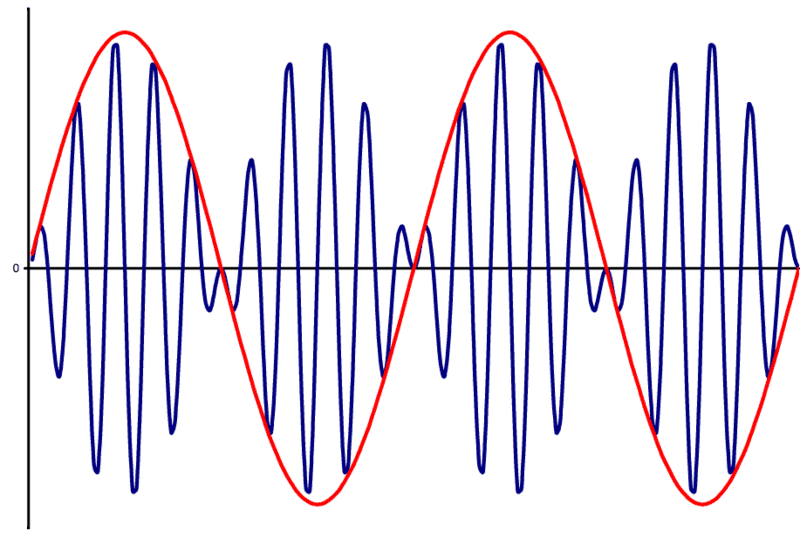
800px-AM-DSBSC.png
Case II : Amplitude modulation with carrier:
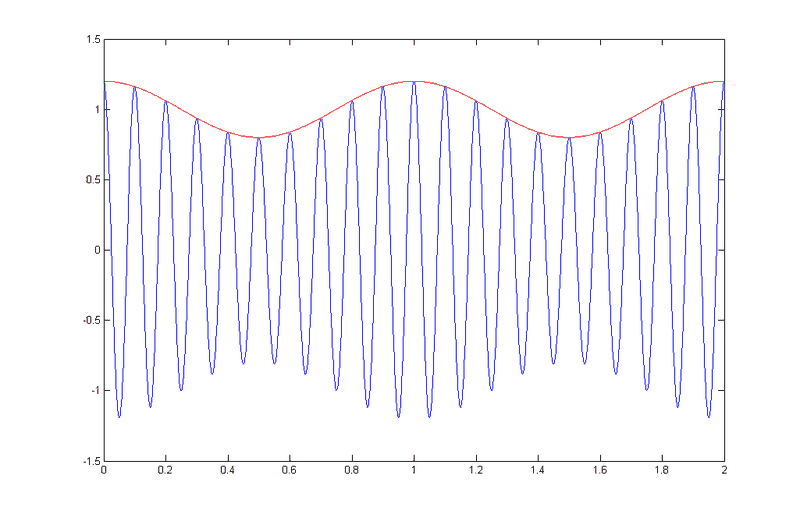
800px-AM_20%25_modulation_depth.png


Now, it's not really clear to me the difference between the graphics above. More precisely, I have some questions about this topic:
1) How can be deduced from a signal plot which of the two cases is represented?
2) How can I understand the same from a matematical point of view? I mean, let's assume I have written down matematically the function of my signal. From this expression, how can I understand if the signal is modulated with carrier or with suppressed carrier?
3) Which operation should be done to obtain the Case I, and which operation to obtain the Case II ?

Thank you a lot in advance for any explanation!
 
Engineering news on Phys.org
It's often easier this consider these in the frequency domain. Assuming sinusoidal modulation, in the suppressed carrier case we simply have two pure tones (the sidebands) beating against each other. They could be, for example, 0.99MHz and 1.01MHz. Your Case I waveform could just as easily be representing two sound waves, close in frequency, beating against each other producing the wowwwow sound (say 499Hz and 501Hz).

In the second case there are three pure tones, the two sidebands, and the carrier which is centered in between the sidebands in frequency, (0.99MHz, 1MHz, 1.01MHz). You can see the carrier tone in the Case II waveform.

There are lots of references online describing the relevant math and the methods used to generate, for example:
https://en.wikipedia.org/wiki/Double-sideband_suppressed-carrier_transmission

In a simplified nutshell we can generate both of these by multiplying (with a mixer) the carrier tone (1MHz) with a modulation tone (10KHz) that is appropriately offset in amplitude. In the case of suppressed carrier the offset is zero [cos(ωmt)*cos(ωct)]. In the case of AM the offset is necessary [1+ cos(ωmt)]*cos(ωct)].
 
  • Like
Likes Marvin94 and Averagesupernova
Good inputs to think about.. Thanks again !
 
In case 1, DSB, you will notice that the carrier phase reverses when the modulation crosses zero volts. That is because the DSB modulator is a “four quadrant” multiplier. Both carrier and modulation are bipolar signals that cross zero. Because the carrier flips phase by 180° it tends to cancel with itself over time, which suppresses the carrier, but the two sidebands remain.

In case 2, AM, the phase of the modulated carrier never reverses. The carrier is always present. The modulation signal is offset from zero sufficiently to always remains of the same polarity. The modulator used can then be a “two quadrant multiplier” and the receiver a very simple envelope detector.
 
  • Like
Likes Marvin94 and the_emi_guy
Most likely this can only be answered by an "old timer". I am making measurements on an uA709 op amp (metal can). I would like to calculate the frequency rolloff curves (I can measure them). I assume the compensation is via the miller effect. To do the calculations I would need to know the gain of the transistors and the effective resistance seen at the compensation terminals, not including the values I put there. Anyone know those values?

Similar threads

  • · Replies 5 ·
Replies
5
Views
2K
Replies
5
Views
2K
  • · Replies 15 ·
Replies
15
Views
5K
Replies
4
Views
2K
  • · Replies 2 ·
Replies
2
Views
3K
  • · Replies 3 ·
Replies
3
Views
6K
  • · Replies 19 ·
Replies
19
Views
8K
  • · Replies 2 ·
Replies
2
Views
2K
  • · Replies 13 ·
Replies
13
Views
4K
  • · Replies 41 ·
2
Replies
41
Views
7K