Why Does the Skin Effect Not Reverse into a Core Effect in AC Conductors?

Click For Summary
SUMMARY

The discussion focuses on the skin effect in AC conductors, specifically why it does not reverse into a core effect. The skin effect causes charge carriers, primarily electrons, to concentrate near the surface of the conductor due to the opposing electric field generated by changing magnetic fields. This phenomenon is exacerbated at higher frequencies, where the rapid reversal of current prevents significant penetration of eddy currents into the core. The discussion emphasizes the non-conservative nature of the electric field produced by dB/dt, which pushes charge carriers outward, maintaining the skin effect.

PREREQUISITES
  • Understanding of AC circuit theory
  • Familiarity with electromagnetic induction principles
  • Knowledge of eddy currents and their behavior in conductors
  • Basic grasp of electric and magnetic field interactions
NEXT STEPS
  • Research "AC skin effect in conductors" for detailed explanations and examples
  • Study "electromagnetic induction" to understand the principles behind back EMF
  • Explore "eddy currents in conductors" to learn about their formation and effects
  • Investigate "frequency response of conductors" to see how frequency impacts skin effect
USEFUL FOR

Electrical engineers, physicists, and students studying electromagnetism or AC circuit design will benefit from this discussion, particularly those interested in the behavior of conductors under alternating current.

Jackson Lee
Messages
77
Reaction score
1
Hey, guys. There is something interesting about the skin effect, which also made me curious:wink:. Could you please help to solve it?
The following is what I got from Wiki.

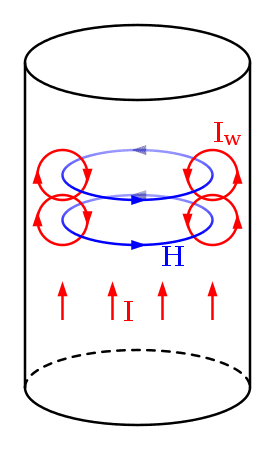
alternating current flowing through that conductor. The charge carriers constituting that current, usually electrons, are driven by an electric field due to the source of electrical energy. An alternating current in a conductor produces an alternating magnetic field in and around the conductor. When the intensity of current in a conductor changes, the magnetic field also changes. The change in the magnetic field, in turn, creates an electric field which opposes the change in current intensity. This opposing electric field is called “counter-electromotive force” (back EMF). The back EMF is strongest at the center of the conductor, and forces the conducting electrons to the outside of the conductor, as shown in the diagram on the right.[1]
275px-Skineffect_reason.svg.png
It is said that, according to theory of induction, induced current would oppose the change of magnetic field. Then when current increases in the upward direction, the outward induced current would be formed. However, when current decreases in the upward direction (you know this is AC current), then it seems induced current would change into inward direction so as to maintain magnetic field. If it is the case, the "skin effect" would change into "core effect". However, why does this never come true?
 
Engineering news on Phys.org
The speed of magnetic field propagation in a good conductor is very slow, not much better than walking speed. The magnetic field diffuses into the conductor, but does not get very far because the surface AC current reverses and quickly cancels the previous half cycle. The core ends up with an average of zero field.

Instead of EMF and a Back EMF, think of a Counter-Current, being the image of the surface current seen reversed in the reflective surface of the conductor. That is what keeps energy on the surface and limits diffusion into the conductor.

A surface current causes a magnetic field at 90°. That magnetic field causes another current at a further 90°. Turning left twice is equivalent to reversing direction.
 
There is a fundamental difference between the electric field produced by electrostatic potential difference and the electric field produced due to dB/dt. The latter is non-conservative and circular in nature.It acts on the charge carriers perpendicular to the drift velocity in a clockwise direction or anticlockwise directions. Both ways the charge carriers get pushed away from the axis of the conductor to the periphery.
 
I once saw a graphic here on PF illustrating @Baluncore 's point. But I can't find it today.

In the graphic in the OP, the red circles are eddy currents. Imagine them with much smaller radii near the surface.

1/120 second later: those eddies will move toward the core and be weakened by resistive losses, and a new set of eddies rotating the opposite way will be formed on the surface. The new and old eddies try to cancel each other.

Over several cycles we will have many layers of (alternate direction, but weakening) eddies moving toward the core.

Skin effect is stronger for higher frequencies. It is a race between the frequency of current reversal versus speed of propagation of the eddies toward the core.
 
Let'sthink said:
There is a fundamental difference between the electric field produced by electrostatic potential difference and the electric field produced due to dB/dt. The latter is non-conservative and circular in nature.It acts on the charge carriers perpendicular to the drift velocity in a clockwise direction or anticlockwise directions. Both ways the charge carriers get pushed away from the axis of the conductor to the periphery.
Sorry, I was confused. What do you mean? In clockwise direction, the inner current seems to be propelled to outside. However, in anticlockwise direction, the condition is reversed. Why are charge carriers pushed away in both conditions? Could you please state it a little more clearly?
 
I once saw a graphic here on PF illustrating @Baluncore 's point. But I can't find it today.

In the graphic in the OP, the red circles are eddy currents. Imagine them with much smaller radii near the surface.

1/120 second later: those eddies will move toward the core and be weakened by resistive losses, and a new set of eddies rotating the opposite way will be formed on the surface. The new and old eddies try to cancel each other.

Over several cycles we will have many layers of (alternate direction, but weakening) eddies moving toward the core.

Skin effect is stronger for higher frequencies. It is a race between the frequency of current reversal versus speed of propagation of the eddies toward the core.

I really hope I can see that graph. I am trying to imagine your described image and connect it with my question. If you can find it or come up with other possible explanations, please write it down here. I will feel very appreciative for it.
 
Suppose a charge carrier is drifting parallel to axis at some distance from it suppose it gets acted upon by a circular electric field normal to the axis whether clockwise or anticlockwise will the distance from the axis will increase or not?
 

Similar threads

  • · Replies 6 ·
Replies
6
Views
2K
Replies
10
Views
2K
  • · Replies 15 ·
Replies
15
Views
5K
  • · Replies 30 ·
2
Replies
30
Views
3K
Replies
36
Views
3K
  • · Replies 7 ·
Replies
7
Views
4K
  • · Replies 7 ·
Replies
7
Views
5K
  • · Replies 4 ·
Replies
4
Views
2K
  • · Replies 7 ·
Replies
7
Views
2K
  • · Replies 6 ·
Replies
6
Views
2K