Analyzing applied torque to one of lug nuts instead of wheel center

Click For Summary
SUMMARY

This discussion focuses on calculating the force exerted by a car wheel when torque is applied to a lug nut instead of the wheel center. The torque applied is 35 Nm, with the tire radius (C) at 0.289 meters, and two other distances (A and B) at 0.238 meters and 0.339 meters respectively. The effective wrench length varies based on the direction of the handle, affecting the torque calculation. The horizontal force exerted on the ground (Fg) can be determined using the formula Fg = (Fh * w) / r, where Fh is the force applied to the torque wrench handle, w is the effective length, and r is the wheel radius.

PREREQUISITES
  • Understanding of torque and its components (force and distance)
  • Familiarity with basic physics concepts such as force, mass, and acceleration
  • Knowledge of free body diagrams and balance of forces
  • Experience with torque wrenches and their application in automotive settings
NEXT STEPS
  • Research the principles of torque application in automotive mechanics
  • Learn how to construct and interpret free body diagrams for mechanical systems
  • Study the relationship between torque, force, and acceleration in vehicle dynamics
  • Explore advanced torque wrench techniques and their impact on vehicle performance
USEFUL FOR

Automotive engineers, mechanics, and physics students interested in the dynamics of torque application and its effects on vehicle movement.

karabiner98k
Messages
90
Reaction score
12
We all know that torque consists of force and distance. If we apply torque to the center of a car wheel, the force that the tire exerts to the ground can be calculated by dividing the torque by tire radius but what about applying torque to one of lug nuts which is off center?
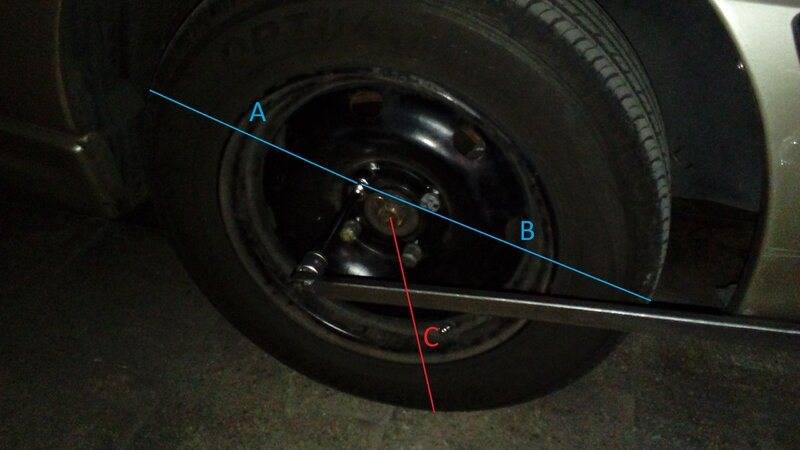
20220324_170202.jpg


In the above picture of my car:

C = Tire radius = 0.289 meter
B = 0.339 meter
A = 0.238 meter


Therefore, B > C > A

If I set my torque wrench to 35 nm and torque the center bolt down, the force would be: 35 / 0.289 = 121 N
What about applying torque to one of lug nuts at the point between B & A?
How do you calculate force if I apply the same 35 nm to it?
35 / 0.339 = 103 N? or 35 / 0.238 = 147 N?
Which one is the answer and why?
 
Last edited:
Engineering news on Phys.org
Construct a normal to the line of the wrench handle, a normal that passes through the wheel centre. The distance from that normal, along the wrench to your hand, is the effective wrench length when computing torque to the wheel. It may be more or less than the lug nut torque.
 
Lug nut torque is not my question because I already know the torque which I'm applying to the nut (35 nm). When I apply this amount of torque to the nut, the wheel starts rotating very slowly and the car begins moving forward. So, there is a force that moves it forward and I want to know the magnitude of this force. If the torque was being applied to the center of wheel, the force would be simply obtained by dividing the torque by tire radius but I don't know how to get it in this case since the nut is off-center.
 
What part of my post do you not understand ?
 
Constructing the normal. Could you please edit this picture to show the force and the lines?

20220324_170342.jpg
 

Attachments

  • 20220324_170332.jpg
    20220324_170332.jpg
    22.2 KB · Views: 161
Last edited:
The picture is too black.

If the nuts are at a radius of r from the centre of the wheel, then the handle of the torque wrench is effectively lengthened or shortened by a maximum of r, depending on the direction of the handle. If the handle passes over the centre of the wheel, the length is reduced by r, so the torque is less. If the handle points away from the wheel centre, then the handle is effectively lengthened by r, so torque is increased.
 
  • Like
Likes   Reactions: karabiner98k
I replaced the black picture with a bright one.
20220324_170342.jpg
 
Last edited:
WheelTorque.PNG
 
  • Like
Likes   Reactions: hutchphd and karabiner98k
Thanks for your drawing. What about acceleration force that the tire exerts to the ground and causes movement of the car?
 
  • #10
karabiner98k said:
What about acceleration force that the tire exerts to the ground and causes movement of the car?
The force applied to the torque wrench handle, Fh, is multiplied by the torque wrench effective length, w, then divided by the wheel radius. That gives the horizontal force applied to the ground; Fg .
Then use F = m a; So, acceleration; a = Fg / m; where m is the mass of the vehicle.
 
  • Like
Likes   Reactions: karabiner98k
  • #11
karabiner98k said:
Lug nut torque is not my question because I already know the torque which I'm applying to the nut (35 nm). When I apply this amount of torque to the nut, the wheel starts rotating very slowly and the car begins moving forward. So, there is a force that moves it forward and I want to know the magnitude of this force. If the torque was being applied to the center of wheel, the force would be simply obtained by dividing the torque by tire radius but I don't know how to get it in this case since the nut is off-center.
You could do a free body diagram of the wheel and a balance of forces and moments about the contact patch.
Those 35 N-m of torque are applied to the whole wheel, not only to the lug nut.
 

Similar threads

  • · Replies 16 ·
Replies
16
Views
3K
  • · Replies 18 ·
Replies
18
Views
7K
  • · Replies 18 ·
Replies
18
Views
3K
  • · Replies 9 ·
Replies
9
Views
1K
  • · Replies 8 ·
Replies
8
Views
7K
  • · Replies 23 ·
Replies
23
Views
11K
  • · Replies 25 ·
Replies
25
Views
42K
  • · Replies 2 ·
Replies
2
Views
5K
Replies
1
Views
4K
  • · Replies 2 ·
Replies
2
Views
3K