George_J
- 1
- 0
Hello!
Before I start I want to apologize for my english and not having a scanner (lol).
I'm calculating the torque needed to rotate a wheel* around its own axis from above, ( see the link at the end of post). I have quite an good idea to how I'm supposed to calculate it but I feel that something is missing.
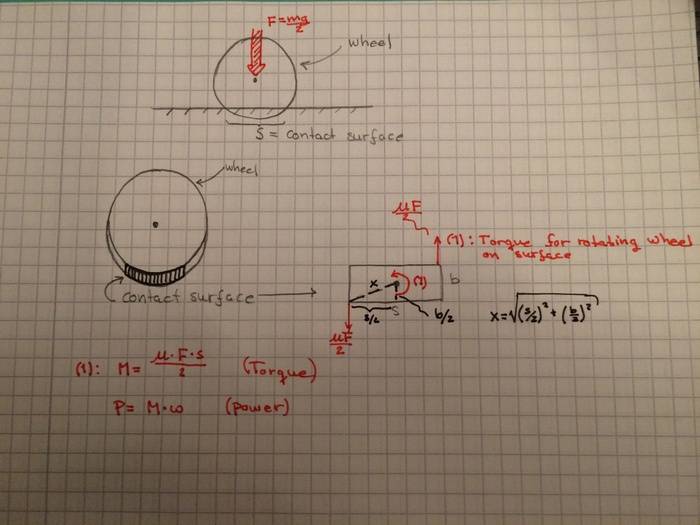
My picture explains it in a very simplistic matter, the wheel is intersecting the ground just to magnify the contact surface and the wheel is also bearing a Force (m*g) and also a torque. The contact surface I explained as a simple rectangle with a center, the longest path is from the center to one of the corners, will be the lever for the torque applied. I hope my picture explains it better than I do. The path can be calculated easily with Pythagoras and the Torque in this case is called ''force couple'' or ''pure moment'' , sadly I don't know the exact name since I'm studying in Swedish. & with that I can calculate the power needed for this rotation.
The purpose is to purchase a motor that can handle the torque/power. I could always just buy a very strong motor but that is not the purpose of my ''research''. But anyhow I really think something is missing here. The inertia perhaps ? I can't put my finger on it and I'm very bad at dynamics..
I have datasheets to all available motors, which includes their torque, inertia and much more, I just need some hints in what is missing in my calculation..
For those wondering I'm building a monorail robot, and it should approximately weigh 30ish kg. The wheels are supposed to be 10-15 cm in diameter.
Now I humbly ask for your help, and I hope I don't come over as an arrogant person asking such a big favor..
* http://www.cleaningshop.com.au/contents/media/l_19097_utility_cart_wheels.jpg
(This picture is not accurate the axis of the wheel will be aligned with the wheels center. As of now anyway.)
Before I start I want to apologize for my english and not having a scanner (lol).
I'm calculating the torque needed to rotate a wheel* around its own axis from above, ( see the link at the end of post). I have quite an good idea to how I'm supposed to calculate it but I feel that something is missing.
My picture explains it in a very simplistic matter, the wheel is intersecting the ground just to magnify the contact surface and the wheel is also bearing a Force (m*g) and also a torque. The contact surface I explained as a simple rectangle with a center, the longest path is from the center to one of the corners, will be the lever for the torque applied. I hope my picture explains it better than I do. The path can be calculated easily with Pythagoras and the Torque in this case is called ''force couple'' or ''pure moment'' , sadly I don't know the exact name since I'm studying in Swedish. & with that I can calculate the power needed for this rotation.
The purpose is to purchase a motor that can handle the torque/power. I could always just buy a very strong motor but that is not the purpose of my ''research''. But anyhow I really think something is missing here. The inertia perhaps ? I can't put my finger on it and I'm very bad at dynamics..
I have datasheets to all available motors, which includes their torque, inertia and much more, I just need some hints in what is missing in my calculation..
For those wondering I'm building a monorail robot, and it should approximately weigh 30ish kg. The wheels are supposed to be 10-15 cm in diameter.
Now I humbly ask for your help, and I hope I don't come over as an arrogant person asking such a big favor..
* http://www.cleaningshop.com.au/contents/media/l_19097_utility_cart_wheels.jpg
(This picture is not accurate the axis of the wheel will be aligned with the wheels center. As of now anyway.)
