Angle Between Planes: Is i1+cos(rotation)*i2 Correct?

  • Context: Graduate 
  • Thread starter Thread starter tony873004
  • Start date Start date
  • Tags Tags
    Angle Planes
Click For Summary

Discussion Overview

The discussion revolves around calculating the angle between two orbital planes, particularly in the context of celestial mechanics. Participants explore various mathematical formulations and geometric interpretations related to the inclination and rotation of these planes.

Discussion Character

  • Technical explanation
  • Mathematical reasoning
  • Debate/contested

Main Points Raised

  • One participant proposes a formula, i1 + cos(rotation) * i2, to describe the inclination between orbital planes.
  • Another participant clarifies that the angle between two planes is defined by the angle between their normal vectors and discusses the geometric implications of rotating a plane about a line.
  • A different participant questions the concept of the radius of the circle traced by the normal vector, suggesting an alternative formula: acos(sin(a1)sin(a2)cos(rot) + cos(a1)cos(a2).
  • Clarifications are made regarding the definitions of variables a1, a2, and rot, with specific angles assigned to the orbital planes in the context of the ecliptic.
  • One participant notes that when rot = 0, the angle between the planes simplifies to |a1 - a2|, highlighting the complexity introduced by additional rotations.
  • Another participant provides a detailed mathematical representation of the normal vectors and the angle calculation between them, using dot products and trigonometric identities.

Areas of Agreement / Disagreement

Participants express differing views on the correct approach to calculating the angle between the planes, with no consensus reached on a single formula or method. The discussion remains unresolved regarding the best mathematical representation.

Contextual Notes

Participants acknowledge the complexity of the problem due to the multiple axes of rotation and the need for precise definitions of angles and orientations. The discussion includes various assumptions about the orientations of the planes and their relationships to the ecliptic.

Who May Find This Useful

Readers interested in celestial mechanics, orbital dynamics, and mathematical modeling of angles between planes may find this discussion relevant.

tony873004
Science Advisor
Gold Member
Messages
1,753
Reaction score
143
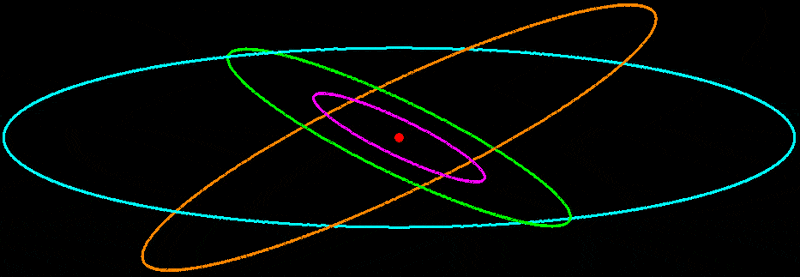
Consider the following diagram:
inclinations2.GIF


All 4 orbits are inclined 30 degrees to the xy plane (I tilted the diagram a bit for clarity, so we're not looking from directly in the xy plane.

The green orbit and the purple orbit are inclined 0 degrees from each other.

The orange orbit is rotated 180 degrees from the green and purple orbits. It appears to be inclined 60 degrees to the green and purple orbits.

The blue orbit is rotated 90 degrees with respect to the green and purple orbits. I'm guessing that it is inclined 30 degrees from the green and purple orbits and also 30 degrees from the orange orbit.

So in trying to come up with a formula to describe how one orbital plane is inclined relative to another my first guess is :

i1+cos(rotation)*i2

Is this correct?
 
Physics news on Phys.org
Let me clarify this: You have a plane, and you rotate the plane by an angle a2 about a line that passes through the plane at an angle a1 (in this case the vertical line through the center of the orbits). You want to know what the angle is between the first plane and the rotated plane.

The angle between two planes is defined as the angle between their normal vectors. For simplicity say that the first plane is initially flat on the xy plane, having normal vector (0, 0, 1). As this plane is rotated about a line L, its normal vector traces a circle about the projection of itself onto L. This circle has radius r = sin(pi/2 - a1). You want to determine the angle at the origin of the triangle formed by the rotated normal, the original normal, and the line segment joining their ends. Two of the sides of this triangle are 1 (normal vector and rotated normal). Using the law of cosines for the third side on the traced circle, the third side has length sqrt(2r^2 - 2r^2 cos(a2)). Using the law of cosines then on your triangle of interest, the angle is given by theta = arccos((2r^2 - 2r^2 cos(a2) - 2)/(-2)) = arccos((sin(pi/2 - a1))^2(cos(a2)-1) + 1). You can simplify if you want.
 
Last edited:
I don't quite understand the part about the radius of the circle (the planes extend to infinity).

Asking around, I came up with this:
acos(sin(a1)sin(a2)cos(rot)+cos(a1)cos(a2))

It works for rotation = 0 and rotation = 180, the only 2 values where I can intuitively come up with the answer. What do you think?
 
I don't know what to make of that since you have not defined rot, a1, or a2.

The circle, as I said, is traced by the normal vector of the plane. Its center is the projection of the normal vector onto the line of rotation. A drawing may illustrate what this circle is. The circle is in blue, and the angle of rotation is in red.
http://img403.imageshack.us/my.php?image=planerotateuj3.png
 
Last edited:
0rthodontist said:
I don't know what to make of that since you have not defined rot, a1, or a2.
:blushing: sorry.

a1 is the angle of the plane of the first orbit with respect to the ecliptic (xy plane).
a2 is the angle of the plane of the 2nd orbit with respect to the ecliptic plane (xy plane).

rot is the angular distance between the ascending nodes (where the orbit in question intersects the ecliptic) of the orbits.

For example, in the picture I linked to, let's call the green orbit "1". So a1 is the angle between its orbital plane and the ecliptic (xy plane). It is 30 degrees. Let's call the orange orbit "2". So a2 is the angle between its orbital plane and the ecliptic. It is also 30 degrees. But these 2 orbits are rotated in the xy plane by 180 degrees (rot=180). So the angle between the planes of orbits 1 and 2 is 60 degrees.

Thanks for the image. In my example, the orbits are rotated about a line that passes vertically (z-axis) through the origin.
 
When rot = 0, the orbits intersect the ecliptic along the same place. Therefore, if I am interpreting you correctly, |a1 - a2| = the angle between the two planes when rot = 0.

This is a slightly different problem because the plane is not just rotated around an axis, it is also tilted around another axis first.

I know what you meant about the vertical line, I drew it that way because it was convenient. It does not depend on the orientation of the plane and line, only on the angle between them.

A representation of the normal vectors of your planes can be found here. The black vector represents the second plane's normal vector, the red vector represents the first plane's normal vector, and the green vector represents the second plane's normal vector after it has been rotated about the line. You want to find the angle between the red vector and the green vector.
http://img523.imageshack.us/my.php?image=rot2rk1.png

Origin at (0, 0, 0). If the angle between the red vector and the xy plane is a1, and the angle between the black vector and the xy plane is a2, the red vector is (cos a1, 0, sin a1) and the black vector is (cos a2, 0, sin a2). If you then rotate the black vector by your angle rot in a counter-clockwise direction, the new green vector is (cos rot * cos a2, sin rot * cos a2, sin a2). The angle between the green vector and the red vector is arccos (green dot red / (|green| |red|))
(cos a1, 0, sin a1)
(cos rot * cos a2, sin rot * cos a2, sin a2)
<br /> = cos^{-1} (cos (rot) \cdot cos (a_2) \cdot cos (a_1) + sin (a_2) \cdot sin (a_1))<br />
 
Last edited:
Thanks for taking the time to explain this. It helps me put together an Excel spreadsheet for a celestial mechanics-based experiment where I need my angles between orbits with respect to each other, rather than ecliptic-based.
 

Similar threads

  • · Replies 6 ·
Replies
6
Views
3K
  • · Replies 4 ·
Replies
4
Views
2K
  • · Replies 2 ·
Replies
2
Views
2K
  • · Replies 5 ·
Replies
5
Views
2K
  • · Replies 2 ·
Replies
2
Views
3K
  • · Replies 4 ·
Replies
4
Views
3K
  • · Replies 1 ·
Replies
1
Views
3K
  • · Replies 16 ·
Replies
16
Views
2K
  • · Replies 8 ·
Replies
8
Views
4K
Replies
4
Views
6K