Angle relationships of a blazed diffraction grating

Click For Summary
SUMMARY

The discussion centers on the angle relationships of a blazed diffraction grating, specifically the equation θi - θr = 2γ, which is derived from the principles of reflection and incidence angles. The participants clarify that the equation is valid only if an opposite sign is assigned to θr. They also discuss the conditions for constructive interference in diffraction patterns, emphasizing the importance of angle measurements. Additionally, there is a focus on using blazed gratings for efficiently combining laser beams of different wavelengths.

PREREQUISITES
  • Understanding of basic geometric optics principles
  • Familiarity with diffraction and interference concepts
  • Knowledge of laser beam properties and configurations
  • Ability to interpret mathematical equations related to optics
NEXT STEPS
  • Research the mathematical derivation of the diffraction grating equation mλ = d(sin θi ± sin θr)
  • Explore the Littrow configuration for maximizing diffraction efficiency
  • Study the effects of beam collimation on laser focusing
  • Investigate resources on blazed gratings and their applications in optics
USEFUL FOR

Optics students, laser engineers, and researchers interested in diffraction phenomena and the practical applications of blazed gratings in combining laser beams.

NihalRi
Messages
134
Reaction score
12
I am trying to understand how a blazed diffraction grating works and came across a deduction I don't understand. I believe that you don't need to know much about optics to answer this question as it is more geometry related.
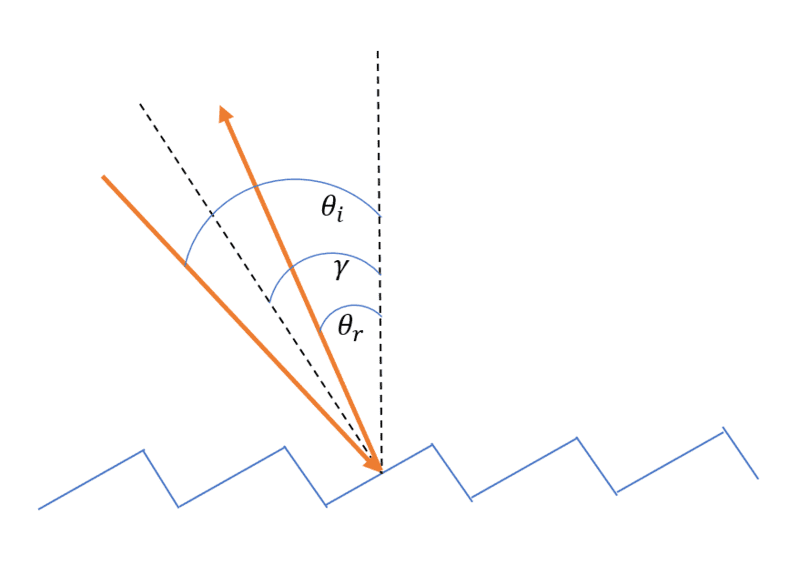
I have the diagram below of a diffraction grating with all the relevant angles labeled.
2018-10-18 (2).png

The blue zag is a zoom in of the diffraction grating surface. A beam (orange arrow on left) is hitting a face on the surfaces and reflecting (orange arrow on right) relative to normal of the face which is the dotted line between the arrows.
The deduction made is that θi - θr = 2γ and I can't seem to deduce this. I'll be happy to provide any additional information and any help will be appreciated.
 

Attachments

  • 2018-10-18 (2).png
    2018-10-18 (2).png
    9.9 KB · Views: 1,058
Science news on Phys.org
## \theta_i-\gamma=\gamma-\theta_r ## for angle of incidence =angle of reflection (measured from the normal to the blaze). Simple algebra gives ## \theta_i+\theta_r=2 \gamma ##. The equation they have is in error, unless they assign an opposite sign to ## \theta_r ##. ## \\ ## (In some derivations, they do assign an opposite sign to ## \theta_r ##. The equation for constructive interference between adjacent slits or lines on a grating reads ## m \lambda=d (\sin{\theta_i}\pm \sin{\theta_r} ) ##, (this is the condition/location for a primary maximum in the diffraction pattern), where the sign that is used in the ## \pm ## depends upon the sign convention for how ## \theta_r ## is measured. When they put in this opposite sign, this makes ## \theta_i=\theta_r ## for ## m=0 ##, so that the equation reads ## m \lambda=d (\sin{\theta_i}-\sin{\theta_r} )##).
 
Last edited:
  • Like
Likes   Reactions: NihalRi
Charles Link said:
## \theta_i-\gamma=\gamma-\theta_r ## for angle of incidence =angle of reflection (measured from the normal to the blaze). Simple algebra gives ## \theta_i+\theta_r=2 \gamma ##. The equation they have is in error, unless they assign an opposite sign to ## \theta_r ##. ## \\ ## (In some derivations, they do assign an opposite sign to ## \theta_r ##. The equation for constructive interference between adjacent slits or lines on a grating reads ## m \lambda=d (\sin{\theta_i}\pm \sin{\theta_r} ) ##, (this is the condition/location for a primary maximum in the diffraction pattern), where the sign that is used in the ## \pm ## depends upon the sign convention for how ## \theta_r ## is measured. When they put in this opposite sign, this makes ## \theta_i=\theta_r ## for ## m=0 ##, so that the equation reads ## m \lambda=d (\sin{\theta_i}-\sin{\theta_r} )##).
Thank you, this makes perfect sense now!
 
  • Like
Likes   Reactions: Charles Link
Charles Link said:
## \theta_i-\gamma=\gamma-\theta_r ## for angle of incidence =angle of reflection (measured from the normal to the blaze). Simple algebra gives ## \theta_i+\theta_r=2 \gamma ##. The equation they have is in error, unless they assign an opposite sign to ## \theta_r ##. ## \\ ## (In some derivations, they do assign an opposite sign to ## \theta_r ##. The equation for constructive interference between adjacent slits or lines on a grating reads ## m \lambda=d (\sin{\theta_i}\pm \sin{\theta_r} ) ##, (this is the condition/location for a primary maximum in the diffraction pattern), where the sign that is used in the ## \pm ## depends upon the sign convention for how ## \theta_r ## is measured. When they put in this opposite sign, this makes ## \theta_i=\theta_r ## for ## m=0 ##, so that the equation reads ## m \lambda=d (\sin{\theta_i}-\sin{\theta_r} )##).
On another note, I'm likely to make this another thread but my aim is to uses the grating to combine two laser beams of different wavelengths. I want to do this in an energy efficient manner. Do you know any good resources I could use that explains the math of a blazed grating well?
 
NihalRi said:
On another note, I'm likely to make this another thread but my aim is to uses the grating to combine two laser beams of different wavelengths. I want to do this in an energy efficient manner. Do you know any good resources I could use that explains the math of a blazed grating well?
Your idea sounds like something that could work. Meanwhile I don't have any good source at present that discusses blazed gratings. You would need to google the topic. ## \\ ## For a blazed grating, the peak occurs when incident angle equals angle of reflection off of the blaze, but there is a spread of angles that can get a similar intensity, basically as a result of the single slit diffraction pattern width that occurs, as a multiplying factor of the multi-slit or multi-line interference result from the grating. See also: https://www.physicsforums.com/threa...ratio-of-power-densities.956805/#post-6066788 along with the "link" in post 7 of that thread which I will repeat here: http://www.physics.louisville.edu/cldavis/phys299/notes/lo_msgratings.html
 
Last edited:
  • Like
Likes   Reactions: NihalRi
@NihalRi Be sure and see the additions that I added to post 5 above.
 
  • Like
Likes   Reactions: NihalRi
Charles Link said:
Your idea sounds like something that could work. Meanwhile I don't have any good source at present that discusses blazed gratings. You would need to google the topic. ## \\ ## For a blazed grating, the peak occurs when incident angle equals angle of reflection off of the blaze, but there is a spread of angles that can get a similar intensity, basically as a result of the single slit diffraction pattern width that occurs, as a multiplying factor of the multi-slit or multi-line interference result from the grating. See also: https://www.physicsforums.com/threa...ratio-of-power-densities.956805/#post-6066788 along with the "link" in post 7 of that thread which I will repeat here: http://www.physics.louisville.edu/cldavis/phys299/notes/lo_msgratings.html
These look really helpful I will have a look into them. I had been reading that the Littrow configuration you mentioned had high efficiency. However wouldn't the order with the most energy be reflected back on the incidence beam and due to the conservation of energy the other orders be less intense?
 
NihalRi said:
These look really helpful I will have a look into them. I had been reading that the Littrow configuration you mentioned had high efficiency. However wouldn't the order with the most energy be reflected back on the incidence beam and due to the conservation of energy the other orders be less intense?
In general, (there are exceptions), the strongest portion of the emerging energy will not reflect back from where it originated. ## \\ ## I think you could even do what you are trying to do without a blazed grating. With an unblazed grating, the region with the highest energy will be such that the angle of incidence is approximately the angle of reflection. ## \\ ## You would simply take the two beams of interest and have them incident from reasonably close angles, and adjust the incident angles to get the primary maxima to coincide on the emerging beams. The emerging beams are most readily viewed by using a lens or paraboidal mirror to bring the beams to focus in the focal plane of the focusing optic. The beams will each focus to a point. The idea would be to get the focused points to coincide, by adjusting the incident angles. ## \\ ## Depending on the wavelengths that you have, you might have them be primary maxima of different orders ## m ##.
 
  • Like
Likes   Reactions: NihalRi
One additional tip for you on this project: In general, a typical laser is not collimated=it is a slightly diverging source. e.g. For a commercial type HeNe, it emerges from a small aperture and the beam spreads slightly with distance. If you want high precision in the focusing in the focal plane, it can be helpful to use optics to collimate the beams you are using. Alternatively, you can have them be far enough from the diffraction grating that the beam fills the grating. It will still tend to focus with ## \frac{1}{f}=\frac{1}{b}+\frac{1}{m} ##, but with ## b ## quite large, the focus distance ## m \approx f ##.
 
  • Like
Likes   Reactions: NihalRi

Similar threads

  • · Replies 3 ·
Replies
3
Views
2K
  • · Replies 3 ·
Replies
3
Views
2K
  • · Replies 2 ·
Replies
2
Views
1K
  • · Replies 4 ·
Replies
4
Views
5K
  • · Replies 1 ·
Replies
1
Views
2K
  • · Replies 1 ·
Replies
1
Views
5K
  • · Replies 5 ·
Replies
5
Views
14K
  • · Replies 3 ·
Replies
3
Views
2K
  • · Replies 9 ·
Replies
9
Views
3K
  • · Replies 5 ·
Replies
5
Views
2K