Calculating the Angle Between Virtual Sources of Fresnel's Biprism
- Context: High School
- Thread starter Shovon00000
- Start date
-
- Tags
- Angles
Click For Summary
SUMMARY
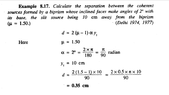
The calculation of the distance between the virtual sources of Fresnel's biprism utilizes the small angle approximation, where the angle α is expressed in radians. The formula for separation is defined as d = 2(μ – 1) sin(α) y₁, which simplifies to d = 2(μ – 1) α y₁ when α is small. This approximation holds true because the values of sin(α) and α in radians are nearly equivalent for small angles. A correction was noted in the calculations, emphasizing the need to use π in the formula instead of degrees.
PREREQUISITES- Understanding of Fresnel's biprism and its applications in optics
- Knowledge of small angle approximations in trigonometry
- Familiarity with radians and their conversion from degrees
- Basic grasp of optical path length calculations
- Study the derivation of the small angle approximation in trigonometry
- Explore the applications of Fresnel's biprism in experimental optics
- Learn about the significance of using radians in scientific calculations
- Investigate common mistakes in optical calculations and how to avoid them
Optics students, physics educators, researchers in experimental optics, and anyone involved in precision optical measurements will benefit from this discussion.
Similar threads
- · Replies 41 ·
Undergrad
Fresnel Zone Equation Problem
- · Replies 8 ·
- · Replies 6 ·
- · Replies 1 ·
- · Replies 58 ·
High School
A variation on the Fresnel Spot experiment
- · Replies 36 ·
- · Replies 2 ·
- · Replies 5 ·
Undergrad
Fresnel Biprism Equation Derviation-
- · Replies 2 ·
Undergrad
How determine aspheric lens beam angle?
- · Replies 5 ·