Fresnel's Biprism Experiment: What Are Virtual Sources?

  • Context: Undergrad 
  • Thread starter Thread starter gracy
  • Start date Start date
Click For Summary

Discussion Overview

The discussion revolves around the concept of virtual sources in Fresnel's biprism experiment, exploring how these virtual sources are formed and their role in the context of interference patterns. Participants engage in clarifying the relationships between rays and virtual sources, as well as the conditions necessary for observing interference.

Discussion Character

  • Exploratory
  • Technical explanation
  • Conceptual clarification
  • Debate/contested
  • Homework-related

Main Points Raised

  • Some participants inquire about the definition of virtual sources in the context of Fresnel's biprism experiment.
  • Others describe how rays from an actual point source create virtual sources S1 and S2 when refracted through the biprism.
  • Participants discuss the tracing of rays (R1, R2, R3, R4) and their relationships to the virtual sources, with some seeking clarification on their labeling.
  • There are questions regarding the conditions necessary for observing interference patterns, including the alignment of the biprism's edge with the slit.
  • Some participants express confusion about the geometry of the biprism and the definition of acute angled prisms.
  • Discussion includes the implications of the prism's orientation on the visibility of interference patterns, with some participants providing explanations based on ray behavior.

Areas of Agreement / Disagreement

Participants generally agree on the basic definitions and relationships between rays and virtual sources, but there are ongoing questions and some confusion regarding the geometry of the biprism and the conditions for interference. Multiple viewpoints exist regarding the necessity of the prism's alignment with the slit.

Contextual Notes

There are unresolved questions about the precise geometry of the biprism and the implications of its angles on the formation of virtual sources and interference patterns. Some assumptions about the behavior of rays and the definitions of prisms are not fully clarified.

Who May Find This Useful

Students and enthusiasts of optics, particularly those studying interference phenomena and the principles of light refraction in prisms, may find this discussion beneficial.

gracy
Messages
2,486
Reaction score
83
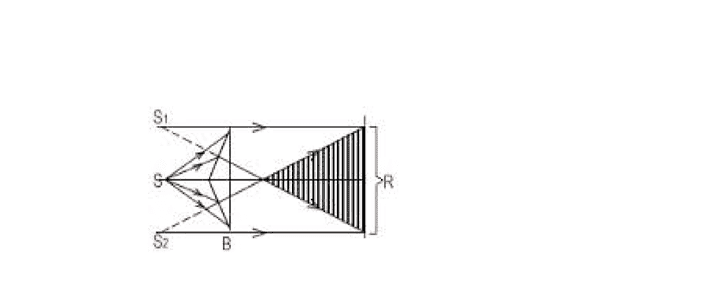
In Fresnel's biprism experiment what is meant by virtual sources?
upload_2015-2-6_22-59-53.png

In this image s1 and s2 are called virtual sources.In my textbook it is written that refracted rays appears to com e from these virtual source.What is virtual source?
 
Science news on Phys.org
gracy said:
In Fresnel's biprism experiment what is meant by virtual sources?
View attachment 78697
In this image s1 and s2 are called virtual sources.In my textbook it is written that refracted rays appears to com e from these virtual source.What is virtual source?

If you follow the rays from the actual point source, S, you will see a virtual source S1 formed by rays entering the upper part of the prism from the actual source S, and a virtual source S2 formed by rays entering the bottom part of the prism.

Labeling the rays R1 through R4 (top to bottom) coming from S, R1 is bent to become parallel with the optical axis, and is the upper ray reaching the screen. R2 refracts downwards to the bottom of the screen. R3 refracts to the top of the screen, and R4 refracts to be parallel with the optical axis, at the very bottom of the screen. R1 and R2, can be traced backwards to form S1, while R3 and R4 can be traced backwards to form S2.
 
Can you please point out R1,R2,R3,R4 in my above picture.
 
gracy said:
Can you please point out R1,R2,R3,R4 in my above picture.

I don't have good software for this. I'll attempt to use words:

Four rays are emerging from S, moving left to right. The top one is R1, it grazes the top of the prism. R2 is directly below R1. The centerline (optical axis) is below R2, and bisects the prism. Below the centerline is R3, and at the very bottom is R4, which grazes the bottom of the prism. After refraction, R1 and R4 travel parallel to the centerline, R2 travels downwards and R3 travels upwards.
 
  • Like
Likes   Reactions: gracy
upload_2015-2-7_1-2-23.png

Have I labeled it correctly?
 
Quantum Defect said:
R1 and R2, can be traced backwards to form S1, while R3 and R4 can be traced backwards to form S2.
How?
 
upload_2015-2-7_1-20-7.png

Have I labeled it correctly?
 
gracy said:
How?

Look at the rays on the right side of the prism. If you trace R1 back -- i.e. use a ruler to draw a straight line from right to left, it goes straight back to S1 (top line in S1). If you trace R2 back, it goes to S1 (bottom line to S1).
 
  • #10
Look at the rays on the right side of the prism. If you trace R1 back -- i.e. use a ruler to draw a straight line from right to left, it goes straight back to S1 (top line in S1). If you trace R2 back, it goes to S1 (bottom line to S1).
upload_2015-2-7_1-40-4.png

Is it right?
 

Attachments

  • upload_2015-2-7_1-39-45.png
    upload_2015-2-7_1-39-45.png
    21.3 KB · Views: 779
  • #11
gracy said:
Look at the rays on the right side of the prism. If you trace R1 back -- i.e. use a ruler to draw a straight line from right to left, it goes straight back to S1 (top line in S1). If you trace R2 back, it goes to S1 (bottom line to S1).
View attachment 78706
Is it right?

That s it.
 
  • #12
Quantum Defect said:
That s it.
I didn't understand.Is any typo here?
 
  • #13
So,S1 is virtual source of R1 and R2. And S2 is virtual source of R3 and R4 ,right?
 
  • #14
gracy said:
I didn't understand.Is any typo here?

You have drawn in the lines correctly. R1 and R2 trace back to S1, and R3 and R4 trace back to S2.

I think that you understand.
 
  • #15
gracy said:
So,S1 is virtual source of R1 and R2. And S2 is virtual source of R3 and R4 ,right?

Exactly right! You understand the whole thing.
 
  • #16
Quantum Defect said:
Exactly right! You understand the whole thing.
All because of you.I will need further help of yours in this particular thread.I am posting my queries .I hope you are there.
 
  • #17
This
Fresnel's biprism experiment is for interference not diffraction ,right?
 
  • #19
gracy said:
Fresnel's biprism experiment is for interference not diffraction ,right?
If yes then at what point interference occurs?
I have pointed out in the image below ,is this a place where interference occurs?
upload_2015-2-7_2-17-38.png
 
  • #20
gracy said:
If yes then at what point interference occurs?
I have pointed out in the image below ,is this a place where interference occurs?
View attachment 78707

The dashed bit is showing the region where you will see interference. i.e. the image plane at R.
 
  • #21
Why should refracting edge of biprism be exactly parallel to slit to see interference pattern consisting of alternate bright and dark bands?
 
  • #22
Quantum Defect said:
The dashed bit is showing the region where you will see interference. i.e. the image plane at R.
This is the place where interference pattern can be seen,and the point which i have shown in the image is where interference will occur i.e two waves will overlap.Right?
 
  • #23
Please answer. Tomorrow is my test.
 
  • #24
gracy said:
be exactly parallel to slit to see interference pattern
The wave fronts that intersect to form the interference pattern need to be parallel to generate a visible pattern. If the edge of the prism is not parallel to the slit/source, the wave fronts won't be parallel.
gracy said:
i.e two waves will overlap.Right?
I think so. It's been a long time since I've looked at this type of problem.
 
  • #25
Bystander said:
If the edge of the prism is not parallel to the slit/source, the wave fronts won't be parallel.
Why?
 
  • #26
Referring to the drawing in the first post, we're looking at a cross-section of the prism and the slit: if the prism edge is not parallel to the slit, as we move "into or out of" the page looking at other cross-sections, the slit/source, "S," will be moving up or down (in the drawing). This will result in the two "virtual" sources moving in opposite directions, and twisting the two "virtual" slit images non-parallel from each other.
 
  • Like
Likes   Reactions: gracy
  • #27
Bystander said:
if the prism edge is not parallel to the slit, as we move "into or out of" the page looking at other cross-sections, the slit/source, "S," will be moving up or down (in the drawing)
Which refracting edge?That's where I am getting confused. Biprism is made up of two prism,so there will be 2 refracting edges.
 
  • #28
Here is what written in my textboook about biprism
interference-17-1024.jpg

I am not getting .What is acute angled prism?
 
Last edited:
  • #29
gracy said:
.What is acute angled prism?
Prism with all angles acute?Is the prism below acute angled prism as angle BAC,angle ABC and angle BCA all are acute angles.
upload_2015-2-7_13-31-48.png
 
  • #30
gracy said:
Which refracting edge?
Excellent question. Actually, there are no refracting edges --- the refractions occur at the surfaces between air and glass, the surfaces of the prism. The edge that has to be parallel to the slit/source is the edge between the two surfaces that are 179 deg. from each other.
 

Similar threads

  • · Replies 2 ·
Replies
2
Views
3K
  • · Replies 58 ·
2
Replies
58
Views
8K
  • · Replies 7 ·
Replies
7
Views
3K
  • · Replies 5 ·
Replies
5
Views
21K
  • · Replies 2 ·
Replies
2
Views
6K
  • · Replies 2 ·
Replies
2
Views
14K
  • · Replies 2 ·
Replies
2
Views
9K
  • · Replies 10 ·
Replies
10
Views
49K
  • · Replies 6 ·
Replies
6
Views
5K
Replies
9
Views
2K