Angular-Linear Momentum Collisions

Click For Summary
SUMMARY

The discussion focuses on calculating the final velocities (a_1, a_2) and angular velocities (w_1, w_2) of colliding objects in a physics engine developed in Java. It establishes that the conservation of linear momentum and angular momentum principles govern these calculations. The conversation highlights that the method remains consistent even when initial angular velocities are present, provided the initial conditions are known. A simulation tool is recommended for visualizing collision outcomes.

PREREQUISITES
  • Understanding of conservation of momentum principles
  • Familiarity with angular momentum concepts
  • Basic knowledge of physics equations governing collisions
  • Proficiency in Java programming for physics engine development
NEXT STEPS
  • Research the equations for conservation of linear and angular momentum
  • Explore Java libraries for physics simulations, such as JBox2D
  • Learn about collision detection algorithms in physics engines
  • Investigate the use of simulations for visualizing physics concepts
USEFUL FOR

Physics students, game developers, and software engineers interested in implementing realistic collision mechanics in simulations or games.

JWA
Messages
1
Reaction score
0
Hi there,

A friend of mine is creating a physics engine in java (mostly as a challenge I believe).

Today he asked me a question about the results of collisions between objects. For example, imagine that these 2 objects collide:
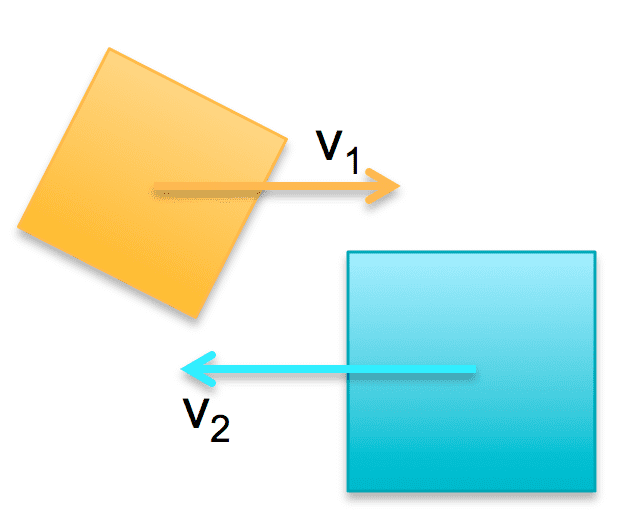
fab24a989f.png


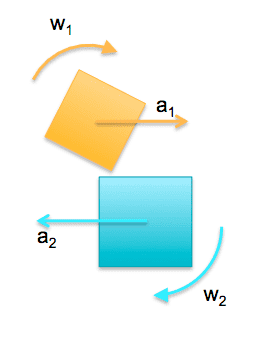
The results of such a collusion would be something like this:
c6e51b0016.png


where w_1 and w_2 are angular velocities, a_1 and a_2 are final velocities in the x,y plane.

The question really is, how do you calculate the values of a_1, a_2, w_1 and w_2?

Then does the method/answer change when you have initial angular velocities as well?

I would love to have a method for finding these values, but from what I've searched online, I can't find anything...

P.S. I would assume this is graduate level physics. I did a degree in physics and have honestly no clue but that might also be because I was never much good with physics :P

Thanks,
~jwa
 
Physics news on Phys.org
JWA said:
The question really is, how do you calculate the values of a_1, a_2, w_1 and w_2?

Then does the method/answer change when you have initial angular velocities as well?

I would love to have a method for finding these values, but from what I've searched online, I can't find anything...

By common sense one can say that the angular momentum before the collision and after the collision will be same...as the angular momentum is moment of momentum and simple momentum is being conserved.
the equations governing the conservation of momentum as well as angular momentum for closed
systems can give you the values of the angular velocities as well as the linear velocities if the initial conditions are given.
if you wish to see a simulation pl. visit <http://www.myphysicslab.com/collision.html>
 
Last edited by a moderator:

Similar threads

  • · Replies 3 ·
Replies
3
Views
3K
  • · Replies 13 ·
Replies
13
Views
3K
  • · Replies 35 ·
2
Replies
35
Views
4K
  • · Replies 6 ·
Replies
6
Views
2K
  • · Replies 9 ·
Replies
9
Views
2K
  • · Replies 30 ·
2
Replies
30
Views
3K
  • · Replies 14 ·
Replies
14
Views
4K
  • · Replies 2 ·
Replies
2
Views
2K
  • · Replies 4 ·
Replies
4
Views
3K
  • · Replies 5 ·
Replies
5
Views
2K