How Is Angular Momentum Calculated Without Considering Gravity and Viscosity?

Click For Summary
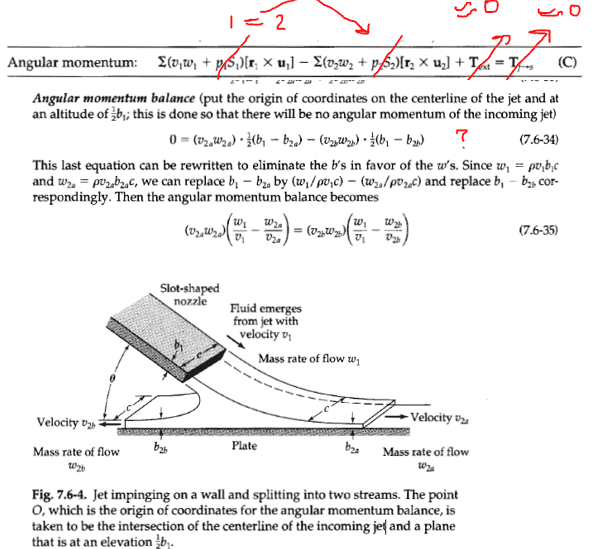
Angular momentum can be calculated without considering gravity and viscosity by focusing on the forces and torques acting on the system. The discussion highlights confusion regarding the derivation of the equation, particularly concerning the altitude and angle of the variable ##b_1##. Participants express uncertainty about the force from the plate and its impact on torque calculations. The incoming flow generates a downward force on the plate, which creates a reaction torque about the chosen axis. Clarification on defining the r and u vectors in the equation is needed to fully understand the cross product computation.
Est120
Messages
54
Reaction score
3
Homework Statement
write the macroscopic angular momentum balance for the following problem
Relevant Equations
see image
we neglect gravity and viscosity efects
i really can't understand how does the author managed to get the equation in the image
Bird Angular Momentum Balance.png
 
Physics news on Phys.org
Not making any sense to me either.
Altitude at ##\frac 12b_1## from where?
##b_1## is at an angle, so ##b_1-b_{2a}## doesn’t seem right.
And what about the force from the plate? We don't know where that is centred, so we can't set the axis so as to eliminate its torque.
 
it's an idealized problem, all i need to know is how they compute the cross product , there is no viscosity so there is no friction with the plate
 
Est120 said:
how they compute the cross product
For that, I need you to define the r and u vectors in the boxed equation.
Est120 said:
there is no friction with the plate
It's not to do with friction. The incoming flow exerts a vertically downward force ##w_1v_1## on the plate. The reaction from the plate likely has a torque about the chosen axis.
 
The book claims the answer is that all the magnitudes are the same because "the gravitational force on the penguin is the same". I'm having trouble understanding this. I thought the buoyant force was equal to the weight of the fluid displaced. Weight depends on mass which depends on density. Therefore, due to the differing densities the buoyant force will be different in each case? Is this incorrect?

Similar threads

Replies
17
Views
2K
  • · Replies 17 ·
Replies
17
Views
866
  • · Replies 10 ·
Replies
10
Views
2K
Replies
6
Views
1K
Replies
67
Views
4K
  • · Replies 5 ·
Replies
5
Views
2K
Replies
3
Views
1K
  • · Replies 45 ·
2
Replies
45
Views
4K
  • · Replies 50 ·
2
Replies
50
Views
4K
  • · Replies 8 ·
Replies
8
Views
2K