Angular momentum conservation help

Click For Summary
The discussion focuses on a physics problem involving angular momentum conservation in a bola weapon, which consists of three identical spheres connected by strings. The key questions are about finding the ratio of final to initial angular speeds (f/i) and the ratio of corresponding rotational kinetic energies (Kf/Ki). Participants emphasize the importance of understanding that angular momentum is conserved and that gravity does not exert torque about the system's center of mass once the bola is released. The approach involves calculating the initial and final angular momentum about the center of mass and setting them equal to derive the necessary ratios. The conversation highlights the challenge of solving the problem without numerical values and the need for a solid grasp of angular momentum principles.
snoggerT
Messages
183
Reaction score
0
A bola consists of three massive, identical spheres conected to a common point by identical lengths of sturdy string (Fig. 11-51a). To launch this native South American weapon, you hold one of the spheres overhead and then rotate that hand about its wrist so as to rotate the other two spheres in a horizontal path about the hand. Once you manage sufficient rotation, you cast the weapon at a target. Initially the bola rotates around the previously held sphere at angular speed i but then quickly changes so that the spheres rotate around the commonconnection point at angular speed f (Fig. 11-51b).
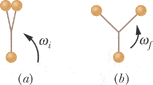
57807?db=v4net.gif


(a) What is the ratio f /i?

(b) What is the ratio Kf /Ki of the corresponding rotational kinetic energies?


Li=Lf


The Attempt at a Solution


- I'm absolutely stumped on this problem. Mainly because I'm given no numbers and don't know how to get a ratio with just the equations. Where would I begin on a problem like this?
 
Physics news on Phys.org
I believe the idea is that the angular momentum about the center of mass is conserved... gravity is the only force acting once the bola is released... and gravity doesn't exerts 0 torque about the center of mass of the system...

given the initial angular speed i... what is the angular momentum about the center of mass initially... you'll have to find the center of mass...

and what's the angular momentum about the center of mass afterwards...

finally set the initial angular momentum = final angular momentum... this will give a relationship between f and i...
 
The book claims the answer is that all the magnitudes are the same because "the gravitational force on the penguin is the same". I'm having trouble understanding this. I thought the buoyant force was equal to the weight of the fluid displaced. Weight depends on mass which depends on density. Therefore, due to the differing densities the buoyant force will be different in each case? Is this incorrect?

Similar threads

Replies
5
Views
1K
Replies
335
Views
16K
  • · Replies 2 ·
Replies
2
Views
2K
Replies
14
Views
2K
  • · Replies 15 ·
Replies
15
Views
2K
Replies
19
Views
3K
  • · Replies 9 ·
Replies
9
Views
2K
  • · Replies 3 ·
Replies
3
Views
3K
  • · Replies 5 ·
Replies
5
Views
6K
  • · Replies 25 ·
Replies
25
Views
2K