How is the Angular Velocity of a Planetary Gear Determined?

Click For Summary
The angular velocity of gear D can be determined using the relationship between the velocities of gears C and D at their point of contact. Since gear C is pinned, the gear ratio does not apply directly, leading to the equation ωd = ωc x (rcd / rd) for calculating ωd. Given the values, the calculated angular velocity of gear D is -2.125 rad/s. The velocities of points on the rims of both gears are equal, allowing for the expression of these velocities in terms of their respective angular velocities. This approach provides a method to solve for the angular velocity of gear D based on the known parameters.
rara
Messages
3
Reaction score
0
Gear C has radius 0.12 m and rotates with angular velocity 1.9 k rad/s. The connecting link rotates at angular velocity 1.5 k rad/s. Gear D has radius 0.05 m. Find the angular velocity of gear D (in rad/s). Note that gear C is pinned to ground and gear D is a planetary gear.
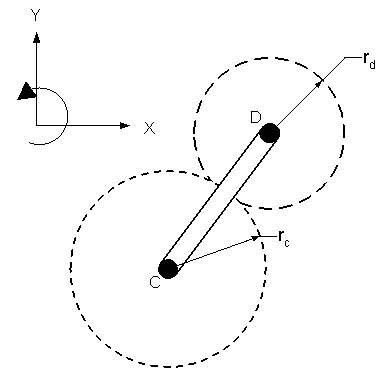
2vxegq8.jpg


Since gear c is pinned, the gear ratio ωc/ωd=rd/rc does not directly apply here right? I wonder if the correct solution would be ωd=ωc x rcd / rd. I got -2.125 rad/s. Thanks.
 
Physics news on Phys.org
Hello.

At the point of contact of the gears, suppose you pick a point ##c## on the rim of gear C and a point ##d## on the rim of gear D as shown.

Let ##\vec{V_c}## and ##\vec{V_d}## be the velocities of those points, respectively, as measured relative to the fixed point at the center of gear C.

How are ##\vec{V_c}## and ##\vec{V_d}## related?
 

Attachments

  • Gears.jpg
    Gears.jpg
    7.7 KB · Views: 549
Last edited:
Vc and Vd are the same
 
OK. So, ##\vec{V_c}## = ##\vec{V_d}##. If you can express each of these velocities in terms of the angular velocities of the gears (##\omega_C## and ##\omega_D##) and the angular velocity of the link (##\omega_L##), then you would have an equation that you could solve for ##\omega_D##.

Start with the velocity vector ##\vec{V_c}##. Suppose you introduce a unit vector ##\hat{t}## that is tangent to the gears at the point of contact, as shown. How can you express ##\vec{V_c}## in terms of ##\omega_C##, ##r_C##, and ##\hat{t}##?
 

Attachments

  • Gears 2.jpg
    Gears 2.jpg
    8.3 KB · Views: 574
Last edited:

Similar threads

  • · Replies 5 ·
Replies
5
Views
2K
  • · Replies 4 ·
Replies
4
Views
2K
  • · Replies 1 ·
Replies
1
Views
5K
Replies
3
Views
2K
  • · Replies 5 ·
Replies
5
Views
3K
  • · Replies 5 ·
Replies
5
Views
6K
  • · Replies 1 ·
Replies
1
Views
3K
Replies
7
Views
5K
  • · Replies 1 ·
Replies
1
Views
1K
Replies
23
Views
1K