Ansys Maxwell- Transient torque fluctuating problem

Click For Summary

Discussion Overview

The discussion revolves around modeling a 5 kW induction motor using ANSYS Maxwell, specifically addressing issues related to transient torque fluctuations observed during simulation. Participants explore the causes of these fluctuations, the setup of the motor parameters, and the implications of the excitation frequency on the torque output.

Discussion Character

  • Technical explanation
  • Debate/contested
  • Mathematical reasoning

Main Points Raised

  • Initial observations indicate that the transient torque fluctuates with an average close to zero Nm, raising questions about the simulation setup.
  • Some participants inquire whether the motor is single-phase or three-phase, clarifying that it is a three-phase induction motor with 120-degree phase shifts.
  • One participant suggests that the observed torque characteristics may be related to third harmonic torque rather than line frequency, particularly during initial switch-on transients.
  • Another participant proposes that the armature might be changing direction rapidly, indicating a potential issue with the field winding setup.
  • Concerns are raised about the rotor resistance settings, with speculation that a zero rotor resistance could lead to no torque development at fundamental frequency.
  • Participants discuss the excitation setup, suggesting that errors in current/voltage wave configurations could be contributing to the torque issues.
  • One participant mentions that the excitation frequency is 95 Hz, which may explain the observed higher harmonics in the torque output.
  • There is a discussion about the expected torque output, with one participant anticipating around 16 Nm under the given excitation conditions.

Areas of Agreement / Disagreement

Participants express various hypotheses regarding the causes of the torque fluctuations, with no consensus reached on the exact issue. Multiple competing views regarding the excitation setup, rotor resistance, and the nature of the torque fluctuations remain unresolved.

Contextual Notes

Limitations in the discussion include the lack of detailed information about the motor parameters provided to ANSYS, the assumptions made in the mathematical model, and the potential impact of rotor heating on torque output. The discussion also highlights the complexity of accurately simulating motor behavior in ANSYS Maxwell.

Who May Find This Useful

This discussion may be useful for individuals working with induction motor simulations, particularly those using ANSYS Maxwell, as well as those interested in the effects of excitation setups and harmonic analysis in motor performance.

RanchodDasChanchad
Hii Friends,
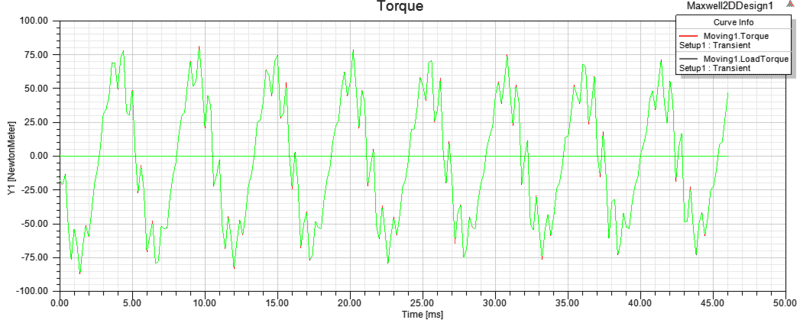
I was trying to model an Induction motor 5 KW in ANSYS Maxwell. The final output of Transient torque looks like shown below. It fluctuates with average torque almost equal to zero Nm.

The input passed is a sine wave current with 120 deg phase shift.

Any Suggestion will be highly appreciated.
upload_2017-9-24_18-11-57.png
 
Engineering news on Phys.org
Welcome to PF!
 
  • Like
Likes   Reactions: RanchodDasChanchad
RanchodDasChanchad said:
Any Suggestion will be highly appreciated.

Single phase ? Do you have a start winding on your simulation?
 
  • Like
Likes   Reactions: RanchodDasChanchad
jim hardy said:
Single phase ? Do you have a start winding on your simulation?

It is a three phase Induction motor, phases are shifted with 120 deg each.
 
That looks like it's third harmonic torque not line frequency.
Something like that can happen while the initial switch-on transients decay. What happens if you let it run for ten whole line cycles ?

Try switching two phases on first, third one two-thirds of a line cycle(240 degrees) later.

I know nothing about ANSYS , just trying to make it show what it's doing.
 
  • Like
Likes   Reactions: RanchodDasChanchad
jim hardy said:
That looks like it's third harmonic torque not line frequency.
Something like that can happen while the initial switch-on transients decay. What happens if you let it run for ten whole line cycles ?

Try switching two phases on first, third one two-thirds of a line cycle(240 degrees) later.

I know nothing about ANSYS , just trying to make it show what it's doing.
Thanks for your suggestions.

when I run ten whole cycle, same torque characteristics follow. Amplitude of torque reduces to half in 2.5 cycles and then reduced amplitude follows for rest of the cycle pattern.
jim hardy said:
That looks like it's third harmonic torque not line frequency.
Something like that can happen while the initial switch-on transients decay. What happens if you let it run for ten whole line cycles ?

Try switching two phases on first, third one two-thirds of a line cycle(240 degrees) later.

I know nothing about ANSYS , just trying to make it show what it's doing.

Thanks for your suggestions

I completed running the simulation for 10 full cycle. the average of torque is still zero but the amplitude reduces till 2.5 cycles and then follows till 10 cycles. like shown below:
upload_2017-9-25_20-27-49.png
 
RanchodDasChanchad said:
I completed running the simulation for 10 full cycle. the average of torque is still zero but the amplitude reduces till 2.5 cycles and then follows till 10 cycles. like shown below:
I'm assuming you're working with 60 hz...

So the question becomes
'why does my simulation produce only third harmonic torque?'

Note that third harmonic of all three phases is in phase , what does your armature current look like? Is it 60 hz?

and i observe that your peak instantaneous torque is in the neighborhood of 75 N-m which at 1800 RPM would make around 18hp, which seems a lot for a 5hp motor but not impossible.
http://www.magtrol.com/support/motorpower_calc.html

And- why did torque fade with time? Are your simulated motor windings heating up and limiting current ?

What is your rotor resistance? Non-zero i trust. Low rotor resistance = low starting torque.
RanchodDasChanchad said:
It fluctuates with average torque almost equal to zero Nm.
Almost, you say. Is rotor accelerating ?

In other words , somebody has to figure out what that computer program does. I've never seen ANSYS so can't be much help there..

Keep pinging away at it 'till something happens to give a clue.
 
  • Like
Likes   Reactions: RanchodDasChanchad
Doesn't the first plot actually show that the armature is changing direction of rotation completely every few milliseconds ?

This suggests that the armature is being pulled in alternate forward and back directions by some incorrectly set up arrangement of field windings ?
 
  • Like
Likes   Reactions: RanchodDasChanchad and jim hardy
Did you actually write out the equations, or did you rely on ANSYS to assemble the mathematical description?
 
  • Like
Likes   Reactions: jim hardy and Nidum
  • #10
Nidum said:
This suggests that the armature is being pulled in alternate forward and back directions by some incorrectly set up arrangement of field windings ?
Since we know nothing of what motor parameters he's given ANSYS (which appears to be a pretty thorough simulator)
we're all guessing.

My immediate suspicion is that rotor resistance is set to zero
in which case rotor mmf directly opposes stator mmf and no torque is developed (at fundamental anyway)
and line current will be quite high
and with those tremendous mmf's opposing one another i can imagine a lot of distortion in the flux

upload_2017-9-26_15-24-56.png
zero rotor resistance = zero rotor power factor

That's just a guess though.

Dr.D said:
Did you actually write out the equations, or did you rely on ANSYS to assemble the mathematical description?
+1 @Dr.D
 
  • Like
Likes   Reactions: RanchodDasChanchad
  • #11
He used the build in mathematical model to calculate the torque (Curve info: load and moving torques). The only other place to make a math mistake is at the excitation setup (current/voltage wave setup).

@RanchodDasChanchad: Check your excitation setup carefully (if the amplitudes/phase shift are fine). Next step - rotor setup. Is it a squirrel-cage ? Are there currents flowing in it ? Next thing: motion setup. If you won't find anything let me know via PM - I can take a look at it if you like to send me the file.
 
  • Like
Likes   Reactions: Asymptotic, RanchodDasChanchad and jim hardy
  • #12
Nidum said:
Doesn't the first plot actually show that the armature is changing direction of rotation completely every few milliseconds ?
Hmmm Sure is experiencing alternating acceleration in opposite directions, and it seems to have not achieved rotation
so yes it appears to be hunting at about 3x line frequency , but why 188 hz not 180 ? And why those higher harmonics?

ansysmotor.jpg
.

Maybe @RanchodDasChanchad will tell us about what it is he's simulated.
 
  • Like
Likes   Reactions: Asymptotic and RanchodDasChanchad
  • #13
jim hardy said:
Hmmm Sure is experiencing alternating acceleration in opposite directions, and it seems to have not achieved rotation
so yes it appears to be hunting at about 3x line frequency , but why 188 hz not 180 ? And why those higher harmonics?

View attachment 211823 .

Maybe @RanchodDasChanchad will tell us about what it is he's simulated.
@jim hardy

Thanks a lot for your efforts and apology for the delay in reply

1. The excitation frequency is 95 Hz. The high amplitude and frequency of output transient torque is my concern also, which I am not able to figure out.

2. I guess torque fades with time as winding heating/ inertia is part of mathematical model inside ANSYS Maxwell motor.

3. The term almost zero was used as at time its close to zero but not exactly zero as per the output curve.

4. The rotor resitance is not zero a calculateed value is entered in the rotor detail
Basically this is a 4 pole 3 phase squirrel cage aluiminum rotor induction motor with rated power of 5 kW, its a 48 V machine and operates roughly around 100 amps for rated operation.

The number of torque which I am expecting the torque to be around 16 Nm at given excitations.
 
  • #14
gerbi said:
He used the build in mathematical model to calculate the torque (Curve info: load and moving torques). The only other place to make a math mistake is at the excitation setup (current/voltage wave setup).

@RanchodDasChanchad: Check your excitation setup carefully (if the amplitudes/phase shift are fine). Next step - rotor setup. Is it a squirrel-cage ? Are there currents flowing in it ? Next thing: motion setup. If you won't find anything let me know via PM - I can take a look at it if you like to send me the file.

@gerbi
@jim hardy

Like Mr. gerbi stated, I also doubt the excitation setup to be wrong

Basically this is a 4 pole 3 phase squirrel cage aluiminum rotor induction motor with rated power of 5 kW, its a 48 V machine and operates roughly around 100 amps for rated operation.

The number of torque which I am expecting the torque to be around 16 Nm at given excitation.

I have basically created all the 3 phases separately with following excitation

Ia = Imax * sin (omegarad*time)

Ib = Imax * sin (omegarad*time+2*pi/3)

Ic = Imax * sin (omegarad*time+4*pi/3)Imax = 100
omegarad= (360*Nrpm*polepairs/60)*pi/180
Nrpm = 2850
polepairs = 2
 
  • #15
RanchodDasChanchad said:
1. The excitation frequency is 95 Hz.
Thanks - that explains 188 hz - close enough to 2X line frequency when reading from a graph.

RanchodDasChanchad said:
I have basically created all the 3 phases separately with following excitation
Ia = Imax * sin (omegarad*time)....

"i" being amps? I notice you set current rather than set voltage ? Should be okay , i suppose it'll just give a soft start..

If a squirrel cage motor receives stator current and rotor current is allowed to flow, it ought to spin.

RanchodDasChanchad said:
4. The rotor resitance is not zero a calculateed value is entered in the rotor detail
Does your simulator let you see rotor current ? How much power is being dissipated as heat in the rotor ?

Does your simulator let you see what terminal voltage results from your applied currents ? Again pardon my ignorance of ANSYS , just my simple thinking makes me question how complex test equipment works. Mr @gerbi probably knows the answer to that one.

Basic troubleshooting - change something and look for effect... that's how we draw a circle around a problem . Then we tighten the circle.
I would try both increasing and decreasing rotor resistance tenfold, see what changes.

old jim
 
  • Like
Likes   Reactions: RanchodDasChanchad
  • #16
Hii,

I have tried some suggestions from Mr @gerbi and I have seem to achieve the expected result :)

upload_2017-9-30_9-13-2.png


we have changed the order of excitation on phases based on the winding order and included a skew in the rotor.

@gerbi @jim hardy

Thanks a lot for your help and support, God bless you guys :)
 
  • Like
Likes   Reactions: Asymptotic and jim hardy
  • #17
RanchodDasChanchad said:
God bless you guys :)
Thank you ...
RanchodDasChanchad said:
I have seem to achieve the expected result :)

Great ! This is how we learn... doing things.

This you will find interesting i think..
http://www.lmphotonics.com/InductionMotor/MCog.php

i was wondering about cogging,... that must be a very thorough simulation you have.
 
  • Like
Likes   Reactions: Asymptotic
  • #18
jim hardy said:
Great ! This is how we learn... doing things.

Thats Right, there is no substitute to learning while doing :)

jim hardy said:
This you will find interesting i think..
http://www.lmphotonics.com/InductionMotor/MCog.php

Thanks for the link :)

jim hardy said:
i was wondering about cogging,... that must be a very thorough simulation you have.

I will definitely let you know when I run such a simulation :D
 
  • #19
@RanchodDasChanchad
I do have the same problem! what you did to solve the problem?
 

Similar threads

  • · Replies 2 ·
Replies
2
Views
2K
Replies
2
Views
3K
Replies
8
Views
2K
  • · Replies 2 ·
Replies
2
Views
8K
Replies
4
Views
3K
Replies
2
Views
9K
  • · Replies 1 ·
Replies
1
Views
2K
  • · Replies 9 ·
Replies
9
Views
4K
  • · Replies 7 ·
Replies
7
Views
4K
  • · Replies 31 ·
2
Replies
31
Views
4K