Antenna induction, oscillating circuit generating EM Waves

Click For Summary

Discussion Overview

The discussion revolves around the concept of antenna induction and the generation of electromagnetic waves (EMW) from an oscillating circuit composed of a capacitor and a coil. Participants explore the mechanisms of energy transfer, the role of antenna design, and the conditions necessary for effective radiation of EMW.

Discussion Character

  • Exploratory
  • Technical explanation
  • Debate/contested

Main Points Raised

  • One participant describes the oscillating circuit as a capacitor and coil in series, discussing the energy transfer between electric and magnetic fields and questioning whether a closed oscillating circuit can produce EMW.
  • Another participant asserts that while current flow generates a magnetic field and radiates EMW, power and frequency are independent variables, and an antenna can be designed to radiate a stronger signal than a compact oscillator.
  • A different participant notes that every wire has inductance, and that the size of the circuit relative to the wavelength is crucial for effective radiation, emphasizing that resonance is not a requirement for radiation.
  • Some participants discuss the relationship between displacement current and electric fields, questioning the conditions under which displacement current exists and its implications for radiation.
  • One participant highlights that radiation cannot be explained solely by field properties, emphasizing the role of accelerating charges in the radiation process.
  • There is a mention of the necessity for significant size and large current in a loop for efficient radiation, particularly in the context of a closed circuit.

Areas of Agreement / Disagreement

Participants express differing views on the conditions necessary for effective radiation, the relationship between antenna design and EMW generation, and the role of displacement current. The discussion remains unresolved with multiple competing perspectives presented.

Contextual Notes

Some participants reference external sources and images to support their claims, leading to further questions about the accuracy of descriptions related to electromagnetic waves and displacement currents. There are unresolved assumptions regarding the nature of fields and currents in relation to radiation.

Steels
Messages
4
Reaction score
0
TL;DR
Antena induction, oscillating circuit, EMW
Hello!
Now i need a bit explanation, so "oscillating circuit" capacitator + coil in series. Let's look at this as infinite, without any loss. We get changing magnetic field and electric field. Capacitator discharges, current goes to coil increasing its magnetic field, then starts magnetic field change, and then starts coil induction (Lentz law), when capacitator is empty, coil starts to lose energy and magnetic field energy turns back to electric energy and capacitator recharges, but current direction has changed.

When we straighten capacitator and coil and we make antenna, we add AC voltage, current starts to travel from one side of antenna to the other side. And then we get Electromagnetic waves. AND we get EMW in antenna because there is no longer induction in coil (because simply there is no coil anymore?) AND current is now traveling from one side to another side without negating each other?

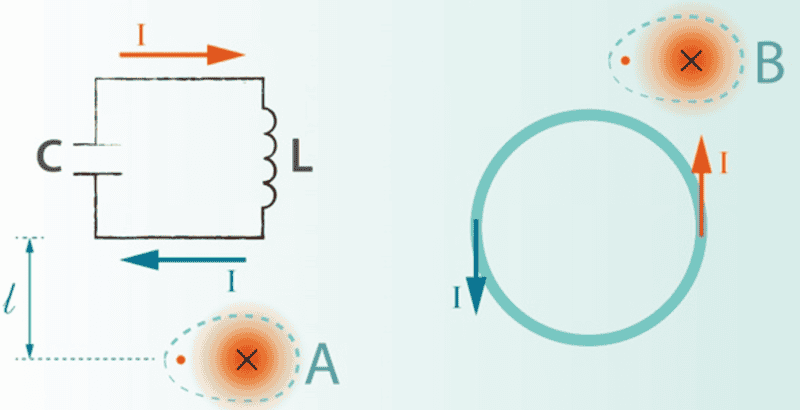
(by negating each other i mean, when you look at coil magnetic field and current directions are different, check picture, in A picture, we see different current directions I, and magnetic field they produces negates each other and look at picture B in coil current direction produces magnetic field, but they negates each other because...) My question is, did I said everything correctly? Can I say, that in closed oscillating circuit is just too weak to produce EMW? OR if its poweful enough, but it only produces EMW inside of that cuicruit? Can I say that straighten antenna with AC makes larger and stronger waves (stronger, more powerful frequency)?

Any help would be super apreciated.
Thank you and have a nice day!
1713711404646.png


1713711902971.png
 
Last edited by a moderator:
Physics news on Phys.org
Too many question marks, and too much confusion.

If a current flows, there will be a magnetic field generated, and there will be an EM wave radiated.

Steels said:
Can I say that straighten antenna with AC makes larger and stronger waves (stronger, more powerful frequency)?
Power and frequency are independent variables.

An antenna will be designed to radiate a stronger signal than a compact oscillator.
The antenna does not have to be straight, it could be a loop.
 
Every wire has inductance, so the opened out conductors have L and C and still have resonances. The only requirement for an electric circuit to be a good antenna is for it to be comparable in size with the wavelength. Very small circuits do not radiate very much. There is no requirement for resonance for radiation, it is just the current and dimensions which matter. However, in the resonant condition, the generator can see a resistive load, which is desirable.
 
Steels said:
TL;DR Summary: Antena induction, oscillating circuit, EMW

Hello!
Now i need a bit explanation, so "oscillating circuit" capacitator + coil in series. Let's look at this as infinite, without any loss. We get changing magnetic field and electric field. Capacitator discharges, current goes to coil increasing its magnetic field, then starts magnetic field change, and then starts coil induction (Lentz law), when capacitator is empty, coil starts to lose energy and magnetic field energy turns back to electric energy and capacitator recharges, but current direction has changed.

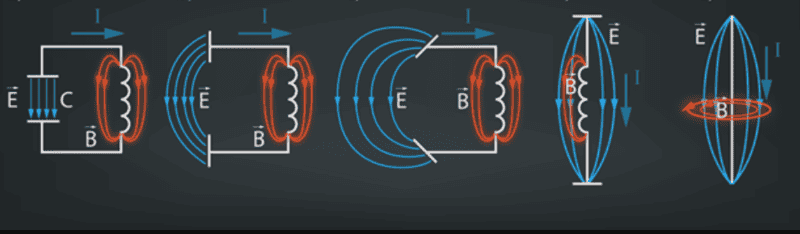
When we straighten capacitator and coil and we make antenna, we add AC voltage, current starts to travel from one side of antenna to the other side. And then we get Electromagnetic waves. AND we get EMW in antenna because there is no longer induction in coil (because simply there is no coil anymore?) AND current is now traveling from one side to another side without negating each other?

(by negating each other i mean, when you look at coil magnetic field and current directions are different, check picture, in A picture, we see different current directions I, and magnetic field they produces negates each other and look at picture B in coil current direction produces magnetic field, but they negates each other because...) My question is, did I said everything correctly? Can I say, that in closed oscillating circuit is just too weak to produce EMW? OR if its poweful enough, but it only produces EMW inside of that cuicruit? Can I say that straighten antenna with AC makes larger and stronger waves (stronger, more powerful frequency)?

Any help would be super apreciated.
Thank you and have a nice day!
View attachment 343836

View attachment 343837
The last image you included in your post is interesting, could you post the source of that image or the text that went with the image. A similar graphic appears in, https://global.canon/en/technology/s_labo/light/001/11.html

Thanks.
 
The link provided says the following: "electromagnetic waves-in which an electric field and magnetic field alternately appear-are created in the space between the two electrodes and travel into their surroundings."
However, the magnetic and electric waves are in-phase, which is in conflict with this description.
 
tech99 said:
The link provided says the following: "electromagnetic waves-in which an electric field and magnetic field alternately appear-are created in the space between the two electrodes and travel into their surroundings."
However, the magnetic and electric waves are in-phase, which is in conflict with this description.
I don't think I read the text. The picture of the capacitor morphing into an antenna forces you to also imagine how the displacement current also changes. For some poor reason I think that I thought that only between the charging capacitor plates is where you found the displacement current, not true, right?

If I know the electric field far from a dipole antenna the displacement current field looks the same as the electric field that has been shifted in time a quarter cycle?

In particular, if the divergence of the electric field is zero so is the corresponding displacement current field? Where the electric field is zero (edit, and changing) the displacement current is maximum?

1715041248307.png


Thanks.
 
Last edited:
The mechanism of radiation cannot be explained using the properties of the fields alone. A capacitor which has a vacuum as its dielectric will not radiate, only the wires leading to it will do that. To understand radiation we need to consider charges, such as electrons, which are subject to acceleration.
By the way, in the original question you mention currents flowing in opposite directions in an LC circuit. This is correct, so to obtain efficient radiation the loop must have significant size and the current must be large. As this is a "closed" circuit it is actually easy to obtain large current.
 

Similar threads

  • · Replies 6 ·
Replies
6
Views
2K
  • · Replies 6 ·
Replies
6
Views
2K
  • · Replies 6 ·
Replies
6
Views
1K
  • · Replies 60 ·
3
Replies
60
Views
7K
  • · Replies 3 ·
Replies
3
Views
2K
Replies
152
Views
7K
  • · Replies 2 ·
Replies
2
Views
3K
  • · Replies 4 ·
Replies
4
Views
1K
  • · Replies 4 ·
Replies
4
Views
2K
  • · Replies 1 ·
Replies
1
Views
2K