Apparent depth when two or more refracting surfaces are present

Click For Summary

Discussion Overview

The discussion revolves around the concept of apparent depth when observing an object through multiple refracting surfaces. Participants explore how the presence of two or more refracting surfaces affects the perceived depth of an object submerged in a medium, considering both theoretical and practical implications.

Discussion Character

  • Exploratory
  • Technical explanation
  • Debate/contested

Main Points Raised

  • One participant defines apparent depth as the depth at which an object appears when viewed from a different medium and questions how this changes with multiple refracting surfaces.
  • Another participant suggests that the angle at which light emerges from the water is the only factor that matters for determining apparent depth, regardless of the light's path prior to that point.
  • A participant notes that calculations for apparent depth can be made when only one refracting surface is involved.
  • Another participant argues that it is possible to calculate the light path for multiple surfaces, but emphasizes the need for knowing the specific layout of the surfaces involved.

Areas of Agreement / Disagreement

Participants express differing views on the calculation of apparent depth with multiple refracting surfaces, with some asserting that it is feasible while others highlight the complexities involved. No consensus is reached on the best approach to the problem.

Contextual Notes

Participants mention the importance of layout and angles in calculations, indicating that assumptions about the arrangement of surfaces and the angles of incidence and emergence are critical but not fully resolved in the discussion.

esha
Messages
74
Reaction score
3
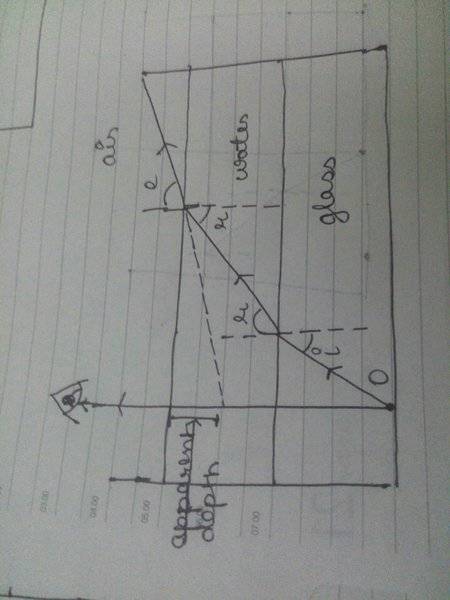
I know the concept of apparent depth as such: It is the depth at which an object is seen when viewed from a different medium. But i want to know what happens when two refracting surfaces are kept one after the other. In the given diagram let the object be placed at the bottom of the vessel. Of course the apparent depth this time wud be different if it would have been only one refracting surface. It is because the emergent ray will converge or diverge (in this case) more. But i don't know how to calculate it.
1504205987750.jpeg
 
Science news on Phys.org
All that counts is the angle at which the light emerges from the water and enters the eye. We can have absolutely no idea of the path that the light took before that.
In real situations, the eye only sees a narrow range of angles (of course) and the diagrams that people draw are always much exaggerated, which doesn't help.
 
Last edited:
but we are able to calculate it when only one surface is present
 
We can calculate the path for as many surfaces as we want to. But we need to know the layout (multiple lenses calculations etc) first.
 

Similar threads

  • · Replies 5 ·
Replies
5
Views
3K
  • · Replies 20 ·
Replies
20
Views
5K
  • · Replies 7 ·
Replies
7
Views
7K
  • · Replies 8 ·
Replies
8
Views
2K
  • · Replies 9 ·
Replies
9
Views
4K
Replies
1
Views
4K
  • · Replies 4 ·
Replies
4
Views
1K
  • · Replies 2 ·
Replies
2
Views
4K
  • · Replies 17 ·
Replies
17
Views
2K
  • · Replies 1 ·
Replies
1
Views
3K