Beelzedad
- 24
- 3
- TL;DR
- Do the following extra highlighted words in the ##\epsilon-\delta## definition of limit prevent us from concluding that the limit exists? Why? Why not?
This question consists of two parts: preliminary and the main question. Reading only the main question may be enough to get my point, but if you want details please have a look at the preliminary.
PRELIMINARY:
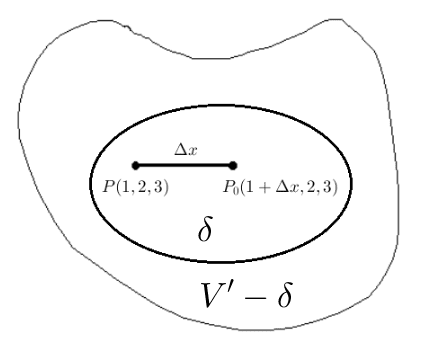
Let potential due to a small volume ##\delta## at a point ##(1,2,3)## inside it be denoted by ##\psi_{\delta}##.
_______________________________________________________________________________________________________________________________________________________________________
It can be shown that for every ##\epsilon>0##, we can choose a volume ##\delta## such that:
##\left| \dfrac{\psi_{\delta}(1+\Delta x,2,3)-\psi_{\delta}(1,2,3)}{\Delta x} \right| < \dfrac{\epsilon}{3} \tag1##
That is ##\epsilon## can be made as small as we can by choosing a small volume ##\delta##.
_______________________________________________________________________________________________________________________________________________________________________
Also, using spherical coordinate system we can show that for every ##\epsilon>0##, we can choose a volume ##\delta## such that:
##\displaystyle\left| \iiint_{\delta} \dfrac{\rho'}{R^2} \dfrac{x-x'}{R} dV' \right| < \dfrac{\epsilon}{3}##
That is:
##\displaystyle\left| \iiint_{V'} \dfrac{\rho'}{R^2} \dfrac{x-x'}{R} dV'
-\iiint_{(V'-\delta)} \dfrac{\rho'}{R^2} \dfrac{x-x'}{R} dV' \right| < \dfrac{\epsilon}{3} \tag2 ##
That is ##\epsilon## can be made as small as we can by choosing a small volume ##\delta##.
_______________________________________________________________________________________________________________________________________________________________________
No matter what our volume ##\delta## is, at point ##P(1,2,3)##, ##\dfrac{\partial \psi_{(V'-\delta)}}{\partial x}## exists (since ##P## being an outside point of ##V'−\delta##). That is:
##\lim\limits_{\Delta x \to 0} \dfrac{\psi_{(V'-\delta)}(1+\Delta x,2,3)-\psi_{(V'-\delta)}(1,2,3)}{\Delta x}=\dfrac{\partial \psi_{(V'-\delta)}}{\partial x} (1,2,3)##
That is, for every ##\epsilon>0##, we can choose an interval ##\delta x## around ##\Delta x=0## (inside volume ##\delta##) such that whenever ##0<|\Delta x−0|<\delta x##:
##\left| \dfrac{\psi_{(V'-\delta)}(1+\Delta x,2,3)-\psi_{(V'-\delta)}(1,2,3)}{\Delta x} - \dfrac{\partial \psi_{(V'-\delta)}}{\partial x} (1,2,3) \right| < \dfrac{\epsilon}{3}##
That is:
##\left| \dfrac{\psi_{(V'-\delta)}(1+\Delta x,2,3)-\psi_{(V'-\delta)}(1,2,3)}{\Delta x} - \left( -\displaystyle\iiint_{(V'-\delta)} \dfrac{\rho'}{R^2} \dfrac{x-x'}{R} dV' \right) \right| < \dfrac{\epsilon}{3} \tag3##
That is ##\epsilon## can be made as small as we can by choosing a small interval ##\delta x## around ##\Delta x=0## (inside volume ##\delta##)
_______________________________________________________________________________________________________________________________________________________________________
Adding inequalities (1),(2)and (3):
##\left| \dfrac{\psi_{V'}(1+\Delta x,2,3)-\psi_{V'}(1,2,3)}{\Delta x} - \left( -\displaystyle \iiint_{V'} \dfrac{\rho'}{R^2} \dfrac{x-x'}{R} dV' \right) \right| < \epsilon##
That is, for every ##\epsilon>0##, we can choose ##\bbox[yellow]{\text{a volume δ and}}## an interval ##\delta x## around ##\Delta x=0## (inside volume ##\delta##) such that whenever ##0<|\Delta x−0|<\delta x##, the above inequality holds.
That is, ##\epsilon## can be made as small as we can by choosing ##\bbox[yellow]{\text{a volume δ and}}## a small interval ##\delta x## around ##\Delta x=0## (inside volume ##\delta##)
QUESTION:
Since there are some extra highlighted words in the above ##\epsilon-\delta## definition of limit, will this prevent us from saying that:
##\lim\limits_{\Delta x \to 0} \dfrac{\psi_{V'}(1+\Delta x,2,3)-\psi_{V'}(1,2,3)}{\Delta x}=-\displaystyle \iiint_{V'} \dfrac{\rho'}{R^2} \dfrac{x-x'}{R} dV'##
? Why? Why not?
PRELIMINARY:
Let potential due to a small volume ##\delta## at a point ##(1,2,3)## inside it be denoted by ##\psi_{\delta}##.
_______________________________________________________________________________________________________________________________________________________________________
It can be shown that for every ##\epsilon>0##, we can choose a volume ##\delta## such that:
##\left| \dfrac{\psi_{\delta}(1+\Delta x,2,3)-\psi_{\delta}(1,2,3)}{\Delta x} \right| < \dfrac{\epsilon}{3} \tag1##
That is ##\epsilon## can be made as small as we can by choosing a small volume ##\delta##.
_______________________________________________________________________________________________________________________________________________________________________
Also, using spherical coordinate system we can show that for every ##\epsilon>0##, we can choose a volume ##\delta## such that:
##\displaystyle\left| \iiint_{\delta} \dfrac{\rho'}{R^2} \dfrac{x-x'}{R} dV' \right| < \dfrac{\epsilon}{3}##
That is:
##\displaystyle\left| \iiint_{V'} \dfrac{\rho'}{R^2} \dfrac{x-x'}{R} dV'
-\iiint_{(V'-\delta)} \dfrac{\rho'}{R^2} \dfrac{x-x'}{R} dV' \right| < \dfrac{\epsilon}{3} \tag2 ##
That is ##\epsilon## can be made as small as we can by choosing a small volume ##\delta##.
_______________________________________________________________________________________________________________________________________________________________________
No matter what our volume ##\delta## is, at point ##P(1,2,3)##, ##\dfrac{\partial \psi_{(V'-\delta)}}{\partial x}## exists (since ##P## being an outside point of ##V'−\delta##). That is:
##\lim\limits_{\Delta x \to 0} \dfrac{\psi_{(V'-\delta)}(1+\Delta x,2,3)-\psi_{(V'-\delta)}(1,2,3)}{\Delta x}=\dfrac{\partial \psi_{(V'-\delta)}}{\partial x} (1,2,3)##
That is, for every ##\epsilon>0##, we can choose an interval ##\delta x## around ##\Delta x=0## (inside volume ##\delta##) such that whenever ##0<|\Delta x−0|<\delta x##:
##\left| \dfrac{\psi_{(V'-\delta)}(1+\Delta x,2,3)-\psi_{(V'-\delta)}(1,2,3)}{\Delta x} - \dfrac{\partial \psi_{(V'-\delta)}}{\partial x} (1,2,3) \right| < \dfrac{\epsilon}{3}##
That is:
##\left| \dfrac{\psi_{(V'-\delta)}(1+\Delta x,2,3)-\psi_{(V'-\delta)}(1,2,3)}{\Delta x} - \left( -\displaystyle\iiint_{(V'-\delta)} \dfrac{\rho'}{R^2} \dfrac{x-x'}{R} dV' \right) \right| < \dfrac{\epsilon}{3} \tag3##
That is ##\epsilon## can be made as small as we can by choosing a small interval ##\delta x## around ##\Delta x=0## (inside volume ##\delta##)
_______________________________________________________________________________________________________________________________________________________________________
Adding inequalities (1),(2)and (3):
##\left| \dfrac{\psi_{V'}(1+\Delta x,2,3)-\psi_{V'}(1,2,3)}{\Delta x} - \left( -\displaystyle \iiint_{V'} \dfrac{\rho'}{R^2} \dfrac{x-x'}{R} dV' \right) \right| < \epsilon##
That is, for every ##\epsilon>0##, we can choose ##\bbox[yellow]{\text{a volume δ and}}## an interval ##\delta x## around ##\Delta x=0## (inside volume ##\delta##) such that whenever ##0<|\Delta x−0|<\delta x##, the above inequality holds.
That is, ##\epsilon## can be made as small as we can by choosing ##\bbox[yellow]{\text{a volume δ and}}## a small interval ##\delta x## around ##\Delta x=0## (inside volume ##\delta##)
QUESTION:
Since there are some extra highlighted words in the above ##\epsilon-\delta## definition of limit, will this prevent us from saying that:
##\lim\limits_{\Delta x \to 0} \dfrac{\psi_{V'}(1+\Delta x,2,3)-\psi_{V'}(1,2,3)}{\Delta x}=-\displaystyle \iiint_{V'} \dfrac{\rho'}{R^2} \dfrac{x-x'}{R} dV'##
? Why? Why not?