Are Overly Complicated Homework Problems Beneficial for Student Learning?

Join the discussion
Ask a follow-up here, or get your own question answered by working scientists, mathematicians and engineers — people, not an autocomplete.
Real named experts · corrections over time · the nuance an AI answer skips
2 replies · 2K views
ahmadtibi
Messages
1
Reaction score
0
Thread moved from the technical forums to the schoolwork forums
Hello I'm trying to solve my homework assignment, I have successfully found the thevenin resistance which is equal to 3.75 but I'm stuck on how to even get started to find the voltage because there are too many components.
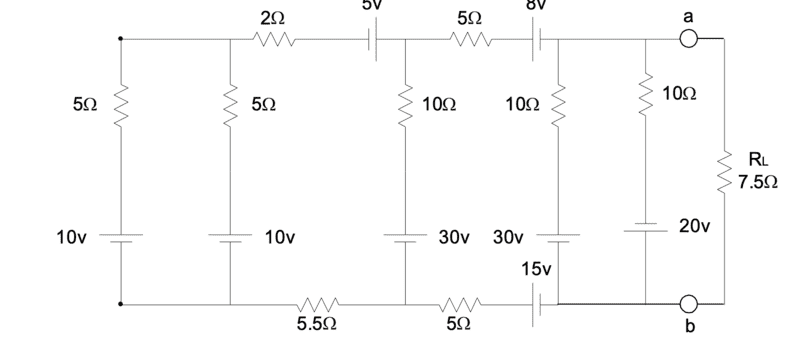
Screen Shot 2022-11-11 at 19.56.42.png

I have shorted the load resistor which is called RL but there are too many currents for me to calculate I'm not sure how to proceed.
 
Physics news on Phys.org
Just write the loop equations and solve them. It's just tedious algebra.

If you want to break it down into smaller parts and deal with each, then start with the two 5ohm/10Volt sections on the left. Combine them into THEIR Thevenin equivalents. Then add the 2ohm and 5.5 ohm and create another Thevenin equivalent. Keep doing that until you have a final Thevenin equivalent.
 
Reply
  • Like
Likes   Reactions: ahmadtibi
Do students really learn anything more by giving them overly complicated problems? I've seen some problems obviously contrived with ridiculous controlled sources.

Jack Welch was famous for demanding 10% more profits every year from GE. Do we have the case where instructors are challenged to make 10% more complicated homework problems each year?
 
Reply
  • Like
Likes   Reactions: SammyS and ahmadtibi