Are the basic axioms of thermodynamics demonstrated experimentally?

  • Context: Undergrad 
  • Thread starter Thread starter drzbigniew31
  • Start date Start date
  • Tags Tags
    Thermodynamics
drzbigniew31
Messages
1
Reaction score
0
TL;DR
During an undergraduate physics course, are the basic axioms of thermodynamics demonstrated experimentally, or are only the theories taught?
I would like to propose a very simple experiment and ask: what is the official thermodynamic prediction for this specific setup?
And, are such basic experiments performed during physics training, or do courses move directly to more complex experiments while taking the foundational axioms for granted?
Proposed experiment:
Approximately 500 mL of tap water in a pan (glass or metallic).
Two thermometers immersed in the water: one at the bottom (touching the inner surface of the pan) and one just below the water surface.
Initial water temperature around 30 °C.
Add 5 ordinary ice cubes (which float at the surface).
Phase 1 – Ice floating on the surface (no flame, just ice melting):
What does standard thermodynamics predict regarding:
The temperature at the bottom versus at the surface?
Which region becomes colder, and which becomes hotter?
Phase 2 – After all ice has melted, turn on the flame (heating from below):
Same questions:
What is the predicted temperature behavior at the bottom versus at the surface?
During the heating process (before boiling), which region should be colder, and which should be hotter?
To be clear: I am not asking whether this exact experiment has been done. I am asking whether the most basic predictions of thermodynamics (e.g., cold water sinks, hot water rises, bottom is hottest under flame) are ever directly demonstrated in undergraduate lab courses, or if they are simply taught as axioms without empirical verification.
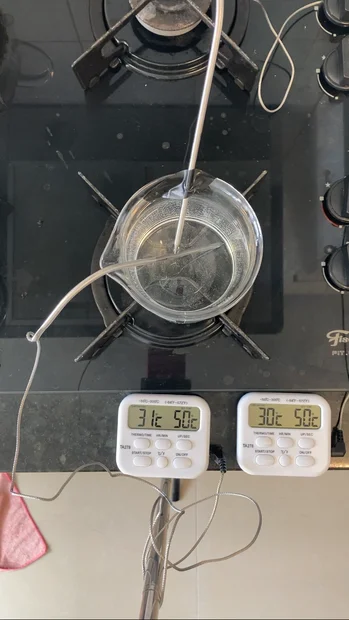
IMG_7383.webp
 
Last edited:
Physics news on Phys.org
Sure, I have seen undergraduate labs on convection.
 
  • Like
Likes   Reactions: russ_watters and Ibix
drzbigniew31 said:
I am asking whether the most basic predictions of thermodynamics (e.g., cold water sinks, hot water rises, bottom is hottest under flame)
@Dale beat me to suggesting dye (you could also add it to the bottom of the water before heating, if you let the water settle and then use a pipette to add the dye).

I'd also add that 0° water is only 0.5% more dense than 30° water, while near-boiling water is 5% less dense than 30° water, and probably has uneven heating from the gas burner coupled with bubbles coming out of solution driving upward flow from hotspots, so much more vigorous convection. It's quite a complex and dynamic situation, so quasi-static rules of thumb like "cold fluids sink" are probably guidelines at best.

I suspect that if you do the dye version of the ice experiment you'll find that the dye does migrate slowly downwards, but sufficiently slowly that it'll mix with the warm water and equilibrate to slightly less than 30° on its way down, rather than sinking like a stone and then equilibrating.
 
Last edited:
  • Like
Likes   Reactions: russ_watters and Dale
Ibix said:
I'd also add that 0° water is only 0.5% more dense than 30° water
Convection is easier with air because of that, IMO. But I guess “hold your hand above this flame” is probably not a good lab exercise.
 
  • Like
Likes   Reactions: russ_watters and Ibix
Here is a simple and convincing convection demonstration.


I used to do something similar and even simpler when I taught. I placed a lit incense stick stuck in a blob of putty at the bottom of a long cylindrical beaker and observed the entire cylinder fill up with smoke but not really rising out of the tube.

I then inserted a strip of cardboard down the axis of the tube to just above the incense separating the volume in two. I observed half the volume clear up as clean air descended into it and pushed the smoke out the other side.
 
  • Like
  • Informative
Likes   Reactions: berkeman, Dale and Ibix
Dale said:
Convection is easier with air because of that, IMO. But I guess “hold your hand above this flame” is probably not a good lab exercise.
They do say that the burnt hand teaches best...
 
  • Like
Likes   Reactions: Dale
drzbigniew31 said:
the most basic predictions of thermodynamics (e.g., cold water sinks, hot water rises, bottom is hottest under flame)
Nitpick: Your thread title says "basic axioms of thermodynamics", which to me indicates the zeroth, first, second and third laws of thermodynamics. Predictions are not axioms.
 
Last edited:
  • Like
  • Agree
Likes   Reactions: Bystander, russ_watters and kuruman
jtbell said:
Nitpick: Your thread title says "basic axioms of thermodynamics", which to me indicates the zeroth, first, second and third laws of thermodynamics. Predictions are not axioms.
That's what I was going to say, and to add; convection(and heat transfer in general) might be a fairly simple concept, but it gets pretty complex pretty quickly.
 
Last edited:
  • Like
Likes   Reactions: jtbell and Bystander
  • #10
russ_watters said:
convection(and heat transfer in general) might be a fairly simple concept, but it gets pretty complex pretty quickly.

I would also add, that because it's so important practically, it's studied experimentally a lot.
 
  • Like
Likes   Reactions: russ_watters
  • #11
russ_watters said:
That's what I was going to say, and to add; convection(and heat transfer in general) might be a fairly simple concept, but it gets pretty complex pretty quickly.
My turn to nitpick: Yes, the concept is simple; its mathematical description is what gets pretty complex pretty quickly. :oldsmile:
 
  • Like
Likes   Reactions: russ_watters
  • #12
kuruman said:
My turn to nitpick: Yes, the concept is simple; its mathematical description is what gets pretty complex pretty quickly. :oldsmile:
Isn't it always the math? :nb)
 
  • #13
drzbigniew31 said:
I am asking whether the most basic predictions of thermodynamics (e.g., cold water sinks, hot water rises, bottom is hottest under flame) are ever directly demonstrated in undergraduate lab courses, or if they are simply taught as axioms without empirical verification
Those are not the most basic axioms of thermodynamics. By "simply taught" I assume you mean only a spoken or written explanation is provided. But they can also be demonstrated or they can be incorporated into a student activity. It depends on the instructor.

Cold water sinking and hot water rising are examples of convection, but they are more complicated than simply that because their explanation depends on the principles of buoyancy and the dependence of density on temperature. As has been pointed out, there are temperatures at which warmer water is more dense than colder water, so the explanation of this example depends on several underlying principles. To answer your question, all those principles could be taught by providing only a written or spoken explanation, or also with a demonstration or student activity.

Convection is one of three methods of heat transfer. They are not considered axioms. Hottest near flame concerns conduction, another of the three methods of heat transfer. And also the rate of energy transfer, again, not an axiom.

Thermodynamics doesn't have axioms. The fundamental or primary pieces of information are the laws. For example, the Zeroth Law states that if two objects are at the same temperature, and the second object is at the same temperature as a third, then the first and third objects are at the same temperature. This could be demonstrated by putting a thermometer in an ice-water bath and observing the reading on the thermometer. Then putting the thermometer in a different ice-water mixture and observing the thermometer reading. If the two thermometer readings are the same, then the Zeroth Law tells us that the two ice-water baths are at the same temperature.

The instructor could describe the above process, an example of a different but analogous example, include a demonstration, or have the students perform an activity.

Is this what you're asking?

(Note: Heavily edited after a night's rest!)
 
Last edited:
  • #14
A cheap thermal camera (~€150, clips onto a smartphone) would be a nice modern upgrade to this experiment. Instead of two point thermometers, you get a full 2D temperature map in real time.
Record a video and you literally see the cold zone forming at the top (Phase 1) and the hot zone building from the bottom (Phase 2).
Note: glass is opaque in thermal IR, so you're measuring the container wall temperature, not the water directly, but if the wall is thin enough, you should still clearly see the thermal gradient.
A metal pan would not work well here: high thermal conductivity smears out the gradient, and low emissivity gives unreliable IR readings.
Pyrex can be a good choice.
You can also use it to visualize the hot air plume above a candle, a direct demonstration of convection in air.
 

Similar threads

  • · Replies 1 ·
Replies
1
Views
2K
  • · Replies 3 ·
Replies
3
Views
2K
  • · Replies 9 ·
Replies
9
Views
3K
  • · Replies 8 ·
Replies
8
Views
9K
  • · Replies 14 ·
Replies
14
Views
5K
  • · Replies 1 ·
Replies
1
Views
2K
  • · Replies 7 ·
Replies
7
Views
3K
  • · Replies 4 ·
Replies
4
Views
3K
  • · Replies 1 ·
Replies
1
Views
3K
  • · Replies 2 ·
Replies
2
Views
2K