Arrhenius plot and activation energy

Click For Summary
SUMMARY

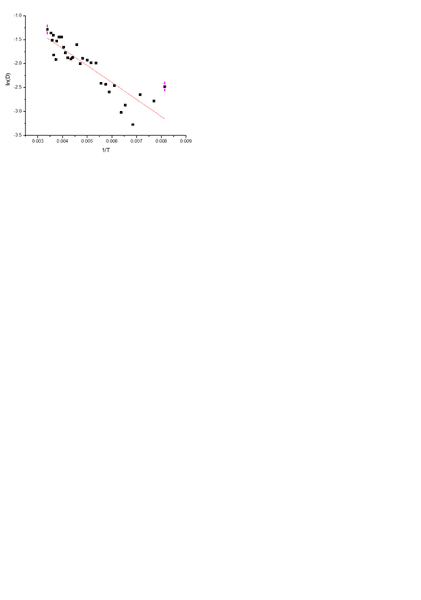
The discussion focuses on determining the activation energy of donor levels using an Arrhenius plot, specifically through the equation D = D0 exp(-Ea/kT). The participant measured absorption at various temperatures of a mono-crystal sample and plotted ln(optical density) against 1/T(K). The expected activation energy is 0.043 eV, but the participant is struggling to obtain the correct value. Key advice includes checking the natural versus decimal logarithm and ensuring the correct units for the Boltzmann constant.

PREREQUISITES
  • Understanding of Arrhenius equation and its application in thermodynamics
  • Familiarity with optical density measurements and their significance
  • Knowledge of logarithmic functions, specifically natural and decimal logs
  • Basic understanding of the Boltzmann constant and its units
NEXT STEPS
  • Review the derivation of the Arrhenius equation for activation energy
  • Learn about error analysis in experimental data, focusing on confidence intervals
  • Investigate the impact of temperature variations on optical density measurements
  • Explore advanced techniques for fitting data to improve accuracy in activation energy calculations
USEFUL FOR

Researchers in materials science, physicists studying semiconductor properties, and anyone involved in thermal activation energy analysis will benefit from this discussion.

prehisto
Messages
111
Reaction score
0
Hi,guys.
I m trying to determine activation energy of donor levels .
So i have measured absorption at different temperatures of my sample (mono-crystal)

And I have plotted ln(optical density) vs 1/T(K).
And I want to calculate activation energy useing
D=D0exp(-Ea/kT)

In plot above (picture) Eactivation should be 0.043eV

The problem is that I can't get the right answer.
Could someone help me,and derive the mentioned formula above for Ea determination? Maybe I am doing it wrong.
34ys9z6.png
 
Physics news on Phys.org
Hi prehisto,

First the scatter in your data should make a large error bar. What is the 95% confidence range of this fitted activation energy?

Second, I would check things like natural log v.s. decimal log and the units of Boltzmann constant, just the basic stuff.
 
I agree, it makes a large error bar. But in this case it does not matter . This is an example for which i know the result ( for this particular liner fitting).

i have checked logarithms and Boltzmann const.

Is this the correct formula?
 

Similar threads

  • · Replies 4 ·
Replies
4
Views
3K
Replies
1
Views
2K
Replies
1
Views
2K
  • · Replies 2 ·
Replies
2
Views
8K
  • · Replies 1 ·
Replies
1
Views
3K
Replies
2
Views
3K
Replies
3
Views
4K
  • · Replies 4 ·
Replies
4
Views
4K
  • · Replies 1 ·
Replies
1
Views
2K
  • · Replies 1 ·
Replies
1
Views
4K