Assignment help - Determining bearing friction?

Click For Summary
SUMMARY

The discussion focuses on understanding the impact of bearing friction on the moment of inertia in a flywheel experiment. The average experimental value calculated was 0.49 kg m², while the theoretical value was 0.50 kg m². It was established that bearing friction acts as a torque opposing rotational motion, which affects the net torque on the flywheel and consequently the falling time measurement. To quantify the effect of friction, one can calculate its influence on the falling time during the experiment.

PREREQUISITES
  • Understanding of moments of inertia
  • Familiarity with torque concepts
  • Basic knowledge of experimental physics
  • Ability to perform calculations involving friction
NEXT STEPS
  • Research the principles of bearing friction in mechanical systems
  • Learn how to calculate torque and its effects on rotational motion
  • Explore methods to measure falling time in experiments
  • Investigate the relationship between static and kinetic friction
USEFUL FOR

Students in physics or engineering courses, particularly those working on assignments related to rotational dynamics and friction analysis.

bikertomm
Messages
1
Reaction score
0
Hi all, I'm new to the forum and have a query with one of my most recent assignments.

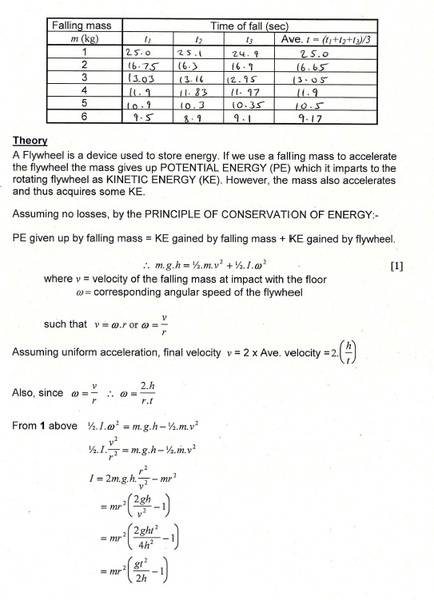
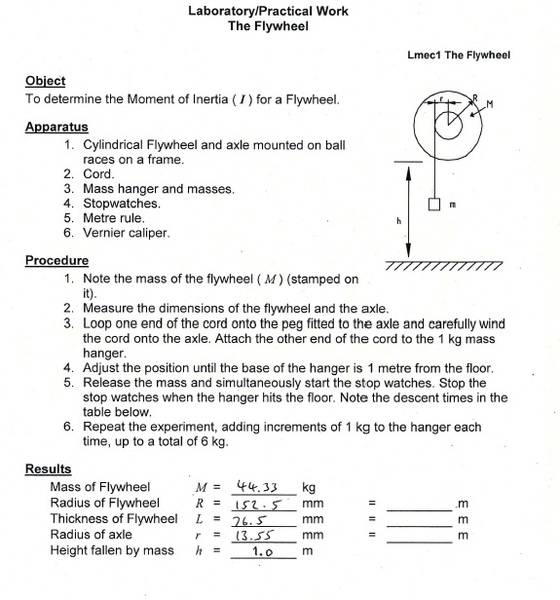
This one is called 'The flywheel' to do with moments of inertia. I have completed the first lot of calculations using the formula no problem.

My average experimental value came out at 0.49 kg m(2)

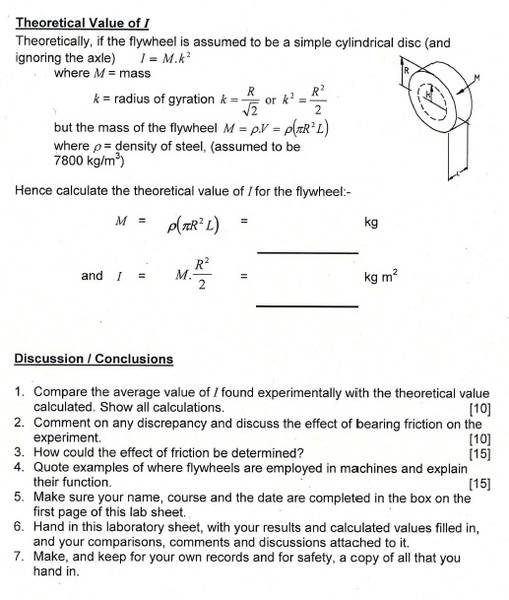
And the theory calculation came out at 0.50 kg m(2)

Question 2 & 3 are the ones I'm struggling with:

Question number 2 says to discuss the effect of bearing friction - I am really struggling to find anything on this.

Question 3 asks how the effect of friction can be determined? I'm struggling with this too. Any help would be massively appreciated..

Here are some pictures of the assignment, cheers.
Q1_zps676aa0b3.jpg


Q2_zps3839237f.jpg


Q3_zps300554fd.jpg
 
Physics news on Phys.org
Just as linear friction is a force opposing relative motion of two bodies with flat surfaces in contact, bearing friction is a torque opposing relative rotational motion about the bearing's axis of two bodies in contact. Again, there will be a static value, typically larger than the kinetic value. Does that help?
 
Q2. You most likely did not take the frictional torque into consideration in your experiment.
It opposes the rotational motion thereby decreasing the net torque acting on the
flywheel. Consider how this would influency your measurement of falling time
and thus the experimental value of the moment of inertia of the flywheel.

Q3 Asks how you can put a value to this frictional effect.
Can you maybe calculate by how much it changed the
falling time?
 
The book claims the answer is that all the magnitudes are the same because "the gravitational force on the penguin is the same". I'm having trouble understanding this. I thought the buoyant force was equal to the weight of the fluid displaced. Weight depends on mass which depends on density. Therefore, due to the differing densities the buoyant force will be different in each case? Is this incorrect?

Similar threads

  • · Replies 1 ·
Replies
1
Views
1K
Replies
18
Views
3K
Replies
13
Views
2K
Replies
16
Views
3K
  • · Replies 2 ·
Replies
2
Views
3K
  • · Replies 23 ·
Replies
23
Views
3K
  • · Replies 6 ·
Replies
6
Views
3K
  • · Replies 21 ·
Replies
21
Views
1K
Replies
6
Views
1K
  • · Replies 33 ·
2
Replies
33
Views
2K