Assistance with Sound Wave Reduction/Amplification Experiment

Click For Summary
SUMMARY

The forum discussion centers on an experiment involving sound wave amplification using a tone generator set at 330 Hz, a glass plate, and various box sizes. The results indicate that the presence of the glass plate increases sound levels by 2 to 13 dB, contrary to the initial expectation of sound reduction. Key factors influencing this phenomenon include the matching of acoustic impedance, standing wave effects, and the geometry of the setup. The discussion highlights the importance of understanding energy conservation and sound propagation principles in acoustic experiments.

PREREQUISITES
  • Understanding of acoustic impedance and its effects on sound propagation
  • Familiarity with standing wave phenomena in acoustics
  • Knowledge of sound wave behavior in different mediums
  • Basic principles of energy conservation in physical systems
NEXT STEPS
  • Research the principles of acoustic impedance matching in sound systems
  • Explore the effects of standing waves on sound amplification
  • Investigate the relationship between box geometry and sound wave behavior
  • Learn about measuring sound power and energy consumption in acoustic experiments
USEFUL FOR

Acoustic engineers, sound designers, and researchers conducting experiments in sound wave behavior and amplification will benefit from this discussion.

pasomatt
Messages
1
Reaction score
0
I was conducting an experiment with a tone generator (330 Hz) in boxes of different sizes with a glass plate placed on top of the box. There is a receiver about .55 meters away. Without any interference, the receiver registered -41 db +/- 1 db. When the tone generator is placed in the box and left open, there is no discernible change in dbs. When the glass is placed on the box, the sound is increased by a range of 2 to 13 dbs.

Going into this, I expected the sound to be reduced, not amplified. Like rolling up a car window, or closing a window in your house to reduce the noise from outside. After realizing the sound was being amplified I was expecting this to be proportional to the amount off free space in the box. I.e. large box = more space = less of an increase in sound. This second part mostly held up.

In a space of .008 m^3 the sound amplification was 2.
In a space of .003 m^3 the sound amplification was 6.
In a space of .0005 m^3 the sound amplification was 8.
However, in a space of .0007 the sound amplification was 13.Does anyone know why the sound is not being dampened? Or can refer me to some sort of concepts/equations? I'm really struggling to model what is happening.

Let me know if you can help.

Here's an example of my setup:
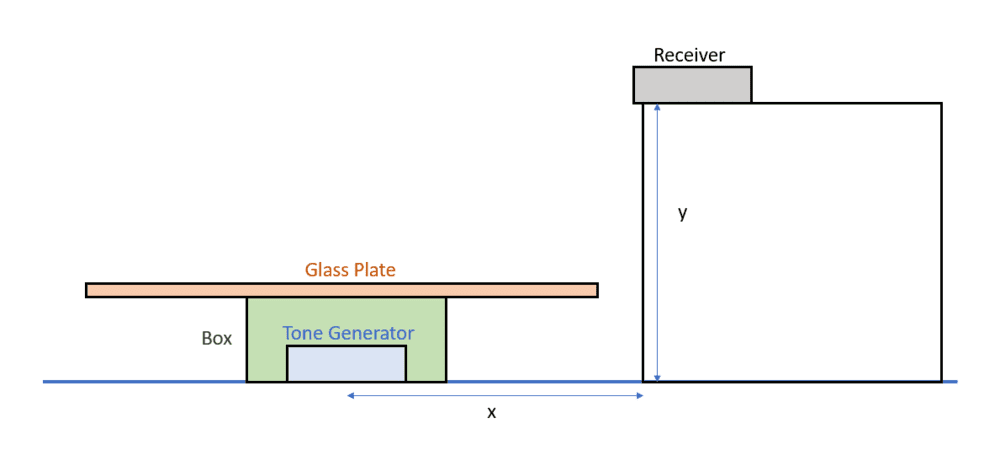
Capture.PNG
 
Physics news on Phys.org
It looks as if the glass plate is Matching the acoustic impedance of the generator to the air. The glass acts like a piston and just moves more air, launching more sound energy.
There would be very little damping. The glass wouldn't be absorbing much energy because it is rigid.
The spacing between generator and receiver and, it appears, the size of the glass are around a half wavelength and the effects of the geometry will be very relevant. For a very low frequency (long wavelength) the air vibrations will be fairly straightforward to describe but diffraction effects are very relevant at the scale you are working. You could be getting standing waves between the box and the generator - it's quite a complex arrangement aamof.
If you vary the height / separation you could expect to get a periodic fluctuation with distance x and / or y (standing wave effect). x would probably be easiest to vary and you could plot the received level against x. Using a linear scale might give a better graph with more obvious level changes.
 
pasomatt said:
Or can refer me to some sort of concepts/equations

Since conservation of energy is such a reliable principle, we can look for an explanation using it as a guide. A simplistic view is that adding the glass plate causes more of the energy inside the box to exit through the plate and less of the energy to exit the box through its sides while the total energy exiting remains the same This suggests placing the receiver where it receives energy mostly from a side of the box - perhaps you must make some sort of acoustic tunnel to restrict the part of the waves that reach the receiver. See what happens to sound emitted from a side of the box before and after the glass plate is added. To see what goes through the bottom of the box, I suppose you must suspend the box in some way to provide room for equipment to measure it.Adding the glass plate can change the amplitudes of the frequencies of the sound waves that arrive at the receiver (imagining a sound to be a superposition of waves at different frequencies). When the receiver analyzes a sound, it may be more accurate at some frequencies than others. If the plate decreases some amplitudes and increases other, the higher decibel reading might be due to the fact the receiver is more sensitive to the frequencies whose amplitudes were increased. Does the documentation for the receiver say anything about the frequencies it can analyze?
 
Stephen Tashi said:
Since conservation of energy is such a reliable principle, we can look for an explanation using it as a guide.
This is actually a bit of HARD ENGINEERING. I'm afraid.
Problem is that the Energy (Power) of the sound coming out depends upon the Matching of the amplifier to the surroundings because the Power may never be generated in the first place . An audio amplifier is not a 'constant power source'. Most audio amplifiers provide a Voltage Out that's proportional to the input signal. The actual Power that's delivered will be that voltage times the Current that flows into the loudspeaker coil and the current will depend on how easy or hard it is to move the diaphragm. This is why loudspeakers have a wide rigid Cone, which gives the voice coil something to 'push against' (i.e the air) and so deliver some significant sound power. (I'm sorry if this is very Noddy approach but the point is important and it relates to the Impedance I referred to earlier) A large flat plate may just be allowing more air to be moved by the generator and, hence more Power. A 5kg slab of concrete would not give any benefit because the driver just couldn't shift it. A light sheet of aluminium might be better than the glass etc. etc.
Once the sound has been launched, there are all the propagation issues with standing waves and the spreading out of the sound power etc.
The situation has those two separate aspects which could be studied with different experiments. But that large box will interact with the sound from the source (plate) and affect the Matching as the distance is varied - until you are a reasonable distance away. As I mentioned, that spacing is around a half wavelength which is very relevant. Working further away would be favourite if the power is high enough or the receiver is sensitive enough. I think I could expect the variation with distance to be a gradual decrease with some ups and downs when in close.
 
  • Like
Likes   Reactions: BvU
sophiecentaur said:
This is actually a bit of HARD ENGINEERING. I'm afraid.
Problem is that the Energy (Power) of the sound coming out depends upon the Matching of the amplifier to the surroundings because the Power may never be generated in the first place .
Yes, from the conservation energy point of view, the physical situation may change the amount of electrical energy that is changed to sound energy. (Likewise for units of power). This could be tested by measuring the power consumption of equipment generating the sound with and without the glass on the box. I wonder how sensitive a watt-meter would have to be in order to detect a change.
 

Similar threads

  • · Replies 1 ·
Replies
1
Views
4K
Replies
20
Views
5K
  • · Replies 1 ·
Replies
1
Views
2K
  • · Replies 5 ·
Replies
5
Views
2K
  • · Replies 3 ·
Replies
3
Views
4K
  • · Replies 2 ·
Replies
2
Views
4K
  • · Replies 3 ·
Replies
3
Views
3K
  • · Replies 48 ·
2
Replies
48
Views
6K
  • · Replies 3 ·
Replies
3
Views
2K
Replies
4
Views
3K