Astronomy - ratio of the magnitude of the force of sun and moon gravity

Click For Summary

Homework Help Overview

The discussion revolves around calculating the ratio of gravitational forces exerted by the Sun and the Moon. Participants are exploring the application of gravitational force equations and the significance of mass and distance in these calculations.

Discussion Character

  • Exploratory, Mathematical reasoning, Assumption checking

Approaches and Questions Raised

  • Participants discuss the correct input of values into the gravitational force equation, questioning the order of operations and the accuracy of their calculations. There is an emphasis on ensuring that the mass and distance values are correctly assigned and squared as necessary.

Discussion Status

Some participants have shared their recalculations and findings, with one confirming a final answer of 177. There is a recognition of the importance of calculator usage and the potential for errors in inputting values. The conversation reflects a collaborative effort to clarify misunderstandings and validate results.

Contextual Notes

Participants are working under the constraints of homework rules, focusing on understanding the calculations rather than simply obtaining the final answer. There are indications of confusion regarding the mathematical operations involved, particularly with squaring values and managing large numbers in calculations.

JordanTim
Messages
4
Reaction score
0
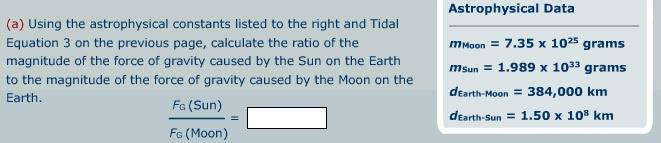
I've been reading and reading and trying to figure this out, but I just can't. Any help anyone can give will be appreciated. It is probably simple as hell, but for some reason my stupid brain can't get it..

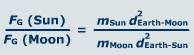
The formula/equation is:
equation3.jpg


What I have to do is:

exercise.jpg


Now, I'm not looking for someone to do it for me I am just looking for help..

I plugged in all the numbers to what I think is right, but I got:

2.660226612 * 10 ^ -46

I don't think that is right...
 
Physics news on Phys.org
Definitely not right.

How have you been plugging it in so far? It really is just a simple matter of plugging the values into the equation, so the only real effort necessary is in ensuring that you have entered all of the values correctly and with the correct order of operations.

Make sure when you enter in the values that you are putting them in properly - note that the mass on top is the mass of the sun, but the distance on top is actually the distance to the moon. Once you plug in those values, you should get the correct answer (and the correct answer is definitely >1, so if you get another amazingly small number, you might want to check your inputs again)
 
I redid it and got a different answer, I was doing the 1.50 * 10^8 squared wrong. So, how I plugged them in is:

(1.989 * 10^33) * (1.47456 * 10^11) / (7.35 * 10^25) * (2.25 * 10^16)

I got: 8.98 * 10^34

Now, I believe it should be a decimal number right? I have to insert the number into the white box in my second picture there, and I don't have enough text to type that. What am I doing wrong?
 
Okay, upon doing a little more and not using my calculator I got the final answer down to 1.77 * 10^2, or 177. This seems high, could the ratio be 177?
 
177 should be right - it is what I get.

The trick with stuff like this is often to know what you are really telling your calculator to do. A lot of times, you can ensure that it is doing things in the order that you think through the use of copious quantities of parentheses - otherwise, the operations may be different than you think.

Oh, and to check it, you can use the relative masses and distances to compare. Msun/mmoon=2.7 *107
Dsun/Dmoon (distance to each)= 390

Note that the sun is 27 million times more massive, but only 390 times farther. The distance value is squared though, so you have to square this to get the effect on strength. The mass scales directly, so at the same distance, the sun would have 27 million times the gravity of the moon. Because it is 390 times farther though, it has 1/(390^2) the gravity that it would have at the distance of the moon. This effectively decreases its relative strength by a factor of 1/150,000. Therefore, the sun has 27 million times the strength if you correct for mass, and 1/150,000th the strength accounting for distance, so these effects combine to an overall effect of 27 million/150,000, which is equal to a factor of a hundred and eighty. This is about what you got, so it does seem right.
 
Thanks a bunch man for your explanation. It helped a lot.

I had to read what you explained a few times to get it, but I think I'm starting to understand more. The only thing my calculator was doing wrong at the beginning was squaring the 1.5 * 10^8, going from 10^8 to 10^64. I figured that out, and fixed it. Next, using the calculator it didn't subtract 42 from 44 when dividing, but it added. Once I figured that out I got 177 :)
 

Similar threads

  • · Replies 5 ·
Replies
5
Views
6K
Replies
18
Views
3K
  • · Replies 2 ·
Replies
2
Views
2K
  • · Replies 10 ·
Replies
10
Views
3K
Replies
3
Views
2K
  • · Replies 3 ·
Replies
3
Views
2K
  • · Replies 5 ·
Replies
5
Views
2K
  • · Replies 2 ·
Replies
2
Views
2K
  • · Replies 4 ·
Replies
4
Views
3K
  • · Replies 22 ·
Replies
22
Views
2K