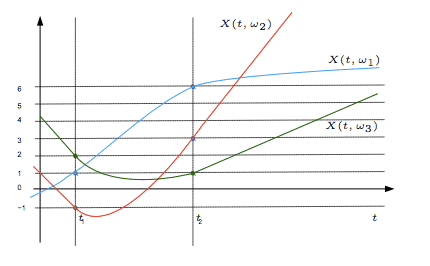
You should define the stochastic process clearly:
##X(t)## is a random variable given by the distribution:
##P(X(t) = f_r(t)) = r##
##P(X(t) = f_g(t)) = g##
##P(X(t) = f_b(t) = b##
Since you imply the trajectory of the process has only 3 possibilities, we can think of realizing it as making one random draw to determine the value of ##X(0)##. If the draw selects ##f_r## then ##X(t) = f_r(t) = f_r(s)## etc. In other words we don't make a random draw at ##X(s)## and make a different random draw at ##X(t)##.
( Saying "the process has only 3 possible trajectories" is different that saying "at each time t, we select the value of the process from one of 3 possible functions". )
The autocorrelation function is defined by
##R(s,t) = \frac { E ( (X(s) - \overline{X(s)} )(X(t) - \overline{X(t)} )}{\sigma_s \sigma_t}##
Start by finding the constants ## \overline{X(s)}, \sigma_s, \overline{X(t)}, \sigma_t ##.
For example, ##\overline{X(s)} = r f_r(s) + g f_g(s) + b f_b(s)##
##\sigma_s = \sqrt{ E(X(s)^2) - \overline{X(s)}^2}##
## = \sqrt{ r f_r(s)^2 + g f_g(s)^2 + b f_b(s)^2 - (\overline{X(s)})^2 } ##
Once you find those constants, the expectation symbol "##E##" implies you compute the expected value of the function ##g(s,t) = \frac { (X(s) - \overline{X(s)} )(X(t) - \overline{X(t)}}{\sigma_s \sigma_t}##
Since we only make one random draw, the function ##g(r,s)## has 3 possible values
##P ( g(s,t) = \frac{( f_r(s) - \overline{X(s)})(f_r(t) - \overline{X(t)})}{ \sigma_s \sigma_t}) = r##
##P ( g(s,t) = \frac{( f_g(s) - \overline{X(s)})(f_g(t) - \overline{X(t)})}{ \sigma_s \sigma_t}) = g##
##P ( g(s,t) = \frac{( f_b(s) - \overline{X(s)})(f_b(t) - \overline{X(t)})}{ \sigma_s \sigma_t}) = b##
Maybe there is some theorem that can be used to avoid all the algebra. (That's not a hint, because, off hand, I don't remember one.)