Automatic hydraulic jack -- choosing motor

Click For Summary

Discussion Overview

The discussion revolves around selecting an appropriate motor for an automatic hydraulic jack powered by a 12V battery. Participants explore various motor types, design considerations, and mechanical configurations relevant to the application.

Discussion Character

  • Exploratory
  • Technical explanation
  • Debate/contested
  • Mathematical reasoning

Main Points Raised

  • One participant suggests using a DC motor with a gear reducer to manage the pumping rate and torque requirements.
  • Another participant questions the practicality of building a custom jack compared to purchasing an off-the-shelf electric jack.
  • There is a proposal to optimize the pumping stroke by maximizing the effective pumping arm length to reduce peak torque.
  • A suggestion is made to consider using a second-hand 12V wiper motor, which includes a reduction gear and crank.
  • Concerns are raised about the need for a telescoping arm for certain designs, with a preference for a scissor jack with a reversible motor for ease of operation.
  • Participants discuss the inefficiency of sliding mechanisms and propose using a connecting rod to optimize motor torque during the lifting cycle.
  • One participant shares a design idea involving changing the connecting rod position and seeks feedback on its feasibility.
  • There are inquiries about how to automate the lowering of the jack, with suggestions about using a pressure release valve.
  • Another participant emphasizes the importance of having an automated system for both raising and lowering the jack, depending on its intended application.

Areas of Agreement / Disagreement

Participants express a range of ideas and concerns regarding motor selection and design, with no consensus reached on a single approach or solution. Multiple competing views on the design and functionality of the jack remain present.

Contextual Notes

Participants highlight various design considerations, including the need for a telescoping arm, the efficiency of sliding mechanisms, and the importance of optimizing motor torque. The discussion includes assumptions about the application and operational requirements of the jack.
TheRedDevil18
Messages
406
Reaction score
2
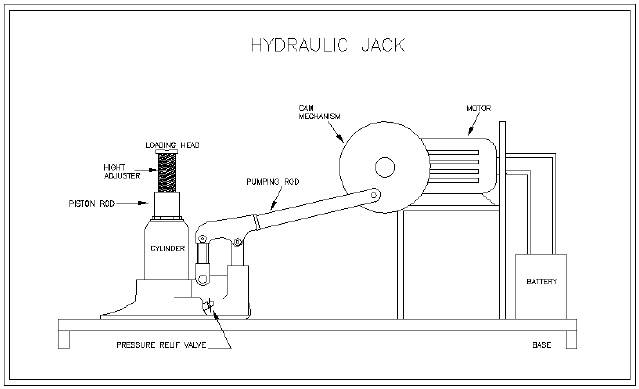
What type of motor can I use for this jack ?
3-75ed7b22a4.jpg


It's running from a 12V battery
 
Engineering news on Phys.org
Something with a gear reducer? I got a funny image of the pump stroking 3,600 times a minute.

If you're running off a battery then obviously a DC motor. You could use something like a digital fishing scale to determine the force required to push the handle down when the jack is under load. Working from that you could determine the minimum torque requirement for the motor. The slower the pumping rate the lower the required torque. You would also have to take into account friction of the drive mechanism, including the gear reducer. And, of course, you'd have to slot that pump rod.
 
That doesn't look like it'd stow conveniently in your car boot...
Why reinvent the wheel? An off the shelf electric jack is about the same size as your bottle jack and they're not too expensive, certainly cheaper than the time and money to design and build your own.
 
True, but we don't know why RedDevil is doing this. I'd like to know.
 
I just thought of something else. The pumping stroke should occur when the effective pumping arm is the longest. That reduces the peak torque required.
 
Consider using a second hand 12V wiper motor from a car.
It will have a reduction gear and crank as supplied.
 
Unless you have a telescoping arm on the jack that design wouldn't work, and you would have to manually let the jack down. a scissor jack with a reversible electric motor straight shaft input attached to the jack itself would work much better.

not sure how much you could lift or what size motor would be efficient for what ever application you are using it for but the design would give you a way to both raise and lower the jack with a flip of a switch.
 
gjonesy said:
Unless you have a telescoping arm on the jack that design wouldn't work, and you would have to manually let the jack down. a scissor jack with a reversible electric motor straight shaft input attached to the jack itself would work much better.

.
+1, w/o telescoping handle the jack or motor would need to be on a sliding mechanism. probably bad to have the jack slide back & forth ;)
 
Sliding mechanisms are usually quite inefficient unless they have captive linear ball races.

A connecting rod would be a better method of connecting the crank to the jack arm. By selecting appropriate linkage dimensions and motor position, the motor torque could be optimised to the lifting part of the rotation cycle. A simple change to the jack handle socket would allow operation by horizontal motion rather than vertical.
 
  • #10
Baluncore said:
Sliding mechanisms are usually quite inefficient unless they have captive linear ball races.

A connecting rod would be a better method of connecting the crank to the jack arm. By selecting appropriate linkage dimensions and motor position, the motor torque could be optimised to the lifting part of the rotation cycle. A simple change to the jack handle socket would allow operation by horizontal motion rather than vertical.

What if I just changed the connecting rod position to something like this
IMG_20160502_114011.jpg


Would it work ?
 
  • #11
Have a look at bell crank mechanisms .
 
Last edited:
  • #12
3 - Copy.jpg
TheRedDevil18 said:
What if I just changed the connecting rod position to something like this
That looks like it would work, so long as the ends of the connecting rod were pins that would allow for the directional differences.
 
Last edited:
  • #13
How are you going to lower the jack?
 
  • #14
gjonesy said:
How are you going to lower the jack?
I expect the pressure "release valve" that is wrongly labelled as “pressure relief” valve will be cracked open slightly.
 
  • #15
Yeah but the diagram doesn't show any automation for that. It would help to know its perpose...i have seen "jacks" rigged like this as a cheap way to make a dump bed on a pickup truck...its actually pretty cool. But it would be a pain in the kester to turn on the jack raise the bed then have to crawl under the truck to turn the pressure release just to lower the bed. Optimally i would opped for a system that both raises and lowers automatically. It really depends on the application of that jack.
 
Last edited:
  • #16
post #10, just make sure the diameter of the crank (I should say stroke) is less than the stroke of the jack piston handle where it connects to connecting rod. you can adjust handle length to accommodate, etc.
 
Last edited:

Similar threads

  • · Replies 6 ·
Replies
6
Views
2K
  • · Replies 4 ·
Replies
4
Views
4K
  • · Replies 19 ·
Replies
19
Views
4K
  • · Replies 15 ·
Replies
15
Views
4K
  • · Replies 7 ·
Replies
7
Views
12K
  • · Replies 35 ·
2
Replies
35
Views
5K
Replies
24
Views
3K
  • · Replies 12 ·
Replies
12
Views
3K
Replies
6
Views
2K
  • · Replies 19 ·
Replies
19
Views
997