Math Amateur
Gold Member
MHB
- 3,920
- 48
I am reading Matej Bresar's book, "Introduction to Noncommutative Algebra" and am currently focussed on Chapter 1: Finite Dimensional Division Algebras ... ...
I need help with some aspects of Example 1.27...
Example 1.27 (including a short preamble and Definition 1.26) reads as follows:
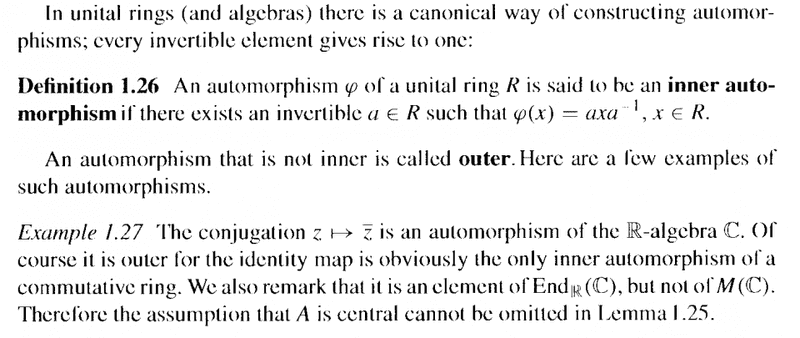
My questions on Example 1.27 comprise the following:
Question 1
In the above example from Bresar we read the following:
" ... ... Of course it is outer ... for the identity map is obviously the only inner automorphism of a commutative ring. ... ... "
I have two questions regarding this remark ...
(a) ... why does Bresar assert that "the identity map is obviously the only inner automorphism of a commutative ring" ... surely a commutative ring may have some units (invertible elements other than ##1## ...) and so may have some inner automorphisms ... BUT Bresar is asserting that this is not the case ... can someone please clarify this issue ...(b) ... Bresar seems to be talking about ##\mathbb{C}## ... but he is referring to "a commutative ring" in the quote above ... but why? ... ##\mathbb{C}## is a field ... ?
Can someone please clarify what Bresar means ...
Question 2
In the above example from Bresar we read the following:
" ... ... We also remark that it is an element of ##\text{End}_\mathbb{R} ( \mathbb{C} )## but not ##M( \mathbb{C} )##. ... "I have two questions on this remark ... as follows ...(a) ... ... Bresar proved in Lemma 1.25 (see previous post) that for
##M(A) = \text{End}_F (A)## ...
so ... why isn't it true that ##M( \mathbb{C} ) = \text{End}_\mathbb{R} ( \mathbb{C} )## ... ?(b) ... can someone please explain exactly why the conjugation automorphism is an element of ##\text{End}_\mathbb{R} ( \mathbb{C} )## but not of ##M( \mathbb{C} )## ... ?Help will be much appreciated ... ...
Peter=============================================================================
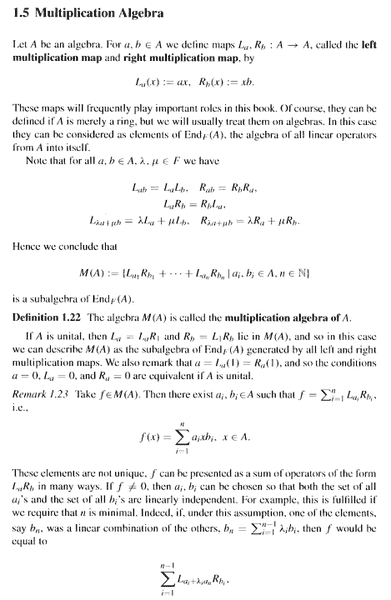
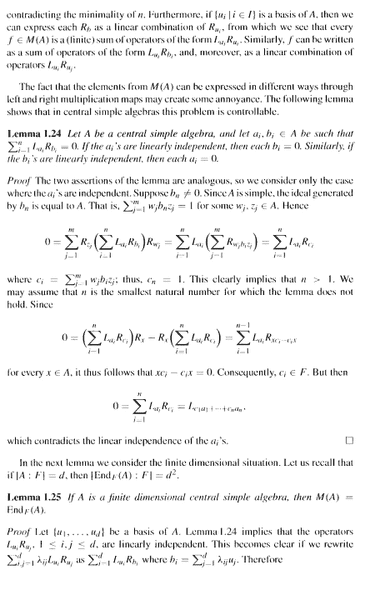
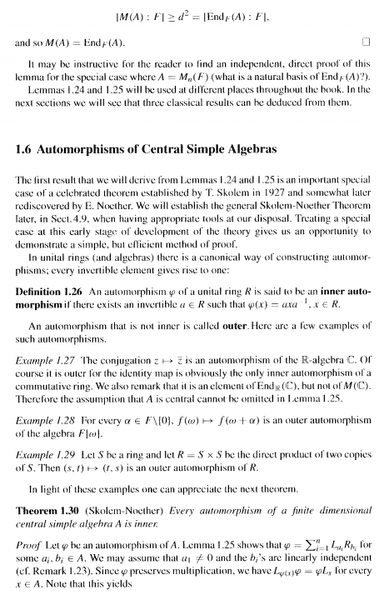
So that readers of this post can appreciate the notation and the context I am providing Bresar Section 1.5 ( which includes Lemmas 1.24 and 1.25) and also the start of Bresar Section 1.6 ... ... as follows:
I need help with some aspects of Example 1.27...
Example 1.27 (including a short preamble and Definition 1.26) reads as follows:
My questions on Example 1.27 comprise the following:
Question 1
In the above example from Bresar we read the following:
" ... ... Of course it is outer ... for the identity map is obviously the only inner automorphism of a commutative ring. ... ... "
I have two questions regarding this remark ...
(a) ... why does Bresar assert that "the identity map is obviously the only inner automorphism of a commutative ring" ... surely a commutative ring may have some units (invertible elements other than ##1## ...) and so may have some inner automorphisms ... BUT Bresar is asserting that this is not the case ... can someone please clarify this issue ...(b) ... Bresar seems to be talking about ##\mathbb{C}## ... but he is referring to "a commutative ring" in the quote above ... but why? ... ##\mathbb{C}## is a field ... ?
Can someone please clarify what Bresar means ...
Question 2
In the above example from Bresar we read the following:
" ... ... We also remark that it is an element of ##\text{End}_\mathbb{R} ( \mathbb{C} )## but not ##M( \mathbb{C} )##. ... "I have two questions on this remark ... as follows ...(a) ... ... Bresar proved in Lemma 1.25 (see previous post) that for
##M(A) = \text{End}_F (A)## ...
so ... why isn't it true that ##M( \mathbb{C} ) = \text{End}_\mathbb{R} ( \mathbb{C} )## ... ?(b) ... can someone please explain exactly why the conjugation automorphism is an element of ##\text{End}_\mathbb{R} ( \mathbb{C} )## but not of ##M( \mathbb{C} )## ... ?Help will be much appreciated ... ...
Peter=============================================================================
So that readers of this post can appreciate the notation and the context I am providing Bresar Section 1.5 ( which includes Lemmas 1.24 and 1.25) and also the start of Bresar Section 1.6 ... ... as follows:
Attachments
-
 Bresar - Example 1.27 ....png31.4 KB · Views: 1,240
 -
 Bresar - 1 - Section 1.5 Multiplication Algebra - PART 1 ... ....png27.6 KB · Views: 686
 -
 Bresar - 2 - Section 1.5 Multiplication Algebra - PART 2 ... ....png29.5 KB · Views: 661
 -
 Bresar - 1 - Section 1.6 ... Automorphisms of Central Simple Algebras ... PART 1 ....png66.3 KB · Views: 804