Average path length through a box

Click For Summary

Homework Help Overview

The discussion revolves around calculating the average distance traveled through a box of length w by various straight paths. The original poster presents mathematical expressions for the average distance to adjacent and opposite faces of the box, involving integration over spatial dimensions. There is uncertainty about the correctness of the approach and the method of averaging over possible paths.

Discussion Character

  • Exploratory, Conceptual clarification, Mathematical reasoning, Assumption checking

Approaches and Questions Raised

  • Participants discuss the need to define the averaging method, questioning whether it should be based on entry points, solid angles, or other factors. There is a suggestion to consider all directions equally likely and concerns about the implications of using Cartesian coordinates. Some participants relate the problem to concepts in radiative heat transfer and the complexity of resulting expressions.

Discussion Status

The discussion is ongoing, with participants exploring different interpretations of the problem and questioning the assumptions made about entry points and angles. Some guidance has been offered regarding the need for clarity in defining the averaging process, but no consensus has been reached on the best approach.

Contextual Notes

There are mentions of fixed versus variable entry points and the implications of averaging over different geometrical configurations. The original poster acknowledges the need for a more comprehensive approach that considers all possible paths through the box.

jamie.j1989
Messages
76
Reaction score
0
Moved from a technical forum, so homework template missing
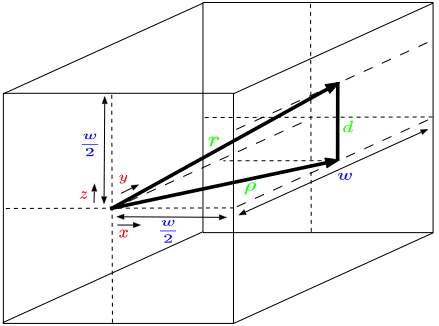
Hi, I would like to try and calculate the average distance traveled through a box of length ##w## by any straight path possible. As shown in the attached figure. Where the path through the box to an adjacent face is given by

$$r_{adj}^2=\left(\frac{w}{2}-x\right)^2+y^2+z^2.$$
intersection box.png

The average distance traveled through the intersection can be found by integrating over the three spatial dimensions ##x,y,## and ##z##, in the following way,$$\left<r_{adj}\right>=\frac{1}{N_xN_yN_z}\sum^{N_x,N_y,N_z}_{i,j,k}\sqrt{\left(\frac{w}{2}-x_i\right)^2+y_j^2+z_k^2}$$Where ##N_x=\frac{w}{\delta x},N_y=\frac{w}{\delta y},N_z=\frac{w}{\delta z}##, the small change in displacement along ##x## is ##\delta x=x_{i}-x_{i-1}##, and likewise for ##\delta y## and ##\delta z##. And as ##N_x,N_y,N_z\rightarrow \infty##, the summation turns into the integration,

$$\left<r_{adj}\right>=\frac{1}{w^3}\int^{\frac{w}{2}}_{-\frac{w}{2}}dx\int^{w}_{0}dy\int^{\frac{w}{2}}_{-\frac{w}{2}}dz\sqrt{\left(\frac{w}{2}-x\right)^2+y^2+z^2}.$$

So this then gives us the average distance through the box traveled between one adjacent face and the other. All other similar paths with adjacent faces will add and average to the same value.

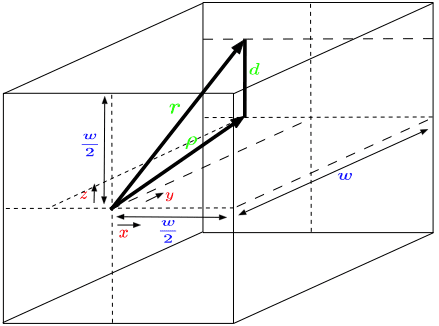
Then we need to consider paths to opposite faces through the box, where the second figure attached shows the path taken, and where the distance traveled is,

$$r_{opp} =\sqrt{\left(\frac{w}{2}-x\right)^2+w^2+\left(\frac{w}{2}-z\right)^2}$$
Beam Intersection 2.png


And so we can average like before to get,

$$\left<r_{opp}\right> = \frac{1}{w^2}\int^{\frac{w}{2}}_{-\frac{w}{2}}dx\int^{\frac{w}{2}}_{-\frac{w}{2}}dz\sqrt{\left(\frac{w}{2}-x\right)^2+w^2+\left(\frac{w}{2}-z\right)^2}$$

Where all other paths originating from all other faces and going to their respective opposite faces will just average to the same again. And now the total average is just

$$\left<r\right>=\frac{\left<r_{opp}\right>+\left<r_{adj}\right>}{2}$$

I'm not really sure if this is right, and apart from writing a simulation to compute and average over many possible path lengths I'm not sure how to check it either?

Thanks
 
Physics news on Phys.org
I would have thought the idea was to have all directions equally likely, so long as they go through the box.
Using Cartesian coordinates related to the exit points will not achieve that. It will make the oblique angles more common than is fair.
Also, I'm not quite sure what range of entry points is to be considered. The diagram implies it is always through the centre of one end of the box. Is that right?
 
  • Like
Likes   Reactions: BvU
Hi guys,
The situation described reminded me of the view factor in radiative heat transfer. Page 9 http://www.kostic.niu.edu/352/_352-posted/Heat_4e_Chap13-Radiation_HT_lecture-PDF.pdf demonstrates how hideous the resulting expressions are. I expect something equally labyrinthic for the average path lengths ! Things simplify considerably if the single entry point is the center of one of the faces, but an elegant, simple expression is too much to hope for is my humble guess.
 
First you have to define what you want to average over. Over the possible exit area, over the solid angle, over something else?

Is your initial entry point fixed?
 
mfb said:
First you have to define what you want to average over. Over the possible exit area, over the solid angle, over something else?

Is your initial entry point fixed?

The average is over the distance of the path traveled through the box in a straight line. The entry point isn't fixed, now that the fixed entry point has been mentioned I realize that this isn't correct. I would need 6 degrees of freedom to explain all the possible entry and exit points?
 
haruspex said:
I would have thought the idea was to have all directions equally likely, so long as they go through the box.
Using Cartesian coordinates related to the exit points will not achieve that. It will make the oblique angles more common than is fair.
Also, I'm not quite sure what range of entry points is to be considered. The diagram implies it is always through the centre of one end of the box. Is that right?

I'm not sure I understand, why would the oblique angles be more common?
 
jamie.j1989 said:
I'm not sure I understand, why would the oblique angles be more common?
It might be clearer to start with two dimensions.
Consider straight lines through the origin traversing the unit square in the first quadrant.
By symmetry, only need to consider those passing below (1,1).
If we take the y intercept at x=1 as being uniformly distributed, the probability of the intercept being between y and y+dy is dy. If the angle to the horizontal is θ, the probability of the angle being between θ and θ+dθ is sec2(θ)dθ.
If you want all angles equally likely, you need the probability to be (4/π)dθ.
 
jamie.j1989 said:
The average is over the distance of the path traveled through the box in a straight line.
That is what you average, it is not what you average over.

As an example, consider a die which has faces "1", "1", "4", "4", "4", "4". What is the average? You can average over the result of many rolls: 3. But you can also average over the possible results (1 and 4): 2.5. This example might look a bit constructed, but you have exactly this problem with your cube: It is unclear how to weight the different possible results relative to each other. By surface area is a possibility, but not the only one, and it looks quite odd.
 
haruspex said:
f the angle to the horizontal is θ, the probability of the angle being between θ and θ+dθ is sec2(θ)dθ.
If you want all angles equally likely, you need the probability to be (4/π)dθ.

I understand why the probability of the that the line goes through a point y+dy is dy as dy as a fraction of the entire length of the unit square is just dy/1=dy. But surely the probability of it going through the corresponding angle θ+dθ to go through a point on the x=1 vertical line is, from y=tanθ, cos2(θ)dy? Which would give more favourable oblique paths.
 
  • #10
jamie.j1989 said:
I understand why the probability of the that the line goes through a point y+dy is dy as dy as a fraction of the entire length of the unit square is just dy/1=dy. But surely the probability of it going through the corresponding angle θ+dθ to go through a point on the x=1 vertical line is, from y=tanθ, cos2(θ)dy? Which would give more favourable oblique paths.
Consider dividing the (1,0) to (1,1) line into tengths of 0.1. With your scheme each of those has equal probability. Out towards the (1,1) end, the lines from the origin get bunched closer together, spreading the same 0.1 probability over progressively narrower ranges of angles. Thus the probability density of a given angle increases. sec increases, cos decreases.
Algebraically, y=tanθ, dy =sec2(θ)dθ. The probability that the line hits between y and y+dy is dy, so the probability that the angle is between θ=atan(y) and θ+dθ=atan(y+dy) is sec2(θ)dθ.
 
  • #11
mfb said:
That is what you average, it is not what you average over.

As an example, consider a die which has faces "1", "1", "4", "4", "4", "4". What is the average? You can average over the result of many rolls: 3. But you can also average over the possible results (1 and 4): 2.5. This example might look a bit constructed, but you have exactly this problem with your cube: It is unclear how to weight the different possible results relative to each other. By surface area is a possibility, but not the only one, and it looks quite odd.

I think i understand, I want to average over all possible paths regardless of degeneracy. So is my approach possible or would a change of method by surface area be easier?
 
  • #12
haruspex said:
Consider dividing the (1,0) to (1,1) line into tengths of 0.1. With your scheme each of those has equal probability. Out towards the (1,1) end, the lines from the origin get bunched closer together, spreading the same 0.1 probability over progressively narrower ranges of angles. Thus the probability density of a given angle increases. sec increases, cos decreases.
Algebraically, y=tanθ, dy =sec2(θ)dθ. The probability that the line hits between y and y+dy is dy, so the probability that the angle is between θ=atan(y) and θ+dθ=atan(y+dy) is sec2(θ)dθ.

I don't see how that's the probability for a particular angle, it's equal to dy=sec2(θ)dθ which is the probability that the path goes through a point between y and dy, which also isn't constant as was first suggested?
 
  • #13
For your box, you don't have degeneracy, you have a continuous problem. It is up to you to determine what you want to average over.

Where does the original problem come from?
 
  • #14
jamie.j1989 said:
I don't see how that's the probability for a particular angle, it's equal to dy=sec2(θ)dθ which is the probability that the path goes through a point between y and dy, which also isn't constant as was first suggested?
Not sure what you are saying. Your initial approach was as though the probability of passing between y and y+dy was proportional to dy. If all directions are to be considered equally likely, you need it to be proportional to dθ. Clearly these are not the same.
 
  • #15
mfb said:
For your box, you don't have degeneracy, you have a continuous problem. It is up to you to determine what you want to average over.

Where does the original problem come from?

I just want to average over all possible paths through the box, Its something I thought of and wanted to try and solve. So am I right in saying that my current method is only averaging over all possible paths from a fixed entry point? And I'm being biased with oblique angles as pointed out by haruspex due to using cartesian coordinates?
 
  • #16
jamie.j1989 said:
So am I right in saying that my current method is only averaging over all possible paths from a fixed entry point? And I'm being biased with oblique angles as pointed out by haruspex due to using cartesian coordinates?
Yes to both.
 

Similar threads

  • · Replies 10 ·
Replies
10
Views
2K
Replies
2
Views
2K
Replies
3
Views
2K
Replies
20
Views
2K
  • · Replies 5 ·
Replies
5
Views
3K
  • · Replies 8 ·
Replies
8
Views
3K
  • · Replies 1 ·
Replies
1
Views
2K
  • · Replies 14 ·
Replies
14
Views
2K
  • · Replies 9 ·
Replies
9
Views
3K
  • · Replies 2 ·
Replies
2
Views
2K