The Role of Baffles in a Reactor: Increasing Mixing & Heat Exchange

  • Thread starter Thread starter gfd43tg
  • Start date Start date
  • Tags Tags
    Reactor
Click For Summary
SUMMARY

The discussion centers on the role of baffles in Continuous Stirred Tank Reactors (CSTRs) and shell and tube heat exchangers. Baffles are essential for directing fluid flow, enhancing mixing, and improving heat transfer efficiency. They create disturbances in the flow, which helps achieve more effective mixing compared to the agitator alone. This leads to reduced concentration gradients and approaches the ideal of perfect mixing within the reactor.

PREREQUISITES
  • Understanding of Continuous Stirred Tank Reactor (CSTR) dynamics
  • Familiarity with heat exchanger design principles
  • Knowledge of fluid dynamics and turbulence
  • Basic concepts of chemical reaction kinetics
NEXT STEPS
  • Research the design and optimization of baffles in CSTRs
  • Study the impact of baffles on heat transfer in shell and tube heat exchangers
  • Explore fluid dynamics simulations to visualize mixing patterns
  • Learn about the effects of turbulence on chemical reaction rates
USEFUL FOR

Chemical engineers, process engineers, and anyone involved in reactor design and optimization will benefit from this discussion.

gfd43tg
Gold Member
Messages
948
Reaction score
48
Hello,

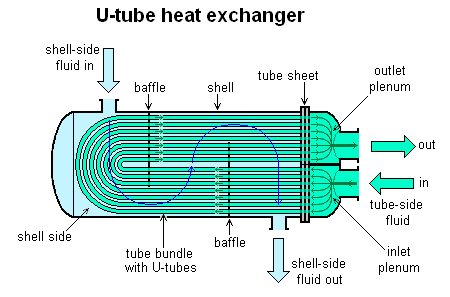
I know the use of baffles in a shell and tube heat exchanger will guide the shell-side fluid as it navigates through the shell, but I saw baffles are also used in CSTRs to help with mixing.

This is clearly illustrated with the diagram
U-tube_heat_exchanger.PNG

where one can see that the baffle is directing the shell fluid up and down, increasing the time it spends inside the exchanger, thus absorbs more heat from the tube side fluid, hence heat exchange. Very useful indeed.

According to wikipedia, the use of a baffle in a tank reactor is
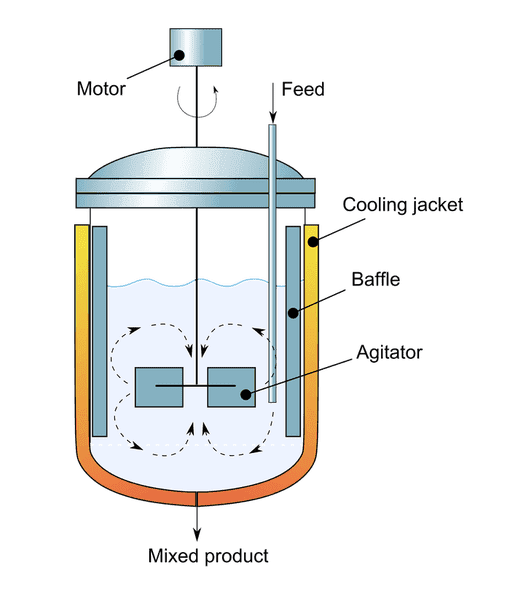
In a chemical reactor, baffles are often attached to the interior walls to promote mixing[2] and thus increase heat transfer and possibly chemical reaction rates.

However, with the diagram here of a stirred reactor, I don't see how having some blocks on the side actually do anything? Is it not the agitator that is doing the mixing? What good is the baffle for?
2000px-Agitated_vessel.svg.png
 
Last edited:
Engineering news on Phys.org
The ideal CSTR model assumes that the fluid in the reactor is perfectly mixed, and that there are no concentration gradients inside the reactor. However, in a real-world stirred tank reactor, you won't have perfect mixing and there will be concentration gradients present. The baffles contribute additional disturbance to the flow created by the mixer, and provide more effective mixing. So, including the baffles brings you closer to the ideal of perfect mixing.

Chet
 
But how does sticking them inside there actually increase mixing? They look like rectangles that just stick to the side of the wall
 
Ever stirred a cup of tea or coffee and had the entire mass of fluid start rotating in the cup? As soon as it happens there is not much turbulence right? You can take your spoon out and watch it continue to spin for some time.
Imagine having baffles on the inside of your cup, how would that change the mixing?
 
  • Like
Likes   Reactions: gfd43tg and Chestermiller
I think I see what you are saying now, it just breaks up the flow and increases turbulence. Thanks
 

Similar threads

  • · Replies 6 ·
Replies
6
Views
3K
  • · Replies 2 ·
Replies
2
Views
2K
Replies
1
Views
5K
Replies
22
Views
4K
Replies
1
Views
5K
Replies
7
Views
3K
Replies
1
Views
1K
  • · Replies 5 ·
Replies
5
Views
5K
Replies
9
Views
3K
Replies
5
Views
11K