Balun, impedance matching and BPF

Click For Summary
SUMMARY

This discussion focuses on the connection of an antenna to a Band Pass Filter (BPF) and a transceiver, specifically the ADTRX1 model. The user seeks confirmation on their understanding of impedance matching, noting that the BPF should be designed for a 50 Ohm source and load resistance to ensure bidirectional communication. The conversation highlights the necessity of using a BALUN to match impedances when the transceiver output is 200 Ohms, and discusses potential antenna options, including Beverage and Delta antennas, which have higher impedances.

PREREQUISITES
  • Understanding of Band Pass Filters (BPF) and their purpose in signal processing.
  • Knowledge of impedance matching techniques, specifically using BALUNs.
  • Familiarity with the specifications of the ADTRX1 transceiver.
  • Basic concepts of antenna design and characteristics, including impedance values.
NEXT STEPS
  • Research the design and implementation of BALUNs for impedance matching.
  • Explore the specifications and performance of the ADTRX1 transceiver in detail.
  • Learn about different antenna types, focusing on Beverage and Delta antennas.
  • Investigate the principles of Band Pass Filter design for specific frequency ranges.
USEFUL FOR

Radio enthusiasts, amateur radio operators, and engineers involved in RF design and antenna systems will benefit from this discussion, particularly those working with transceivers and BPFs.

deltaar
Messages
3
Reaction score
0
Hi.

I need to connect an antenna to a BPF (Band Pass Filter) and this one to a transceiver. The BPF purpose isn't to make matching, is to filter the input/output signals to the desired bandwidth.

I'm a little confuse and would like you to confirm my ideas, to help I made a sketch:
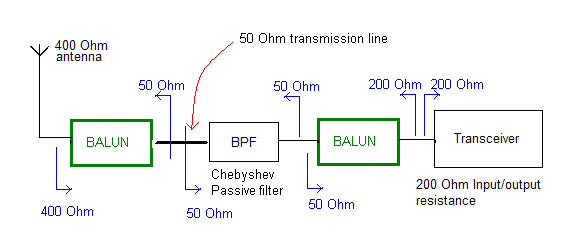
scene.GIF


The BPF and the BALUN next the transceiver are attached to this one. The other BALUN is attached to the antenna.

The communication is bidirectional, so the BPF source and load resistance should be the same. If I were using that scheme for reception or transmission only, that BALUN next to the transceiver wouldn't be necessary, I think. But, because it needs to work in the both directions, I have to ensure the source and load resistance are the same, they will "switch their positions" when I switch from RX to TX and vice-versa, so if they are equal, no problem.

Because the filter, at the antenna side, is connected to a 50 Ohm transmission line, I'm going do design the BPF for a 50 Ohm source and load resistance. This way I need a BALUN between the BPF and the transceiver to match (or maybe this could be achieved with a conventional impedance transformer, perhaps more expensive...)

Am I thinking correct?

I had never done anything similar to this, maybe there are simpler and cheaper solutions. I would appreciate very much you feedback.
 
Engineering news on Phys.org
Welcome to the PF, deltaar. It's a great place for questions like the one you are asking.

I do need to ask, though, why your transceiver has an output impedance of 200 Ohms. Your whole system should be 50 Ohms, including the transceiver TX and RX impedances, and the antenna should also be 50 Ohms. I'm not even sure how a 400 Ohm antenna would be constructed... What frequency band is this system for, and what antenna topology are you using?
 
Hi berkeman.

The transceiver works in ShortWave and you can find it here under the name ADTRX1 (see HF SDR transceiver ADTRX1-YU1LM part2.pdf): http://yu1lm.qrpradio.com/homebrew.htm

I made some calculations (the 74HC4053 resistance is 80 to 180 Ohm at 25ºC, I have used 150 Ohm), I also use 1 MHz to calculate the capacitor impedance and I didn't consider the AMPOP's output impedance (it's low) and I get the value 200 Ohm for the output impedance at TX. For the RX my calculations gave me a smaller value, about 190 Ohm. That's way I said the input/output resistances were 200 Ohm.
Can you confirm these calculations?

Maybe I'll use a Beverage or Delta antenna, the first has an impedance of 450 Ohm and the second one 950 Ohm. I didn't decide about the antenna, because those two aren't very practical.
Or perhaps it's better a 50 Ohm antenna, I have to see this latter...

By the way, I'm using a BALUN, instead of a LC filter, because of it's much higher bandwidth.

Thanks, and please keep posting.
 
Remember, a Beverage antenna (named after its inventor Harold Beverage -- I kid you not) is primarily for receiving signals, not for transmitting them. It's too lossy to be very useful for transmissions.

www.answers.com/topic/beverage-antenna

And you are right, it has an input impedance in the range of 470 Ohms! Wow, I knew about 300 Ohm folded dipoles, but didn't realize that feedpoint impedances could get even higher for some antennas.

In any case, if your antenna does not have a 50 Ohm unbalanced input impedance, then you will place a matching balun between the feedline and the antenna. And if your radio transceiver's antenna output is not 50 Ohms, you will need a matching balun there as well. You have drawn all of that correctly in your sketch.

Pretty cool SDR link. Have Fun!


EDIT -- PS, What is your callsign? If you don't want to post it here, just send me a PM. 73.
 
Thanks for answering.

I'm going to look for a better antenna for transmission.

About the callsign, I don't have anyone yet...
Firstly, I'm going to use the radio in the 27 MHz band (CB), which in my country (Portugal) is not necessary to make any amauter radio exam. All I need is to pay a license, but there's no callsign.
Latter, after I get some experience I'll propose myself to the HAM radio exam, which requires some study and codes practice, then, if I pass, I'll get an HAM license and a callsign.

I leave here my website link. As soon as I have a callsign I'll update the site with it.
http://drodrigues.web.simplesnet.pt/ It's a ugly and messy website, but it has been useful (at least for me).

Best regards.
 
Last edited by a moderator:

Similar threads

  • · Replies 20 ·
Replies
20
Views
3K
Replies
24
Views
3K
Replies
1
Views
2K
Replies
33
Views
3K
Replies
20
Views
3K
  • · Replies 8 ·
Replies
8
Views
5K
  • · Replies 6 ·
Replies
6
Views
1K
  • · Replies 7 ·
Replies
7
Views
3K
  • · Replies 15 ·
Replies
15
Views
5K
Replies
10
Views
3K