Basic commutator of angular momentum

Click For Summary

Discussion Overview

The discussion revolves around the calculation of the commutator of angular momentum, specifically how to transition from one step in the derivation to another using the Leibniz product rule. The focus is on understanding the intermediate steps in the manipulation of commutators in quantum mechanics.

Discussion Character

  • Technical explanation
  • Mathematical reasoning

Main Points Raised

  • One participant seeks clarification on the transition from the second to the third step in a derivation involving commutators.
  • Another participant suggests that the intermediate step can be expressed as a combination of commutators, specifically noting that certain terms evaluate to zero.
  • A later reply mentions the application of the Leibniz product rule as a method to simplify the expression further.
  • Some participants express a belief that the process could be simpler, indicating a potential misunderstanding or a search for a more straightforward approach.
  • One participant advises that proficiency with the Leibniz rule can lead to skipping steps in future calculations, emphasizing the importance of practice with this technique.

Areas of Agreement / Disagreement

Participants appear to have differing views on the complexity of the derivation, with some believing it could be simplified while others emphasize the necessity of the Leibniz rule. The discussion remains unresolved regarding the perceived simplicity of the steps involved.

Contextual Notes

There are assumptions about the participants' familiarity with the Leibniz product rule and commutator properties, which may affect their interpretations of the steps in the derivation.

catsarebad
Messages
69
Reaction score
0
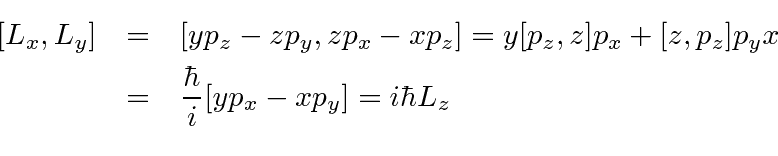
Could someone explain to me how the author goes from 2nd to 3rd step
img1750.png

I think the intermediate step between 2 and 3 is basically to split up the commutator as

[y p_z, z p_x] - [y p_z,x p_z] - [z p_y,z p_x] + [z p_y, x p_z]

2nd term = 0
3rd term = 0

so leftover is
[L_x, L_y] = [y p_z, z p_x] + [z p_y, x p_z]

but how does this turn into what he has on 3rd step?
 
Physics news on Phys.org
catsarebad said:
[...]
so leftover is
[L_x, L_y] = [y p_z, z p_x] + [z p_y, x p_z]

but how does this turn into what he has on 3rd step?
Multiple applications of the Leibniz product rule: ##[AB,C] = A[B,C] + [A,C]B##
 
really? I thought it would be much simpler than that. I thought i was missing a trivial trick.
 
catsarebad said:
really? I thought it would be much simpler than that. I thought i was missing a trivial trick.
Once you become proficient with the Leibniz rule, you'll be able to skip steps. E.g., the ##y## in the 1st commutator commutes with ##zp_x##, so it can just be taken out the front, and so on. You could call that a "trivial" trick, but it's wise to carefully practice the Leibniz rule a few times initially, since it's essential when simplifying more difficult commutators.
 

Similar threads

  • · Replies 1 ·
Replies
1
Views
1K
  • · Replies 14 ·
Replies
14
Views
2K
  • · Replies 39 ·
2
Replies
39
Views
5K
Replies
2
Views
2K
  • · Replies 5 ·
Replies
5
Views
3K
  • · Replies 10 ·
Replies
10
Views
2K
Replies
3
Views
3K
  • · Replies 6 ·
Replies
6
Views
6K
  • · Replies 1 ·
Replies
1
Views
6K
  • · Replies 7 ·
Replies
7
Views
2K