Basic Forces and Motion Problem (friction)

Click For Summary
SUMMARY

The discussion centers on a physics problem involving two masses on a frictionless surface with friction between them. Mass 1 (m1 = 100kg) accelerates at 6 m/s², while Mass 2 (m2 = 20kg) accelerates at 4 m/s² due to the frictional force. The applied force (Fpush) is calculated to be 680N, and the frictional force (Ff) must be considered as it affects the net force acting on m1. The correct approach involves recognizing that the frictional force on m2 originates from m1, thus influencing the overall calculations.

PREREQUISITES
  • Understanding of Newton's laws of motion
  • Familiarity with the concept of frictional force
  • Ability to apply the formula F = ma
  • Basic knowledge of acceleration and mass relationships
NEXT STEPS
  • Calculate the frictional force (Ff) between the two masses
  • Explore the implications of frictionless surfaces in physics problems
  • Study the effects of varying mass on acceleration in Newton's second law
  • Investigate scenarios with and without friction to compare outcomes
USEFUL FOR

This discussion is beneficial for physics students, educators, and anyone interested in understanding the dynamics of forces and motion, particularly in scenarios involving friction between objects.

Nragis
1. Homework Statement
You have two masses moving across a frictionless surface, yet there is friction between the two masses. Mass 2 is on top of Mass 1 A force is applied to m1 which causes It to accelerate at 6 m/s2 and the friction between the two masses causes m2 to accelerate at 4 m/s2

What is Ff? Fpush? Fnet,x?

m1 = 100kg
a1 = 6 m/s2
m2 = 20kg
a2= 4 m/s2

Homework Equations


F = ma
Newton’s third law

The Attempt at a Solution


Both my teacher and my classmates told me that this was wrong and you just plug the formula Fpush = (100kg+20kg)(6m/s) = Fnet,x, but this didn't make sense because the frictional force on m2 had to come from m1, so it was subtracted (added to opposite direction) of m1
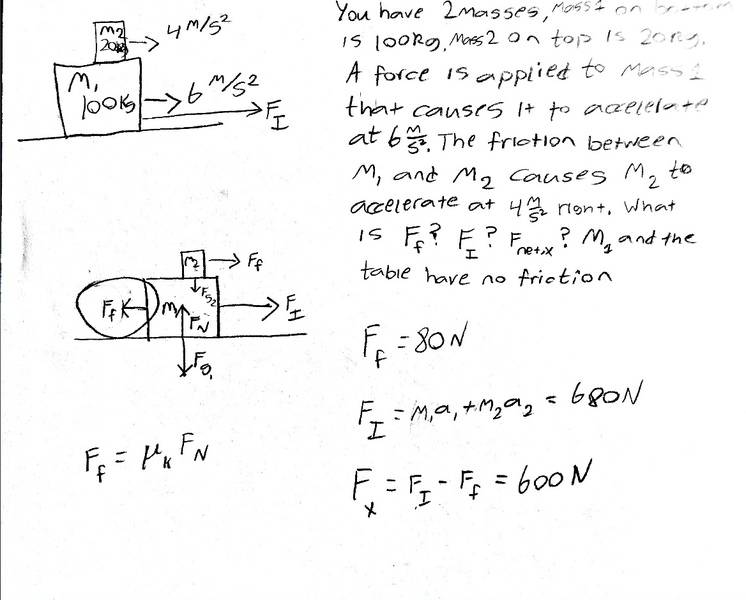
6pExroH.jpg
 

Attachments

  • 6pExroH.jpg
    6pExroH.jpg
    46.6 KB · Views: 863
Last edited by a moderator:
Physics news on Phys.org
Nragis said:
1. Homework Statement
You have two masses moving across a frictionless surface, yet there is friction between the two masses. Mass 2 is on top of Mass 1 A force is applied to m1 which causes It to accelerate at 6 m/s2 and the friction between the two masses causes m2 to accelerate at 4 m/s2

What is Ff? Fpush? Fnet,x?

m1 = 100kg
a1 = 6 m/s2
m2 = 20kg
a2= 4 m/s2

Homework Equations


F = ma
Newton’s third law

The Attempt at a Solution


Both my teacher and my classmates told me that this was wrong and you just plug the formula Fpush = (100kg+20kg)(6m/s) = Fnet,x, but this didn't make sense because the frictional force on m2 had to come from m1, so it was subtracted (added to opposite direction) of m1

View attachment 213714
You are correct. The applied force is 680N.
You could try asking your classmates: what if there were no friction between the blocks?
 
Okay, thanks for the reply. I just didn’t want to bring it up further if I was actually wrong
 

Similar threads

Replies
23
Views
2K
  • · Replies 17 ·
Replies
17
Views
2K
  • · Replies 6 ·
Replies
6
Views
2K
  • · Replies 3 ·
Replies
3
Views
2K
  • · Replies 4 ·
Replies
4
Views
1K
  • · Replies 5 ·
Replies
5
Views
2K
Replies
13
Views
3K
  • · Replies 19 ·
Replies
19
Views
12K
Replies
2
Views
2K
  • · Replies 17 ·
Replies
17
Views
3K