Battery charger circuit fault(s)

Click For Summary

Discussion Overview

The discussion revolves around troubleshooting a faulty 12V battery charger that experienced an overcurrent. Participants analyze the schematic of the charger, focusing on the power side, including the behavior of diodes and a MOSFET, and explore potential causes for incorrect voltage readings and circuit behavior.

Discussion Character

  • Technical explanation
  • Debate/contested
  • Exploratory

Main Points Raised

  • One participant notes that the MOSFET M1 will not turn on and questions the voltages present on the slow and fast charge rails, suggesting that the slow charge voltage is dropping across diodes D10 and D11.
  • Another participant comments on the unusual arrangement of diodes and questions the necessity of D10 and D11, indicating that they provide a voltage drop without apparent heating.
  • A later reply clarifies that D10 and D11 form a Half Wave rectifier circuit, explaining the observed voltage behavior on the black lead due to the average DC voltage measurement.
  • One participant proposes that the rest of the diodes form a Full Wave Bridge rectifier, suggesting that the configuration may be contributing to the confusion regarding voltage outputs.
  • Another participant expresses uncertainty about the charger's design, noting that it never had a 6V charge feature and plans to redraw the circuit for clarity.
  • Ultimately, a participant reports finding the fault, indicating that a short in the transformer caused incorrect voltages affecting the control circuitry, leading to the MOSFET not functioning properly.

Areas of Agreement / Disagreement

Participants express differing views on the function and necessity of certain diodes in the circuit, and there is no consensus on the overall design of the charger. The discussion includes both exploratory reasoning and technical explanations, with some participants agreeing on specific points while others raise questions or propose alternative interpretations.

Contextual Notes

Some assumptions about the circuit design and the function of components remain unresolved. The discussion highlights the complexity of the circuit and the potential for multiple interpretations of the schematic.

Guineafowl
Messages
910
Reaction score
418
My cheapish 12V battery charger suffered an overcurrent, and now is not working properly. Below is a schematic of the main power side:
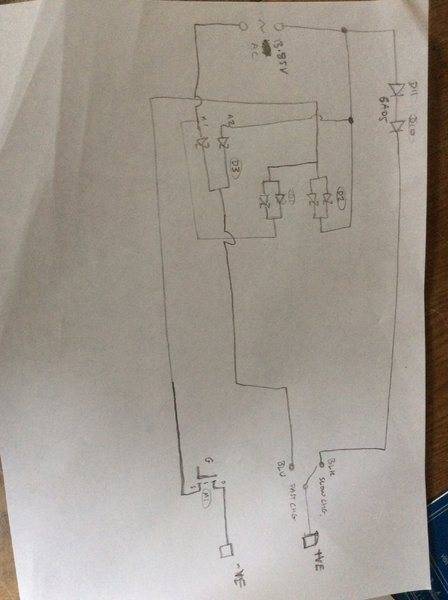
image.jpg


The MOSFET M1 will not turn on, which I'll tackle later, but even with the drain bridged to source the voltages are wrong.

The black, slow charge (rail at top) voltage is only 6.8V, while the blue, fast charge rail is at 12.9V, measured relative to the MOSFET source.

Regarding the slow charge rail, the extra voltage seems to be dropping (5.0V) across the two big diodes D10 and 11, but they are not getting hot, and there is no load anyway. I've removed both and tested the diode drops (0.7V) and all seems fine. The same for the Schottky diode packages Ds 1-3 (Vf 0.2V) What's happening?
 
Engineering news on Phys.org
Guineafowl said:
My cheapish 12V battery charger suffered an overcurrent, and now is not working properly. Below is a schematic of the main power side:

when asking for help, it's a really good idea to provide info in an easy to read way
I have rotated the image so we all don't have to lie on our sides and a little contrast enhancement to make things a little more readable

Please keep in mind ... for future posts ... help those who you would like to get help from :smile:

upload_2017-9-14_7-35-20.png
I don't know why they use D10 and D11 ? all they do is provide a ~ 1.4 V drop ( depending on the diode type)

That's a really strange assemblage of diodes in the middle

Guineafowl said:
My cheapish 12V battery charger suffered an overcurrent, and now is not working properly.

You are not showing the current control circuitry ... maybe the fault is in what you haven't shown ?
 
  • Like
Likes   Reactions: Guineafowl
Yes, sorry about that. I did take the picture in landscape, but the computer kindly rotated it for me.

D10 and 11 are very fat, 6A05 diodes and there is some heat discolouration beneath. I think their only purpose is to drop a volt or two of the charging voltage to provide a lower charge rate. The other diodes are baffling.

I will glady reverse engineer the rest of the control circuit, but as far as I can see its goal is to turn the MOSFET on. The immediate problem is more basic - where does the AC voltage go on the low side?
 
For the moment, ignore D10,11.

The rest of the diodes form a Full Wave Bridge rectifier, just drawn a bit strangely.

D2 (parallel pair) and the parallel pair below them are the Negative bridge output, going to the MOSFET..

D3 and the diode below it form the Positive bridge output; connected with the BLU wire to the switch.

D10,11 explanation:
D10,11 form a Half Wave rectifier circuit with only the positive half cycles of the input AC being used. It is connected with the BLK wire to the switch. (slow charge)
The return, or Negative, always goes thru M1 back to the Negative bridge output.

The approx. 1/2 voltage on the black lead is because the meter you are using is measuring the average DC voltage there. Since only the positive peaks of the AC are allowed thru D10,11, you have 50% duty cycle on the BLK lead. The peak voltage on the BLK lead is the same as on the BLU (full wave) lead but is only there for 1/2 the time, effectively supplying 1/2 the charging current..
 
  • Like
Likes   Reactions: Guineafowl and dlgoff
Tom.G said:
For the moment, ignore D10,11.

The rest of the diodes form a Full Wave Bridge rectifier, just drawn a bit strangely.

D2 (parallel pair) and the parallel pair below them are the Negative bridge output, going to the MOSFET..

D3 and the diode below it form the Positive bridge output; connected with the BLU wire to the switch.

D10,11 explanation:
D10,11 form a Half Wave rectifier circuit with only the positive half cycles of the input AC being used. It is connected with the BLK wire to the switch. (slow charge)
The return, or Negative, always goes thru M1 back to the Negative bridge output.

The approx. 1/2 voltage on the black lead is because the meter you are using is measuring the average DC voltage there. Since only the positive peaks of the AC are allowed thru D10,11, you have 50% duty cycle on the BLK lead. The peak voltage on the BLK lead is the same as on the BLU (full wave) lead but is only there for 1/2 the time, effectively supplying 1/2 the charging current..
That sounds sensible. Perhaps I could have re-drawn the Schottkys as a proper bridge and got less confused, but I was running out of bits of paper!

Only trouble is, this charger never had a 6V charge feature - it was either 12.6V or 13.9V, if I recall correctly. I'll draw up the rest of the circuit and post at some point. Thanks for now.
 
Found the problem, but the charger is scrap. There were two low current taps from the secondary, used to power the control circuitry. One of these had shorted to the high current side, so there was a stray voltage where there should have been ground. This was holding an NPN transistor base high, which was in turn holding the MOSFET gate low.

Measuring the secondary voltages and wiggling the tap wires showed a varying voltage, so I took the transformer apart and found the fault.

Ah well, more parts available for the next repair! Thanks all.
 
  • Like
Likes   Reactions: Tom.G

Similar threads

  • · Replies 11 ·
Replies
11
Views
3K
  • · Replies 6 ·
Replies
6
Views
3K
Replies
5
Views
3K
  • · Replies 2 ·
Replies
2
Views
2K
  • · Replies 8 ·
Replies
8
Views
3K
  • · Replies 3 ·
Replies
3
Views
4K
  • · Replies 1 ·
Replies
1
Views
3K
Replies
2
Views
3K
  • · Replies 13 ·
Replies
13
Views
8K
  • · Replies 17 ·
Replies
17
Views
8K