Boundary conditions of electric field?

Click For Summary
SUMMARY

The discussion centers on the interpretation of electric fields at boundary conditions as described in Griffiths' "Introduction to Electrodynamics." The confusion arises from the application of Gauss's Law, specifically regarding the signs of the electric fields above and below a charged surface. The equation presented, E_above - E_below = (1/ε₀)σ, accurately reflects the contributions of both the external electric field and the field due to the surface charge density. The negative sign indicates the direction of the electric field relative to the surface charge, clarifying the relationship between the fields and the surface charge density.

PREREQUISITES
  • Understanding of Gauss's Law in electrostatics
  • Familiarity with electric field concepts and surface charge density
  • Knowledge of vector calculus, particularly dot products
  • Basic principles of electrostatics as outlined in Griffiths' "Introduction to Electrodynamics"
NEXT STEPS
  • Study the derivation of Gauss's Law in electrostatics
  • Learn about the concept of electric field lines and their directionality
  • Explore the implications of surface charge density on electric fields
  • Review vector calculus applications in electromagnetism, focusing on dot products
USEFUL FOR

Students of electromagnetism, physics educators, and anyone seeking to deepen their understanding of electric fields and boundary conditions in electrostatics.

PhysicsKid0123
Messages
95
Reaction score
1
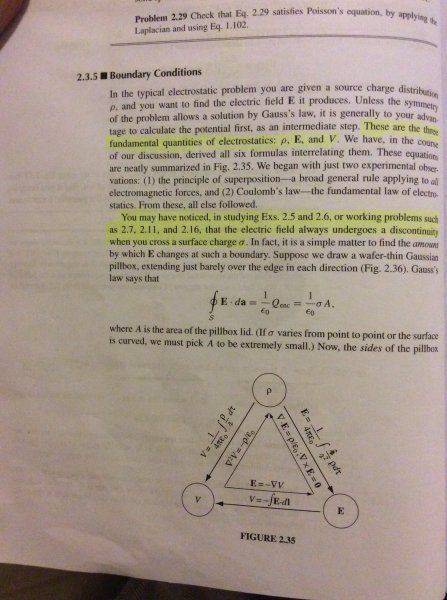
I'm reading griffiths electrodynamics and I am confused about a concept. Mainly because I might be interpreting it in different ways. Why does the equation contain an E with a negative in front? Namely, E_below. Isn't the Electric field pointing away from the surface with the surface charge density and isn't the surface differential also pointing away from the surface? So when using gaus's law, shouldn't the equation be EA +EA =(1/εo)σA or 2E =(1/εo)σ rather than E_above — E_below =(1/εo) σ. This doesn't make sense unless we are talking about an external electric field that is propagating towards and across the surface. Because in that case the dot product of the external electric field and surface differential, one will be positive and one will be negative. But if this is the case, what about the electric field from the surface charge itself? After all, guas's law is relating the electric field coming from the surface and the surface charge density. Can someone clarify what is happening?PS. I've included the pages. One of the pictures doesn't want to change orientation even after rotating it and uploading it again.
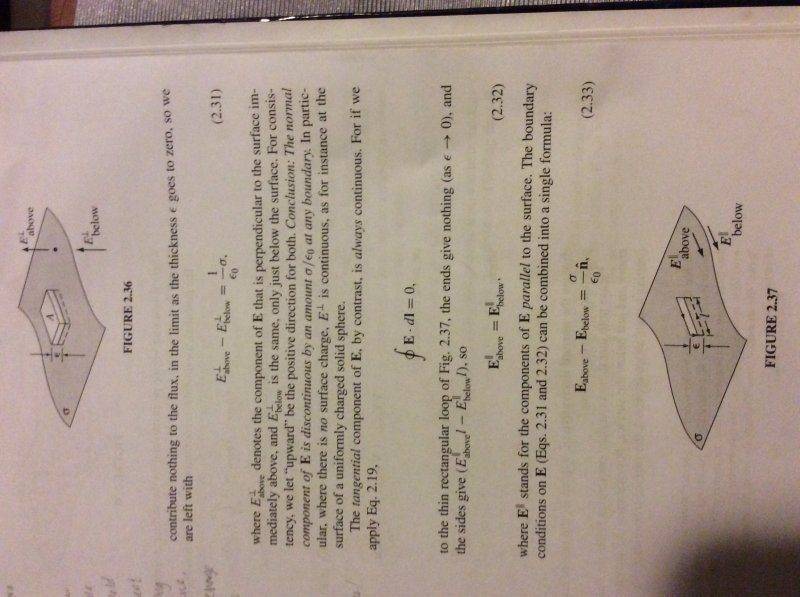
image.jpg
image.jpg
 
Physics news on Phys.org
Think of it as ##\vec E_{above}\cdot (dA\hat z) + \vec E_{below}\cdot (dA(-\hat z))=
((\vec E_{above})_z - (\vec E_{below})_z)dA##
 
Last edited:

Similar threads

  • · Replies 7 ·
Replies
7
Views
1K
  • · Replies 3 ·
Replies
3
Views
3K
  • · Replies 9 ·
Replies
9
Views
3K
  • · Replies 5 ·
Replies
5
Views
1K
  • · Replies 21 ·
Replies
21
Views
4K
  • · Replies 22 ·
Replies
22
Views
3K
  • · Replies 6 ·
Replies
6
Views
573
  • · Replies 4 ·
Replies
4
Views
3K
  • · Replies 14 ·
Replies
14
Views
3K
  • · Replies 9 ·
Replies
9
Views
4K