Branching ratios | Higgs phenomenology

Click For Summary

Discussion Overview

The discussion focuses on the branching ratios (BRs) of the Higgs boson and the associated Feynman diagrams (FDs) in various decay channels. Participants explore the relationships between different decay modes, the factors influencing BRs, and the theoretical underpinnings of Higgs phenomenology, including comparisons between massless and massive decay products.

Discussion Character

  • Exploratory
  • Technical explanation
  • Debate/contested
  • Mathematical reasoning

Main Points Raised

  • One participant notes that the coupling constant for the Higgs particle is proportional to the mass of the decay products, suggesting that heavier particles couple more strongly to the Higgs.
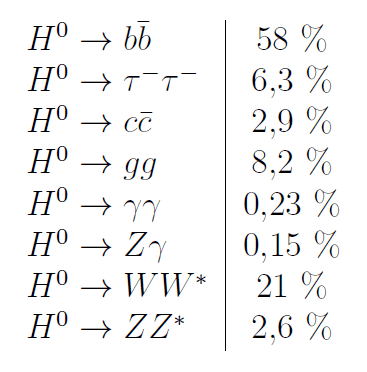
  • Another participant questions why some decay channels have greater BRs than others, particularly comparing the channels ##H^0 \to \gamma \gamma## and ##H^0 \to gg##, and seeks to understand the differences in their FDs.
  • It is mentioned that the amplitudes for the decay to gluons include additional color factors, which may contribute to the differences in BRs.
  • Participants discuss the relationship between the BRs of ##H^0 \to WW## and ##H^0 \to ZZ^*##, with one suggesting that the BR for ##H^0 \to WW## is larger due to the non-identical nature of the W bosons.
  • There is a discussion about the sudden minimum observed in the BR for ##H^0 \to ZZ^*##, with explanations related to the mass of the Higgs and the virtuality of the W and Z bosons.
  • One participant suggests that examining partial widths rather than branching fractions may provide clearer insights into the decay processes.
  • Another participant raises a question about the precision of the Higgs mass that maximizes the diphoton branching fraction, leading to a discussion about the uncertainties involved in these measurements.
  • There are comments on the significance of the Higgs to gamma gamma branching fraction and its relation to the Higgs mass, with some skepticism expressed regarding the relevance of certain numerical coincidences.

Areas of Agreement / Disagreement

Participants express a range of views on the factors influencing branching ratios and the interpretation of Feynman diagrams. There is no clear consensus on the reasons behind the differences in BRs for various decay channels, and multiple competing explanations are presented.

Contextual Notes

Participants note that the understanding of branching ratios is complicated by the need to consider additional factors such as coupling constants and the nature of the particles involved. There are also references to uncertainties in measurements that affect the interpretation of results.

Who May Find This Useful

This discussion may be useful for researchers and students interested in particle physics, particularly those studying Higgs boson phenomenology and decay processes.

JD_PM
Messages
1,125
Reaction score
156
TL;DR
I want to understand why some branching ratios (BRs) are greater than others and discuss some other features of the attached plot. Besides, I want to figure out the Feynman diagrams (FDs) I do not find in the literature.

I will bold the ideas I would like to discuss so that they are easier to identify.
Hi everyone!

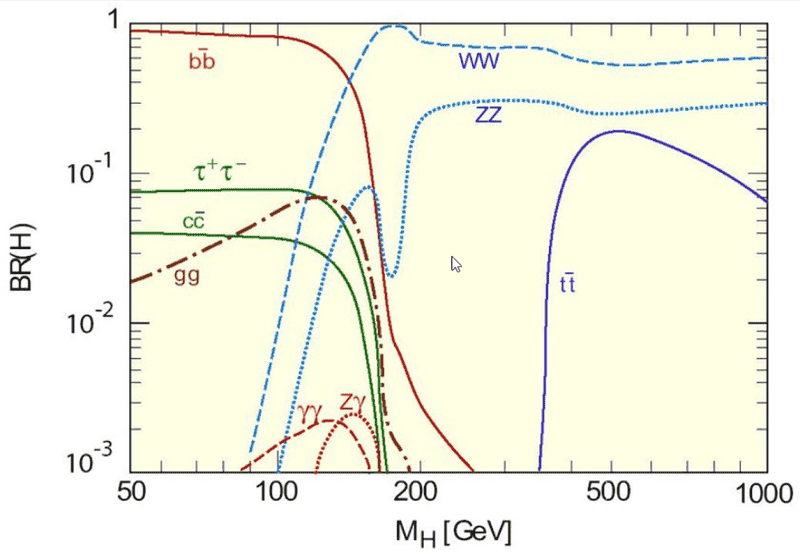
I am studying Higgs phenomenology, in particular its BRs
HiggsBR.png
HiggsBR.Data.png


My line of reasoning is this: I first had a look at the decays where the Higgs particle couples directly (i.e. without intermediate particles) to the products; those are ##H^0 \to b \bar b, \ H^0 \to \tau \bar \tau## and ##H^0 \to c \bar c \ ## (##H^0 \to t \bar t## is of course not allowed due to conservation of energy; the top quark is about ##t \approx 172 \ GeV## while ##H^0 \approx 125 \ GeV##). Given that the coupling constant is ##m/v##, where the vacuum expectation value is given by ##v \approx 246 \ GeV##, it makes sense to think that the more massive the particle is the stronger it couples to the Higgs particle. Indeed, for those three ratios that argument seems to hold. Do you think it is OK?

Here comes the fun.

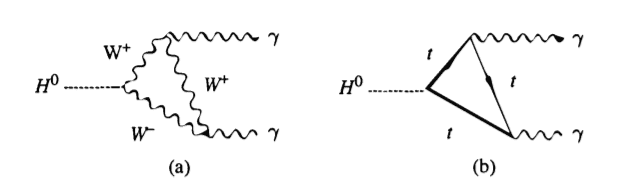
Once intermediate particles come into play I do not really understand why some channels have greater BRs than others. Next, let us look at the "massless" channels ##H^0 \to \gamma \gamma, \ H^0 \to gg##. I studied the golden channel ##H^0 \to \gamma \gamma## (Mandl & Shaw, page 446)
hiqddqhuhduishduqshduisqhhsd.png


OK so W boson and quarks (only the top quark couples significantly to ##H^0## though) are the intermediators.
I struggle to find information in the literature regarding the decay channel ##H^0 \to gg##. I looked up Higgs decay to gluon in Google Scholar and checked the first five but found no (modern i.e. not in terms of ) FD. One could guess and say "well, the gluon is massless as well so we could expect to have the exact same diagrams that for ##H^0 \to \gamma \gamma##" (this is actually the same guess a PF user made back in 2014). I do not think this is right, as the BRs differ quite significantly so I expect the associated FDs to differ as well. Hence

What are the FDs associated to ##H^0 \to gg## and why does its BR differ that significantly with ##H^0 \to \gamma \gamma## (despite both products being massless)?

Regarding FDs, I have the same issue with the channel ##H^0 \to Z \gamma##: I do not find them in the literature.

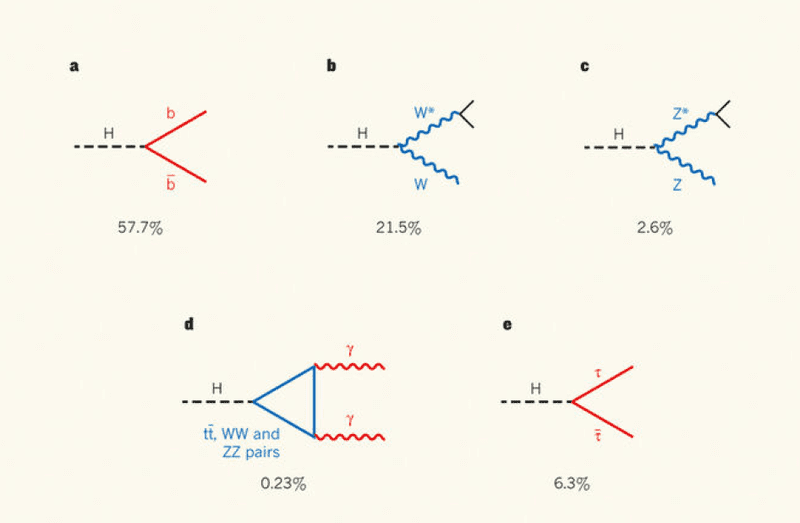
Finally, let me comment on the last two channels: ##H^0 \to W W^*## and ##H^0 \to Z Z^*##. I have studied they have essentially the same FD (b and c below)
jrifjizofjiueofhjiosqhyfsroipugfesûg.png


My argument to explain their difference in BRs is based on their coupling constants: we know that the Higgs particle couples to W and Z bosons as follows
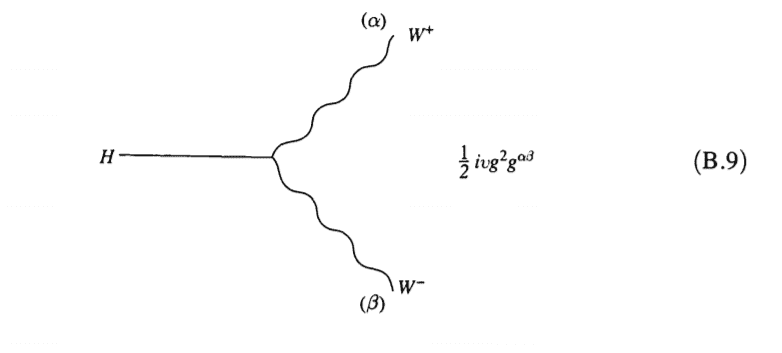
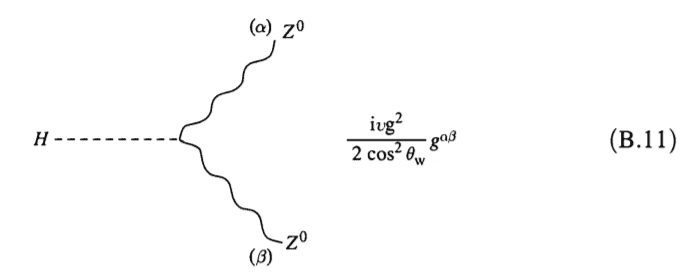
HWWCoupling.png
HZZCoupling.png

We also know that ##M_W^2 = \frac{g^2v^2}{4}## and ##M_Z^2 = \frac{g^2v^2}{4 \cos \theta_W}## so we deduce that the ##HWW## coupling goes as ##M^2_W/v## whereas the ##HZZ## coupling goes as ##M^2_Z/v##. Hence this reasoning leads to think that we should expect a greater BR for Z.

This is wrong and by far... How to explain their BR then?

Last comment: in the plot we observe a sudden minimum in ZZ... why?


I appreciate to discuss with you all

Thank you! :biggrin:
 
  • Like
Likes   Reactions: ohwilleke
Physics news on Phys.org
JD_PM said:
Summary:: I want to understand why some branching ratios (BRs) are greater than others and discuss some other features of the attached plot. Besides, I want to figure out the Feynman diagrams (FDs) I do not find in the literature.

I will bold the ideas I would like to discuss so that they are easier to identify.

I do not think this is right, as the BRs differ quite significantly so I expect the associated FDs to differ as well.
Even if the diagrams are similar, the gg amplitudes come with additional colour factors.
 
  • Like
Likes   Reactions: ohwilleke
Hi, these are interesting questions.

1) H to gg
-FD ?
Same with gg to H production. Gluon radiations through quark triangle.
-Why BR(H to gamma gamma) << BR(H to gg)?
There is another factor, the coupling constant.
You can compare alpha_s (~ 0.1) and alpha_em (~1/137) to understand difference between two BRs.

2) FD of H to Zgamma
It is same with H to gamma gamma. Replace one gamma to Z.

3) BR(H to WW) vs BR(H to ZZ*)
H to W-W+ channel has factor of two bigger BR compared to ZZ since W- and W+ are not identical particles.
(JHEP03(2018)110)

4) Sudden minimum of BR(H to ZZ*)
If mH < 2mW, there is suppression coming from virtuality of W* and Z*.
If 2mW < mH < 2mZ, H to WW channel gets enhancement from on-shell effect.
Because of this enhancement, BR(H to ZZ) shows sudden minimum.
After mH > 2mZ, BR(H to ZZ) and BR(H to WW) show almost flat values until mH = 2mtop.
 
  • Like
Likes   Reactions: ohwilleke, JD_PM and mfb
Orodruin said:
Even if the diagrams are similar, the gg amplitudes come with additional colour factors.

Thank you.

SBoh said:
Hi, these are interesting questions.

1) H to gg
-FD ?
Same with gg to H production. Gluon radiations through quark triangle.
-Why BR(H to gamma gamma) << BR(H to gg)?
There is another factor, the coupling constant.
You can compare alpha_s (~ 0.1) and alpha_em (~1/137) to understand difference between two BRs.

Oh, I see! At low energies, on expects to have a small EM fine structure constant ##\alpha \approx \frac{1}{137}## and a significant (so no perturbation techniques can be used) QCD constant.##g_s \approx 0.1##. I am just wondering why the latter value is not that well-known (I guess that the reason is due to not being really useful, as one cannot use perturbation theory?).

SBoh said:
3) BR(H to WW) vs BR(H to ZZ*)
H to W-W+ channel has factor of two bigger BR compared to ZZ since W- and W+ are not identical particles.
(JHEP03(2018)110)

Could you please elaborate on this? Or alternatively point me at the section of the paper in which one can understand why there is this difference in the BRs? (I have read the abstract and dived through it via the key word "decay" but I did not find the explanation). Besides I found the same question in PSE but the answer does not really help me to get the point ...

SBoh said:
4) Sudden minimum of BR(H to ZZ*)
If mH < 2mW, there is suppression coming from virtuality of W* and Z*.
If 2mW < mH < 2mZ, H to WW channel gets enhancement from on-shell effect.
Because of this enhancement, BR(H to ZZ) shows sudden minimum.
After mH > 2mZ, BR(H to ZZ) and BR(H to WW) show almost flat values until mH = 2mtop.

Thank you, I'll think more about this.
 
  • Like
Likes   Reactions: ohwilleke
It's more instructive to look at the partial widths instead of branching fractions. Branching fractions depend on all other decay modes, partial widths do not.
Using the WW bump as an example: There is nothing special happening to ZZ there. It's just the WW partial width becoming so much larger that it pushes down all other branching fractions - not just ZZ. ZZ would become "competitive" again at masses where the Higgs can decay to two on-shell Z.
 
  • Like
Likes   Reactions: JD_PM, vanhees71 and ohwilleke
Somewhat related question. I've seen statements that the diphoton branching fraction is maximized at about 125 GeV. Does anyone know if there's a source pinning down the Higgs mass that maximizes the diphoton branching fraction to greater precision than that (e.g. is it actually 125.23 GeV?)?
 
You could try to fit tables like this one. 125.6-125.7 as best fit.
 
  • Like
Likes   Reactions: dextercioby and ohwilleke
Before we get started, I think the hypothesis you have expressed elsewhere that there is some sort of significance to the Higgs to gamma gamma branching fraction being close to the maximum is about as likely to be correct as the idea that there is some sort of significance to the Higgs mass being the country code of Switzerland, where it was discovered, in Base 31. (Which is itself the country code for Holland, where some of the LHC magnets were made.)

Second, you need to consider errors and not just central values in @mfb's table. The maximum of the H→γγ branching fraction is 125 ± 5 GeV or so. So at 95% CL it could be anywhere between 115 and 135.
 
  • Like
Likes   Reactions: ohwilleke and mfb
The uncertainties in the individual rows should be highly correlated. Probably close to 100%.
 
  • Like
Likes   Reactions: ohwilleke
  • #10
The uncertainties in the columns are correlated, because it's the same calculation. The uncertainties in the rows are anticorrelated, because the branching fractions need to sum to 1.

My estimate comes from the bbar branching fraction which has some uncertainties depending on the b-quark mass and higher order corrections, which is a) large and b) changing with Higgs mass. Move it around and the point where gmma-gamma is maximal moves too. (Oppositely - shift bbar to the left and gamma gamma moves to the right)
 
Last edited:
  • Like
Likes   Reactions: ohwilleke
  • #11
Vanadium 50 said:
Before we get started, I think the hypothesis you have expressed elsewhere that there is some sort of significance to the Higgs to gamma gamma branching fraction being close to the maximum is about as likely to be correct as the idea that there is some sort of significance to the Higgs mass being the country code of Switzerland, where it was discovered, in Base 31. (Which is itself the country code for Holland, where some of the LHC magnets were made.)

Second, you need to consider errors and not just central values in @mfb's table. The maximum of the H→γγ branching fraction is 125 ± 5 GeV or so. So at 95% CL it could be anywhere between 115 and 135.
Could be (wasn't my idea in the first place, I've just rounded up a variety of non-mutually consistent ideas I'd seen other published works express).

But I'm nonetheless curious anyway, even if it is just a pure coincidence or trivial pursuit class data point.
 
  • #12
Vanadium 50 said:
The uncertainties in the columns are correlated, because it's the same calculation. The uncertainties in the rows are anticorrelated, because the branching fractions need to sum to 1.
I meant the individual rows within the diphoton column, i.e. what you call "in the columns".
ohwilleke said:
(wasn't my idea in the first place, I've just rounded up a variety of non-mutually consistent ideas I'd seen other published works express)
Who published the idea that the highest diphoton branching fraction would be relevant?
 
  • #13
  • #14
mfb said:
Who published the idea that the highest diphoton branching fraction would be relevant?

ohwilleke said:

Baloney.

First, don't bother reading the link. It's just an obfuscated version of the CMS discovery paper. All it says is that the BF reaches its maximum near 125 GeV, not that the numeralogical mumbo-jumbo posted here has anything to do with anything.
 
  • Like
Likes   Reactions: mfb

Similar threads

  • · Replies 13 ·
Replies
13
Views
5K
  • · Replies 11 ·
Replies
11
Views
3K
  • · Replies 2 ·
Replies
2
Views
2K
  • · Replies 1 ·
Replies
1
Views
2K
  • · Replies 1 ·
Replies
1
Views
1K
  • · Replies 17 ·
Replies
17
Views
6K
  • · Replies 2 ·
Replies
2
Views
2K
  • · Replies 1 ·
Replies
1
Views
2K
  • · Replies 2 ·
Replies
2
Views
2K
  • · Replies 4 ·
Replies
4
Views
2K