Breakdown voltage of capacitance network

Click For Summary
SUMMARY

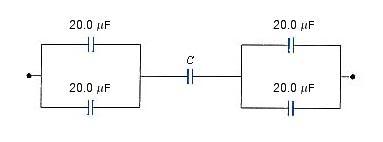
The breakdown voltage of a capacitor network consisting of a central capacitor (C = 11 µF) and two parallel capacitors (40 µF each) is determined to be 26.4 Volts. Each capacitor has a breakdown voltage of 17.0 Volts, and the total voltage is calculated by considering the charge distribution across the series configuration. The central capacitor experiences the largest potential drop, leading to its failure first. The charge on the capacitors is assumed to be equal due to their series connection, allowing for straightforward voltage calculations.

PREREQUISITES
  • Understanding of capacitor configurations (series and parallel)
  • Knowledge of breakdown voltage and its implications
  • Familiarity with capacitance calculations (Ceq, Q = CV)
  • Basic principles of electric charge and voltage distribution in circuits
NEXT STEPS
  • Study the principles of capacitor breakdown voltage and its effects on circuit design
  • Learn how to calculate equivalent capacitance in complex networks
  • Explore the impact of series and parallel capacitor arrangements on voltage and charge
  • Investigate real-world applications of capacitors in electronic circuits
USEFUL FOR

Electrical engineers, electronics students, and anyone involved in circuit design or analysis will benefit from this discussion, particularly those focusing on capacitor behavior and breakdown phenomena.

mitleid
Messages
56
Reaction score
1
Each capacitor in the combination shown in the figure below (C = 11mF) has a breakdown voltage of 17.0 V. What is the breakdown voltage of the combination?
HWc.jpg


On either side of C is an equivalent capacitance of 40 mF (since these are parallel). I'm not certain where to go with this problem since the concept of "breakdown voltage" isn't in my book and it wasn't presented to us during class, unless he just called it something different. Could anyone provide a brief explanation of what that term describes?
 
Physics news on Phys.org
The breakdown voltage is the voltage at which the charge leaks through the capacitor or dielectric, in which case it short circuits, i.e. it is no longer a capacitor.

True the parallel capacitors of 20 uF behave as a 40 uF capacitor.

So then one has 40 uF / 11 uF / 40 uF in series. Knowing that each capacitor has a breakdown voltage of 17V, find the total voltage for which any of the capacitors reach 17 V first.

The capacitor in series divide the total voltage.

http://www.interq.or.jp/japan/se-inoue/e_capa.htm

http://www.tf.uni-kiel.de/matwis/amat/elmat_en/kap_3/backbone/r3_5_1.html
 
Last edited by a moderator:
I see what's going on, but I'm not quite sure how to set it all up.

I know that 1/C(eq) = 2(1/40) + 1/11 = 7.10 uF

I also understand the larger potential drop will occur in the center where there is the smallest capacitance - so the breakdown will happen there first. I need to figure out how much total voltage is needed in the system for C1 to reach 17 Volts. So I'm only working with Vs and Cs, no charge... trying to fill in the holes. hmm.

Let me think about this.
 
Oh! I will assume the charge based on the aforementioned knowledge, so that Q1 = 17 V * 11 uF. From there I can eventually solve for the total voltage of the system, correct?

Let's try it out.
 
Ahh - since this can be treated as this is a series of 40 uF 11 uF 40 uF, each capacitor will maintain the same charge with a different voltage. So the charge Q1 = 187 uC = Q = Q2 as well.

Hope this is a correct assumption. We'll see!

Perfect! Thank you very much. Calculating Ceq isn't necessary then. Once you know the center capacitor will fail first @ a voltage of 17 V, you find it's charge, assume the same charge at the other capacitors and solve for their voltage. Add each voltage together to get something like 4.675 + 4.675 + 17 = 26.4 Volts.
 
And, of course, you only assume the same charge at each node since they are in series with one another. Otherwise charge is based on the 'local' capacitance.
 

Similar threads

  • · Replies 7 ·
Replies
7
Views
2K
  • · Replies 3 ·
Replies
3
Views
1K
Replies
1
Views
2K
Replies
2
Views
2K
  • · Replies 7 ·
Replies
7
Views
2K
  • · Replies 4 ·
Replies
4
Views
6K
Replies
16
Views
4K
  • · Replies 3 ·
Replies
3
Views
3K
  • · Replies 5 ·
Replies
5
Views
4K
  • · Replies 1 ·
Replies
1
Views
2K