Building a logic circuit from a truth table

Click For Summary

Discussion Overview

The discussion revolves around building a logic circuit based on a truth table, focusing on the use of AND, OR, and NOT gates, as well as the application of Karnaugh Maps for simplification. Participants are engaged in a homework-related inquiry regarding the construction of the circuit and the interpretation of the truth table.

Discussion Character

  • Homework-related
  • Technical explanation
  • Exploratory

Main Points Raised

  • One participant expresses confusion about the answer key using 4 AND gates for a circuit with 3 inputs and 1 output, questioning the relationship between the number of gates and the truth table.
  • Another participant suggests drawing a Karnaugh Map to aid in understanding the truth table.
  • A participant acknowledges not having attempted the Karnaugh Map due to it being taught later and commits to trying it now.
  • Clarifications are made regarding the number of inputs in the truth table, with one participant correcting the initial claim of 8 inputs to 3 inputs (A, B, C) and 1 output (F).
  • One participant proposes that the first step should be to reduce the truth table using theorems or a Karnaugh Map, sharing their attempt at organizing the truth table data.
  • Another participant notes that there appear to be no simplifications in the truth table, leading to the conclusion that 4 separate minterms must be ORed together to produce the output.
  • A participant mentions that if allowed to use any gates, a pair of 2-input exclusive-ORs could simplify the circuit, presenting a potential alternative approach.
  • One participant shares a LaTeX formatted version of the Karnaugh Map for clarity.

Areas of Agreement / Disagreement

Participants express varying levels of understanding and approaches to the problem, with some agreeing on the need for simplification through Karnaugh Maps while others highlight confusion regarding the number of inputs and outputs. The discussion remains unresolved regarding the optimal circuit design and the interpretation of the truth table.

Contextual Notes

There are limitations in the clarity of the truth table formatting, and some assumptions about the knowledge of Karnaugh Maps and logic gates may not be shared among all participants.

MarcL
Messages
170
Reaction score
2
P.S I know I am not supposed to use attachment but there are no way for me to input the table in a clean way... same for the logic circuit drawing. Would anyone mind helping me?

1. Homework Statement
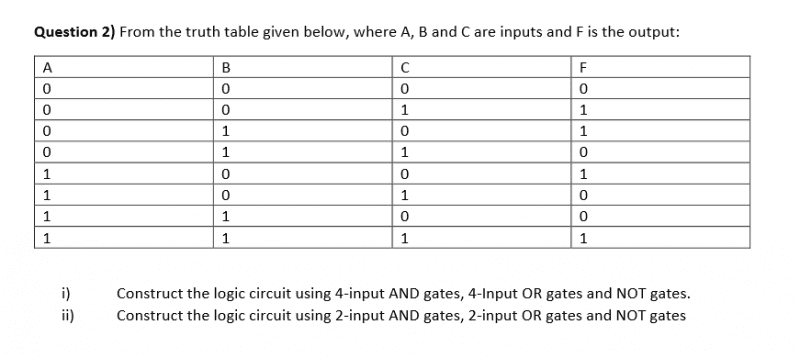

upload_2015-2-10_19-19-20.png

Homework Equations


AND gates require both input to be True to get a true ouput
NOT gates are just the opposite of what you input in them ( 1 -- > 0 and 0 --> 1)
OR gates require at least one input to be true to create a true output

The Attempt at a Solution

I can't seem to understand why the answer key uses 4 AND gates with 3 output. Like the one below :

upload_2015-2-10_19-21-48.png


It just seems very... weird that there are only 4 a inputs where as in the truth table there are 8 inputs in the truth table. Anybody can help me understand that?
 
Physics news on Phys.org
Have you drawn a Karnaugh Map for that truth table? Can you share it with us? :-)
 
Oh, well I know how, I just didn't try because this was a set of problems before it was taught, but I'll do that right now. ^^
 
MarcL said:
It just seems very... weird that there are only 4 a inputs where as in the truth table there are 8 inputs in the truth table.
There are four inputs in the truth table -- A, B, C, and F -- not eight.

Edit: Make that three inputs -- A, B, and C --and one output -- F.
 
Last edited:
So I'm guessing the first thing to do is reduce the truth table either using theorems or karnaugh map right? ( hence why you asked)... If so then I got the following

FAB 00 01 11 10
C
0 0 1 0 1
1 1 0 1 0
and then I group together if I remember correctly and that allows me to cancel the input that "changes" if the input is the same ( I don't know if I'm clear? :/). But none of them are similar.

Edit: Sorry I didn't express myself right... I meant 8 possibilities out of 3 inputs ( 2^3)
Edit2: Can't seem to format this table right ughhhh
 
MarcL said:
Edit2: Can't seem to format this table right ughhhh

Try using the "code" tags to preserve spaces for formatting. Like this:

Code:
A B C D
0 1 0 1
 
Code:
  AB      00  01  11  10
C
0          0   1   0   1
1          1   0   1   0

Thanks!
 
Wow, doesn't look like there are any simplifications. That's why there are 4 separate minterms that you OR together to get the output.
 
@MarcL Has your question now been answered?

As an aside, if you were allowed to use any gates of your choosing, you'd just need a pair of 2-input exclusive-ORs.

F = A ⊕ (B⊕C)
 
  • #10
NascentOxygen said:
F = A ⊕ (B⊕C)

Nice! Too bad he can't use XORs. I'll remember that trick! :-)
 
  • #11
MarcL said:
Edit2: Can't seem to format this table right ughhhh

You can do nice K map tables in Latex:$$
\begin{array}{|c|c|c|c|c|}
\hline C|AB & 00 & 01 & 11 & 10\\
\hline 0&0&1&0&1\\
\hline 1 & 1 & 0 & 1 & 0\\
\hline
\end{array}$$
 
Last edited:
  • Like
Likes   Reactions: berkeman

Similar threads

  • · Replies 20 ·
Replies
20
Views
3K
  • · Replies 4 ·
Replies
4
Views
5K
  • · Replies 10 ·
Replies
10
Views
5K
  • · Replies 14 ·
Replies
14
Views
5K
  • · Replies 1 ·
Replies
1
Views
2K
Replies
5
Views
3K
  • · Replies 1 ·
Replies
1
Views
2K
Replies
5
Views
4K
  • · Replies 2 ·
Replies
2
Views
5K