C2-solutions to a diff.equation.

  • Context: Graduate 
  • Thread starter Thread starter Hatmpatn
  • Start date Start date
Click For Summary
SUMMARY

The discussion focuses on calculating all C2-solutions z(x,y) to a specific differential equation using the substitution u=xy and v=x. Participants emphasize the importance of expressing the differential operators ∂/∂x and ∂/∂y in terms of u and v, and subsequently deriving the second-order operators. By substituting these expressions back into the original partial differential equation (PDE), users can simplify the equation significantly, leading to the cancellation of most terms.

PREREQUISITES
  • Understanding of partial differential equations (PDEs)
  • Familiarity with differential operators
  • Knowledge of variable substitution techniques in calculus
  • Experience with C2 continuity in functions
NEXT STEPS
  • Study the derivation of differential operators in terms of new variables
  • Explore techniques for solving partial differential equations
  • Learn about C2 continuity and its implications in differential equations
  • Investigate examples of variable substitution in PDEs
USEFUL FOR

Mathematicians, physics students, and engineers working with differential equations, particularly those interested in advanced calculus and variable transformation techniques.

Hatmpatn
Messages
6
Reaction score
0
I have the following problem:
----------------------
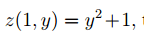
Calculate all the C2-solutions z(x,y) to the differential equation:

gRP2fyi.png


with the following constraint:
dQaYDIt.png

by making the substitution u=xy, v=x


------------------------

Solution
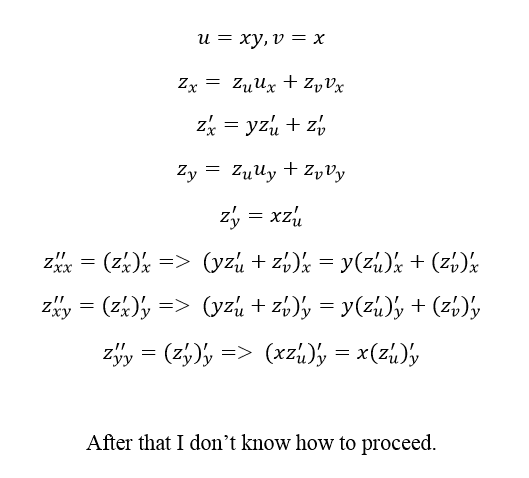
I've begun slightly but this doesn't take me far..
tLErcPB.png
 
Physics news on Phys.org
Start by working out what the differential operators [itex]\frac{\partial}{\partial x}[/itex] and [itex]\frac{\partial}{\partial y}[/itex] are in terms of [itex]u[/itex], [itex]v[/itex] and the differential operators [itex]\frac{\partial}{\partial u}[/itex] and [itex]\frac{\partial}{\partial v}[/itex]. From these you can find expressions for the second-order operators.

Now substitute these expressions into the original PDE, and tidy up the result. You should find that most of the terms cancel.
 

Similar threads

  • · Replies 3 ·
Replies
3
Views
2K
  • · Replies 5 ·
Replies
5
Views
2K
  • · Replies 2 ·
Replies
2
Views
2K
  • · Replies 27 ·
Replies
27
Views
4K
  • · Replies 2 ·
Replies
2
Views
4K
  • · Replies 3 ·
Replies
3
Views
7K
Replies
0
Views
2K
  • · Replies 52 ·
2
Replies
52
Views
9K
  • · Replies 2 ·
Replies
2
Views
3K
  • · Replies 5 ·
Replies
5
Views
4K