Calc 3, area of an ellipsoid slice

Click For Summary
SUMMARY

The discussion centers on calculating the area of an elliptical slice of an ellipsoid defined by the equation \(\frac{x^{2}}{a^{2}} + \frac{y^{2}}{b^{2}} + \frac{z^{2}}{c^{2}} = d\). The specific case involves finding the area when the plane \(z = c\) intersects the ellipsoid. Participants clarify that the equation \(x^{2} + \frac{y^{2}}{4} = 0\) does not represent an ellipse, and the correct approach involves substituting \(c\) into the ellipsoid equation to derive the standard form of the ellipse, ultimately leading to the area formula \(\frac{2\pi(9 - c^{2})}{9}\).

PREREQUISITES
  • Understanding of ellipsoids and their equations
  • Knowledge of elliptical geometry and area calculations
  • Familiarity with integral calculus concepts
  • Ability to manipulate algebraic equations
NEXT STEPS
  • Study the derivation of the area formula for ellipses
  • Learn about the properties of ellipsoids and their cross-sections
  • Explore the use of substitution in solving geometric problems
  • Review integral calculus applications in geometry
USEFUL FOR

Students studying calculus, geometry enthusiasts, educators teaching ellipsoids and their properties, and anyone interested in advanced mathematical problem-solving techniques.

Allenman
Messages
58
Reaction score
0
This isn't homework or anything, I just want to understand the question better.
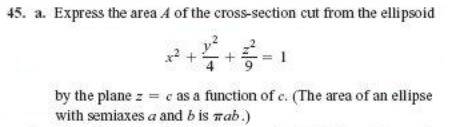
Homework Statement


calcproblem.jpg


The Attempt at a Solution


I'm honestly not sure where to go with this. Is this an integral problem? As I understand it I'm finding the area of a slice, not a volume of the whole ellipsoid.

so z = c which = 3...
the problem then becomes:
x^{2} + \frac{y^{2}}{4} = 0

Does the last description mean that the answer is A= (\pi)(1)(2) ?
It doesn't seem like it should be that simple. lol
 
Physics news on Phys.org
Allenman said:
This isn't homework or anything, I just want to understand the question better.

Homework Statement


calcproblem.jpg


The Attempt at a Solution


I'm honestly not sure where to go with this. Is this an integral problem? As I understand it I'm finding the area of a slice, not a volume of the whole ellipsoid.

so z = c which = 3...
the problem then becomes:
x^{2} + \frac{y^{2}}{4} = 0

Does the last description mean that the answer is A= (\pi)(1)(2) ?
It doesn't seem like it should be that simple. lol
No, because x2 + y2/4 = 0 is not the equation of an ellipse.

Notice that there aren't many points that satisfy this equation.

Have you drawn a sketch of the ellipsoid? A sketch would help illuminate what's going on here.
 
No, it's not an integral problem.

The only real solution for \displaystyle x^2+\frac{y^2}{4}=0 is x = ? = y .

Set z = c , then solve for \displaystyle x^2+\frac{y^2}{4}\,, then divide both sides by the right hand side.
 
Where does it say that the plane is z = 3?
 
calcprobgraph.jpg


But isn't 9 supposed to be c^{2}?

so really I have:
x^{2} + \frac{y^{2}}{4} + \frac{c^{2}}{c^{2}} = 1
which just leads me back to the previous equation where the only x and y values would be zero.
or am I just making a false assumption?

am I supposed to be doing this?
\frac{c^{2}}{9} = 1 - x^{2} - \frac{y^{2}}{4}

c = \sqrt{\frac{1 - x^{2} - \frac{y^{2}}{4}}{9}}

I don't know where i would go from there.The equation my instructor gave us for a ellipsoid is:
\frac{x^{2}}{a^{2}} + \frac{y^{2}}{b^{2}} + \frac{z^{2}}{c^{2}} = d
That's where I got c=3
 
I'm not sure, but I don't think that c as used in this problem is related to the c in your ellipsoid equation. I believe they are using in the equation z = c to mean a plane that is parallel to the x-y plane, that's all.
 
I think you're right Mark. I feel kind of silly for making that assumption. lol.

The book says the answer is:

\frac{2\pi(9 - c^{2})}{9}

I honestly don't see how it got that answer.

Thanks for all the help so far!
 
You're looking for the area of the elliptical cross-section that is cut by the plane z = c.

Follow the directions that SammyS gave back in post #3, substituting c for z in the equation to get

x2 + y2/4 = <something with c in it>

Now divide both sides by what you have on the right side to get this equation into the standard form for an ellipse. You will then be able to pick out a and b, which you can use in your area formula for an ellipse.
 

Similar threads

Replies
4
Views
3K
Replies
4
Views
2K
Replies
8
Views
3K
  • · Replies 6 ·
Replies
6
Views
2K
  • · Replies 9 ·
Replies
9
Views
2K
  • · Replies 1 ·
Replies
1
Views
2K
  • · Replies 2 ·
Replies
2
Views
2K
  • · Replies 3 ·
Replies
3
Views
15K
Replies
9
Views
10K
  • · Replies 1 ·
Replies
1
Views
5K