Calculate cutting force (guillotine) GFRP

Click For Summary

Discussion Overview

The discussion revolves around calculating the cutting force required to sever wind turbine blades made of glass fiber reinforced polymer (GFRP) for transport purposes. Participants explore various cutting methods, particularly the use of a guillotine, and the specific material properties needed for accurate calculations.

Discussion Character

  • Exploratory
  • Debate/contested
  • Technical explanation

Main Points Raised

  • One participant suggests that a guillotine is the best option for cutting the blades, citing various reasons, but acknowledges uncertainty about the cutting force calculation.
  • Another participant expresses skepticism about the guillotine's effectiveness, proposing that a band saw or abrasive string saw might be gentler on the material.
  • Concerns are raised about the potential for crushing the material with a guillotine, and the need for the cutter to match the blade's shape to avoid deflection and crushing.
  • Some participants mention the importance of knowing the interlaminar shear strength of the GFRP material to calculate the necessary cutting force.
  • There is a discussion about the feasibility of cutting the blades into multiple pieces for easier transport, with some suggesting that designing the blades in sections from the start could be more efficient.
  • Participants highlight the complexities involved in cutting the blades due to their varying shapes and the necessity for high-speed cutting methods.
  • Environmental concerns regarding the use of saws or abrasive tools are noted, with a preference for methods that minimize micro-damage.

Areas of Agreement / Disagreement

Participants do not reach a consensus on the best cutting method or the feasibility of using a guillotine. Multiple competing views on cutting techniques and the design of the blades remain unresolved.

Contextual Notes

Participants note the challenges posed by the shape of the turbine blades and the specific material properties of GFRP, which may affect the choice of cutting method. There are also concerns about the costs and reliability of the proposed cutting techniques.

Dirk
Messages
4
Reaction score
0
Hey all,

I want to calculate the force which is needed to cut the blades of a wind turbine in half(for transport reasons). I presume guillotine is the best option due to various reasons. But I don’t know how to calculate the cutting force which is needed for this unique structure and material. The blades material is mostly GFRP (glass fibre reinforced polymer). The width (cutting length) is around 3 meters(variable), the thickness is 20mm(variable).

Below a picture of the structure
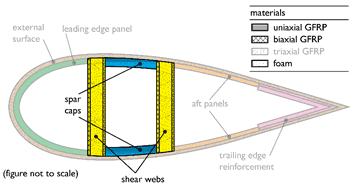
upload_2017-3-6_9-36-19.png


EDIT: actually I am a bit further in my research and i come to the conclusion that I need to know the interlaminear shear strength value of the material used in windturbine blades. Using this value I can calculate the force needed to cut the material I think. So how do I find this value??

If more information is needed, feel free to ask!

Thanks in advance.
 

Attachments

  • upload_2017-3-6_9-36-8.png
    upload_2017-3-6_9-36-8.png
    9.6 KB · Views: 753
Last edited:
Engineering news on Phys.org
Dirk said:
I presume guillotine is the best option due to various reasons

I'm surprised by that. I would expect a guillotine to crush things. My guess is that a band saw or even a saw made with an abrasive string would be more gentle on the blade.

https://www.amazon.com/dp/B0034G67RW/?tag=pfamazon01-20
 
Last edited by a moderator:
anorlunda said:
I'm surprised by that. I would expect a guillotine to crush things. My guess is that a band saw or even a saw made with an abrasive string would be more gentle on the blade.

https://www.amazon.com/dp/B0034G67RW/?tag=pfamazon01-20

Thanks for your reply,

I understand your concerns. But the machine has to work in environments of farmers. By using saws or waterjet cutting machines, the environmental (micro)damage is much more then if we would use a guillotine cutting machine. An alligator shear also seams like a good option.

Although all options are left open, our idea is that a guillotine would be the safest, fastest and best solution in this particular case.

I know at first the machine will crush the material, but that's no problem as the cut doesn't have to look nice.

(sorry for bad english)
 
Last edited by a moderator:
Dirk said:
Hey all,

I want to calculate the force which is needed to cut the blades of a wind turbine in half(for transport reasons). I presume guillotine is the best option due to various reasons. But I don’t know how to calculate the cutting force which is needed for this unique structure and material. The blades material is mostly GFRP (glass fibre reinforced polymer). The width (cutting length) is around 3 meters(variable), the thickness is 20mm(variable).

Below a picture of the structure
View attachment 114156

EDIT: actually I am a bit further in my research and i come to the conclusion that I need to know the interlaminear shear strength value of the material used in windturbine blades. Using this value I can calculate the force needed to cut the material I think. So how do I find this value??

If more information is needed, feel free to ask!

Thanks in advance.

By interlaminear are you referring to the core structure? If that's it look up the material properties. It's hard to imagine whatever the blades are made of there isn't a material data sheet for the material.

The problem you have is with the shape. The cutter would have to match the shape of the fan blade and the cutter speed would have to fast enough to defeat the ability of the material to deflect and crush. BUT, the cutter shape may promote deflection and crush on the bottom side of the blade. If that's true a compound cutter would be required. I've never seen a compound cutting die not be fussy to get to work as planned.

Why wouldn't you use a bandsaw? It also matters what fiberglass the blades are made of. G10 for example is very hard and abrasive. Whatever is used to cut it is not going to be inexpensive.

Another thought, if you are going to cut these why make them in 1 piece? Why not 2 pieces built with hard points to begin with? It would make them much easier to reassemble and more then likely stronger.
 
Work Hard Play Hard said:
By interlaminear are you referring to the core structure? If that's it look up the material properties. It's hard to imagine whatever the blades are made of there isn't a material data sheet for the material.

The problem you have is with the shape. The cutter would have to match the shape of the fan blade and the cutter speed would have to fast enough to defeat the ability of the material to deflect and crush. BUT, the cutter shape may promote deflection and crush on the bottom side of the blade. If that's true a compound cutter would be required. I've never seen a compound cutting die not be fussy to get to work as planned.

Why wouldn't you use a bandsaw? It also matters what fiberglass the blades are made of. G10 for example is very hard and abrasive. Whatever is used to cut it is not going to be inexpensive.

Another thought, if you are going to cut these why make them in 1 piece? Why not 2 pieces built with hard points to begin with? It would make them much easier to reassemble and more then likely stronger.

The shape of a turbine blade is different at each place of the blade. The blades will be cut in 5 or 6 pieces when the blades reach their end-of-life time. They will be cut to ensure cheaper transport. For environmental reasons its not recommended to use saws or abrasive tools.
 
Dirk said:
The shape of a turbine blade is different at each place of the blade. The blades will be cut in 5 or 6 pieces when the blades reach their end-of-life time. They will be cut to ensure cheaper transport. For environmental reasons its not recommended to use saws or abrasive tools.

Dirk,
I think you've missed the most important points of my post. I doubt you will be able to get a shear to reliably cut your blades. A metal shear is the closet cutting machine to a guillotine I can think of. Without any consideration to the materials used it's the shape of the blade that dictates the cutter needed. The same cutter will have to cleanly cut a convex surface on the top surface and then end with a concave surface on the bottom side of the cut. A really high speed press will also be required to run each die needed for every shape of the blade at the cut point.

With the number of difficulties you are facing--not forgetting the costs involved-- can you explain why the blades need to be in one piece and then cut? Why aren't you considering making the blades in the 5 or 6 pieces? If that is the way are made then whatever method you are considering to use to reassemble the blades can be made integral to the blade. You'd be hard pressed to show any way of reassembling the blades with a method introduced after they are cut that would have the strength or reliability of integral hard points.

I can also imagine a number of different methods of dealing with any environmental issues a saw might create that would be much more cost effective then the shear cutting method you seem attached to. Will laser or water jet cutting work with your blades? But this still comes back to how are you putting the blades back together? I sorry to say but with what the information you have provided I see an accident waiting to happen with weak blades or with balancing the blades on the generator. Reassembly shouldn't be an after thought when it may well be your biggest issue.
 
Work Hard Play Hard said:
Dirk,
I think you've missed the most important points of my post. I doubt you will be able to get a shear to reliably cut your blades. A metal shear is the closet cutting machine to a guillotine I can think of. Without any consideration to the materials used it's the shape of the blade that dictates the cutter needed. The same cutter will have to cleanly cut a convex surface on the top surface and then end with a concave surface on the bottom side of the cut. A really high speed press will also be required to run each die needed for every shape of the blade at the cut point.

With the number of difficulties you are facing--not forgetting the costs involved-- can you explain why the blades need to be in one piece and then cut? Why aren't you considering making the blades in the 5 or 6 pieces? If that is the way are made then whatever method you are considering to use to reassemble the blades can be made integral to the blade. You'd be hard pressed to show any way of reassembling the blades with a method introduced after they are cut that would have the strength or reliability of integral hard points.

I can also imagine a number of different methods of dealing with any environmental issues a saw might create that would be much more cost effective then the shear cutting method you seem attached to. Will laser or water jet cutting work with your blades? But this still comes back to how are you putting the blades back together? I sorry to say but with what the information you have provided I see an accident waiting to happen with weak blades or with balancing the blades on the generator. Reassembly shouldn't be an after thought when it may well be your biggest issue.
Thanks for your reply,

When a windmill reaches its end of life and needs to be demolished, we don't want to transport the blades anymore using exceptional transport because of cost reasons (they will not be re-used anyway). The blades should be cut in pieces of around 5 meters so they will fit in a regular 20ft container. After this process a company specialized in recycling composites will take over.

So the blades don't need to be reassembled. Also the cut of the shear doesn't have to be a ''nice looking'' cut. I am thinking about an alligator shear, but all suggestions are welcome.
 
That makes a world of difference. Why didn't you mention disposal? A metal shear will work or your gator action. Bear in mind you will be crush cutting fiberglass which can be messy. Would it be possible to heat the blades to soften and fold them? Again, a materials used issue.
 
images?q=tbn:ANd9GcS4AQnAqS43cds4obnTH-DSJ2UR0dr_4AooZeHK1U_U2AScAUFnrA.jpg


These things are simple, cheap, inexpensive and quite capable of cutting those blades.
 

Similar threads

  • · Replies 8 ·
Replies
8
Views
6K
  • · Replies 2 ·
Replies
2
Views
4K
Replies
17
Views
15K
  • · Replies 6 ·
Replies
6
Views
3K
  • · Replies 2 ·
Replies
2
Views
2K
  • · Replies 1 ·
Replies
1
Views
3K
  • · Replies 1 ·
Replies
1
Views
3K
  • · Replies 21 ·
Replies
21
Views
4K
  • · Replies 5 ·
Replies
5
Views
2K
  • · Replies 1 ·
Replies
1
Views
3K