Calculate Max Resistance for 2 Parallel Wires

Join the discussion
Registration is free. Ask a follow-up in this thread, or start your own.
7 replies · 2K views
Lambda96
Messages
233
Reaction score
77
Homework Statement
How must the lengths ##L_1## and ##L2## be distributed so that the resistance between the points ##X## and ##Y## becomes maximum
Relevant Equations
none
Hi,

I am not sure if I have calculated the task here correctly:
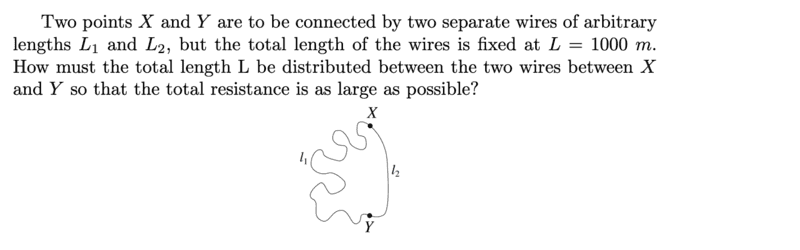
Bildschirmfoto 2023-05-11 um 20.47.35.png

Based on the drawing, I now assumed that the two resistors are connected in parallel. The total resistance can then be calculated as follows ##\frac{1}{R_T}=\frac{1}{R_1}+\frac{1}{R_2}##.

Since the two wires are made of the same material, I only considered their length in the calculation. Then I specified the following ##L_1=x## and ##L_2=1000-x## and substituted into the equation above ##\frac{1}{x}+\frac{1}{1000-x}##

Since the resistance is supposed to be maximum, I calculated the derivative of the above expression and then set it to zero.

$$\frac{1}{(1000-x)^2}-\frac{1}{x^2}=0$$

After that, I simply solved the equation for x and got for ##x=500m## which gives me the following for the lengths ##L_1=500m## and ##L_2=500m##.
 
Physics news on Phys.org
Lambda96 said:
Then I specified the following ##L_1=x## and ##L_2=1000-x## and substituted into the equation above ##\frac{1}{x}+\frac{1}{1000-x}##
I think you have treated the above expression as the total resistance. But it is not - it is the inverse of the total resistance.

Also, a good way of checking answers (when practical) is to compare the answer against extreme cases. E.g. what resistance would you expect if ##L_1=L_2##? What resistance would you expect if ##L_1= 1000m## and ##L_2=0##?
 
Reply
  • Like
Likes   Reactions: Lambda96
Steve4Physics said:
I think you have treated the above expression as the total resistance. But it is not - it is the inverse of the total resistance.
Of course, since ##f(x) = \frac{1}{x}## is strictly monotone decreasing (barring the boundary where ##x = 0##), searching for an extremum on ##\frac{1}{x}## is largely equivalent to searching for an extremum on ##x##.
 
Reply
  • Like
Likes   Reactions: Lambda96
jbriggs444 said:
Of course, since ##f(x) = \frac{1}{x}## is strictly monotone decreasing (barring the boundary where ##x = 0##), searching for an extremum on ##\frac{1}{x}## is largely equivalent to searching for an extremum on ##x##.
Yes. Finding the extremum of ##\frac 1{R_T}## (which is a minmum here) is equivalent to finding the maximum of ##R_T##.

But it's not clear (to me anyway) if that's what the OP has intentionally done!
 
Reply
  • Like
Likes   Reactions: Lambda96 and erobz
Isn't it easier to find an expression for the equivalent resistance and just look at it?
$$\frac{1}{R_{eq}}=\kappa\left(\frac{1}{L-x}+\frac{1}{x}\right)=\frac{\kappa~L}{x(L-x)}\implies R_{eq}=\frac{1}{\kappa}x(L-x).$$ This is equivalent to the problem of having a string of length ##L## and being asked to find the rectangle of perimeter ##L## that has maximum area. The answer is a rectangle of equal sides because for every rectangle of base ##b## and height ##h## there is another rectangle of base ##h## and height ##b## that has equal area. Thus, any ##b\neq h## is not unique and cannot be an extremum. Only ##b=h## gives a unique area and hence an extremum. It is a maximum because when either one of the sides goes to zero, the area goes to zero.
 
Last edited:
Reply
  • Like
Likes   Reactions: Lambda96 and nasu
Thank you vela, Steve4Physics, jbriggs444 and kuruman, for your help and for checking my calculation👍👍👍👍
 
Reply
  • Like
Likes   Reactions: berkeman