Calculate Meeting Time for Equilateral Triangle Turtles | Classic Problem Solved

  • Context: Undergrad 
  • Thread starter Thread starter jpas
  • Start date Start date
Click For Summary

Discussion Overview

The discussion revolves around calculating the time it takes for three turtles, each positioned at the vertices of an equilateral triangle, to meet as they move towards each other. The problem involves concepts of relative motion and geometric relationships within the triangle, with participants exploring different approaches and calculations.

Discussion Character

  • Exploratory
  • Technical explanation
  • Debate/contested
  • Mathematical reasoning

Main Points Raised

  • One participant proposes a method using relative velocity to calculate the time, suggesting that the turtles meet in time \( t = \frac{L}{3V} \).
  • Another participant challenges this approach, stating that the distance between the turtles decreases as \( d = L - vt \) and concludes that they meet when \( L - vt = 0 \).
  • A different participant claims the correct time for the turtles to meet is \( \frac{2L}{3V} \), indicating it is longer than the first calculation.
  • One participant suggests using radial coordinates for a clearer solution, stating that the radial distance from the apex to the center is \( R = \frac{L}{\sqrt{3}} \) and derives a time of \( t = \frac{2L}{3v} \).
  • Another participant seeks clarification on the calculation of the radial step \( dr \) and its relationship to the turtle's movement, discussing the geometry of the situation and the angles involved.
  • Further explanation is provided regarding the relationship between the turtle's movement and the radial distance, using geometric principles to derive the projection of movement in the radial direction.

Areas of Agreement / Disagreement

Participants express differing views on the correct time for the turtles to meet, with no consensus reached. Multiple competing models and calculations are presented, indicating ongoing debate and exploration of the problem.

Contextual Notes

Some calculations depend on specific geometric assumptions and the interpretation of relative motion, which may not be universally agreed upon. The discussion includes various mathematical steps that remain unresolved or contested.

jpas
Messages
45
Reaction score
0
This is supost to be a classic. I solved it but my answer isn´t right and I can´t find out why. Hope you guys can help.

Imagine an equilateral triangle with one turtle on each side of lenth L. All turtles move with velocity V. Turtle 1 always directs its motion to turtle 2, turtle 2 to turtle 3, and turtle 3 to turtle 1, again. Calculate the time the turtles take to meet.


The movement will be something like this.
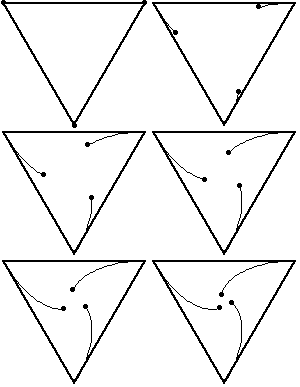
mice3.gif


Relative to turtle 2, turtle 1 will be in uniform rectilinear motion and its velocity will be:

\vec V_{12}=\vec v_1 - \vec v_2

\vec v_1 and \vec -v_2 make an angle of 60º degrees. So,

V_{12}= \frac{V}{\sqrt{3}}

Relative to turtle 2, turtle 1 will only travel the distance that separates it from the center of the triangle, which is \frac{L}{3}

So, t= \frac{v_{12}}{d} = \frac{L}{3V}

P.S.: I guess some of you might have already solved this problem. If not, I recommend it, though I got it wrong.
 
Last edited by a moderator:
Physics news on Phys.org
You have an equilateral triangle with side length L. The velocity of each turtle is v. The triangle defined by the 3 points (turtles) is always at any time t an equilateral triangle. Because the distance d between the turtles (the side of the equilateral triangle) at time t is

d=L-vt,

the turtles meet when

L-vt = 0

Bob S
 
Thanks for the answer.

Because the distance d between the turtles (the side of the equilateral triangle) at time t is

d=L-vt,

This isn´t true. How did you arrive to this equation?

The real time the turtles take is \frac{2L}{3V} , 1.5 times what you got.

Does anyone have other sugestions? I advise you, if you´ve got nothing to do, this is a fun problem!
 
You are correct. The easiest way to get the solution is to use radial coordinates. The direct distance from the apex to the center is (from plane geometry)

R = L/√3

For a radial step dr, the turtle must always travel a distance 2·v·dt/√3

So to travel a radial distance R=L/√3,

v·t = (L/√3)(2/√3) = 2L/3

t=2L/3v

Bob S
 
Hi Bob, thanks for the reply.

R = L/√3

Right. On my orginal post I had a typo. I meant this.


For a radial step dr, the turtle must always travel a distance 2·v·dt/√3

Can you explain this step? What is dr and how did you calculate it?
 
For a radial step dr, the turtle must always travel a distance 2·v·dt/√3.
jpas said:
Can you explain this step? What is dr and how did you calculate it?
A turtle step dx = v·dt is always at a 30-degree angle to the radial direction dr from the apex of the equilateral triangle (between the 3 turtles) to the center, because the radial direction always bisects the 60-degree angle of the equilateral triangle (even as the turtles move and the equilateral triangle rotates), and the instantaneous direction of v·dt is always parallel to one of the sides of the equilateral triangle. Using plane geometry, the longer side of a 30-60-90 degree triangle is equal to √3/2 times the hypotenuse. The turtle step v·dt is along the hypotenuse and the radial step projection dr is along the longer side.

So a radial step dr = (√3)·v·dt/2

Bob S
 

Similar threads

  • · Replies 2 ·
Replies
2
Views
2K
  • · Replies 7 ·
Replies
7
Views
2K
  • · Replies 2 ·
Replies
2
Views
1K
  • · Replies 11 ·
Replies
11
Views
2K
  • · Replies 30 ·
2
Replies
30
Views
2K
  • · Replies 4 ·
Replies
4
Views
1K
  • · Replies 3 ·
Replies
3
Views
2K
  • · Replies 11 ·
Replies
11
Views
3K
Replies
4
Views
2K
  • · Replies 3 ·
Replies
3
Views
2K