Calculate the distance travelled in a moving circumference?

Click For Summary
SUMMARY

The discussion focuses on calculating the distance traveled by a translating and rotating circumference, specifically using the parameters of velocity, angular frequency, and time. The user seeks to derive a function to compute the path taken by a point on the circumference, emphasizing the need for integration to determine the length of the path. The conversation highlights the potential complexity of evaluating the integral analytically and suggests the use of elliptic integrals of the second type for integration over specified time periods.

PREREQUISITES
  • Understanding of angular frequency in motion
  • Familiarity with integration techniques in calculus
  • Knowledge of elliptic integrals, specifically the second type
  • Basic concepts of velocity and its components in motion
NEXT STEPS
  • Research the application of elliptic integrals of the second type in motion analysis
  • Study integration techniques for complex functions in calculus
  • Explore the relationship between angular frequency and linear velocity
  • Learn about parametric equations for translating and rotating objects
USEFUL FOR

Mathematicians, physicists, and engineers interested in kinematics, particularly those analyzing the motion of translating and rotating bodies.

pabilbado
Gold Member
Messages
17
Reaction score
1
First of all I don't mean a rotating circumference, but rather a translating one which is also rotating. Like this one: https://www.desmos.com/calculator/4vdymlzgpp just play the p button. I understand that the x component of the movement is:
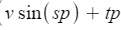
68a939b26317c5080be80eeb341f5591.png
and Y=
4d939c3651eddfe42a77fb0ccf1e852d.png
(where v is the radius, s is the angular frequency, p is time a t is the velocity of the circunference.) How can I derive a function that allows me to calculate the path the point has taken?
 
Physics news on Phys.org
You know the velocity, so you can calculate the speed at every point in time. Integrating this will give the length of the path. The integral might be hard to evaluate analytically.
 
  • Like
Likes   Reactions: pabilbado
mfb said:
You know the velocity, so you can calculate the speed at every point in time. Integrating this will give the length of the path. The integral might be hard to evaluate analytically.
So, if I just change some things like: The velocity on the x-axis =
339514d736b412d7db223e0f96038770.png
and the velocity on the y-axis =
929d2c743d37a5b0d45b2783d2ef838f.png
(v = maximun velocity, w is the angular frequency. x = time and m = the velocity of the circumference.) So can I write that the total velocity =
477694c6a1040292729ae86563edbbb9.png
and integrate between the periods of time I want? And to integrate this may I need to use elliptic integrals of second type?
 
Right.
 
  • Like
Likes   Reactions: pabilbado
mfb said:
Right.
Thanks a lot!
 

Similar threads

  • · Replies 11 ·
Replies
11
Views
4K
  • · Replies 30 ·
2
Replies
30
Views
3K
  • · Replies 13 ·
Replies
13
Views
2K
  • · Replies 14 ·
Replies
14
Views
2K
Replies
5
Views
2K
  • · Replies 5 ·
Replies
5
Views
2K
  • · Replies 32 ·
2
Replies
32
Views
2K
Replies
25
Views
2K
  • · Replies 9 ·
Replies
9
Views
2K
  • · Replies 17 ·
Replies
17
Views
4K