Calculate the flux of the indicated electric field vector through the circle

Click For Summary

Homework Help Overview

The discussion revolves around calculating the electric flux through a circular surface given an electric field vector. The problem involves understanding the relationship between electric field, area, and the angle between them.

Discussion Character

  • Exploratory, Conceptual clarification, Mathematical reasoning

Approaches and Questions Raised

  • Participants discuss the formula for electric flux and the implications of having a closed surface versus an open one. There are attempts to set up integrals and dot products to calculate the flux, with some uncertainty about the correct approach.

Discussion Status

The conversation includes various attempts to calculate the flux, with some participants questioning their assumptions and the setup of the problem. Guidance has been offered regarding the conditions under which integration is necessary, but no consensus has been reached on the correct solution.

Contextual Notes

There is mention of confusion regarding the definition of a closed surface and the implications of charge within that surface. Some participants are also unsure about the values used in their calculations.

cwatki14
Messages
56
Reaction score
0
Calculate the flux of the indicated electric field vector through the surface. (E = 130, = 66.0°.)
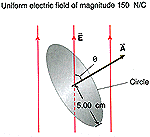
p16-68alt.gif
I know the differential equation for flux d[tex]\phi[/tex]= A [tex]\bullet[/tex] d S
[/B]

My textbook told me that "if there is zero total charge within the closed surface S, there is no net flux of the electric field vector through S."
I guessed that the total flux was 0, but that was wrong...
Or maybe it's
[tex]\int[/tex] (from O to .05m) <130,0> [tex]\bullet[/tex] [tex]\pi[/tex] r ^2(<cos60,sin60>)
But I'm not really even sure how to do an integral with a dot product(would you dot them first?), and I'm fairly certain that's wrong...

Any ideas?
 
Last edited:
Physics news on Phys.org
Welcome to PF!

Hi cwatki14! Welcome to PF! :smile:

(type \cdot, not \bullet :wink:)
cwatki14 said:
My textbook told me that "if there is zero total charge within the closed surface S, there is no net flux of the electric field vector through S."
I guessed that the total flux was 0, but that was wrong...

A "closed surface" mans a surface with no boundary (like a sphere), but S does have a boundary … it's the circle round S :wink:

(I suspect you're confusing this with a topologically closed (as opposed to open) surface … a surface which includes its boundary)
 
So is the flux then
[tex]\int[/tex](130)(sin[tex]\pi[/tex]/3)([tex]\pi[/tex])(dr)^2
and then you take the integral to get
130*sin[tex]\pi[/tex]/3*[tex]\pi[/tex][tex]\int[/tex]dr^2
and I'm not sure when to go from here...
 
Last edited:
So I was pretty sure I had it when I realized you can just take the dot product between the area and the electric field.

Therefore I was led to this answer.
A dot E= 130 * pi(.05)^2 * cos 66
Which is equal to the magnitude of the electric field multiplied by the magnitude of the area multiplied by the angle in between the two vectors (reference the pic above). However, my online homework program quickly told me I was wrong! Blergh! Any suggestions?
 
Hi cwatki14! :smile:

(have a pi: π and a dot: · and try using the X2 tag just above the Reply box :wink:)
cwatki14 said:
So I was pretty sure I had it when I realized you can just take the dot product between the area and the electric field.

That's right … you only need to integrate if the field isn't constant, or if the surface (or its boundary) isn't planar. :smile:
Therefore I was led to this answer.
A dot E= 130 * pi(.05)^2 * cos 66
Which is equal to the magnitude of the electric field multiplied by the magnitude of the area multiplied by the angle in between the two vectors (reference the pic above). However, my online homework program quickly told me I was wrong! Blergh! Any suggestions?

Looks ok to me :confused:

(Are you sure it isn't 150, not 130?)
 

Similar threads

  • · Replies 9 ·
Replies
9
Views
2K
  • · Replies 2 ·
Replies
2
Views
2K
  • · Replies 7 ·
Replies
7
Views
2K
Replies
8
Views
2K
  • · Replies 3 ·
Replies
3
Views
2K
Replies
4
Views
5K
  • · Replies 7 ·
Replies
7
Views
2K
Replies
5
Views
3K
  • · Replies 4 ·
Replies
4
Views
2K
  • · Replies 2 ·
Replies
2
Views
4K