Flux of Electric Field through a cone

Click For Summary

Homework Help Overview

The discussion revolves around calculating the electric flux through a cone, specifically addressing the relationship between the flux through the lateral surface and the base surface when no charge is present inside the cone.

Discussion Character

  • Exploratory, Assumption checking, Problem interpretation

Approaches and Questions Raised

  • Participants examine the calculation of electric flux, questioning the correctness of the original poster's approach and the assumptions made regarding the angles involved.

Discussion Status

Some participants affirm the original poster's calculations while others point out potential discrepancies in the referenced solution, indicating that multiple interpretations of the problem are being explored.

Contextual Notes

There is mention of a different problem context involving shaded regions, which may suggest additional complexity or confusion in the interpretation of the original problem.

Moara
Messages
43
Reaction score
5
Homework Statement
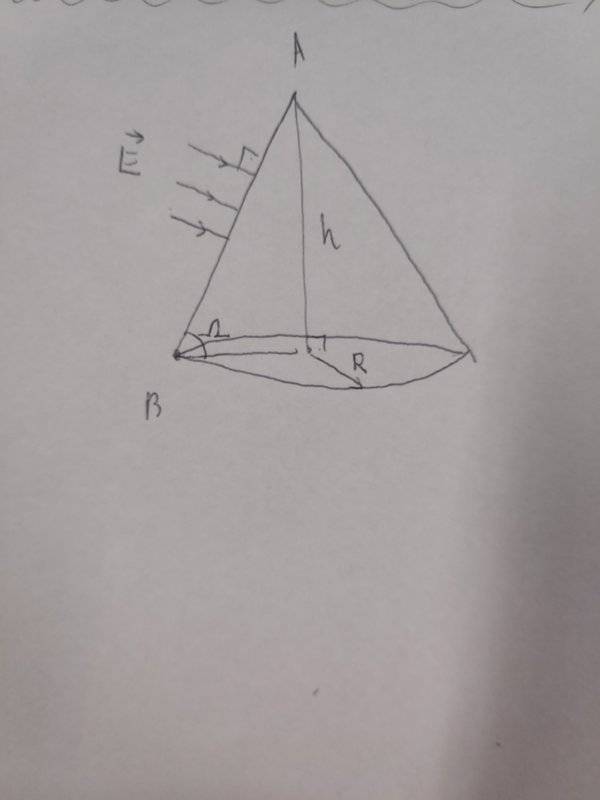
A conic surface is placed Inside a region filled with uniform Electric Field E. The field lines are perpendicular to the geratrix AB. The cone has height h and radius R of it's base. Find the electric flux through the lateral surface of the cone.
Relevant Equations
Ø=E.S.cosx Øtot=qint/€ (gaus law)
Since there is no charge inside the cone, the total flux through its surface is zero, hence Ø(lateral surface)+∅(base surface)=0. But ∅(base surface)=E.πR².cosΩ, because electric Field is homogenous. But by the figure, Ω is just arctg(h/R).
So Ø(lateral surface)=-E.π.R².R/√(R²+h²).
This is not the answer according to the solution I saw. My point is, does anyone could show me where is my mistake?
15720384362294540504960180785928.jpg
 
Physics news on Phys.org
Your work looks correct to me. Do you remember the form of the answer from the solution?
 
Here is the solution I saw. The sentence : " temos que" is equal to " we have that"
Screenshot_2019-10-25-21-14-52-850_com.android.browser.png
 
Looks like this is a different problem where they want the flux through the two shaded regions (the triangle and the semicircle). But I think there is a mistake in the solution where they inadvertently switched the two angles in the third line:
1572050553808.png


Anyway, I think your work is correct for the problem you stated.
 
  • Like
Likes   Reactions: Moara

Similar threads

  • · Replies 9 ·
Replies
9
Views
2K
  • · Replies 4 ·
Replies
4
Views
1K
  • · Replies 14 ·
Replies
14
Views
1K
Replies
20
Views
4K
  • · Replies 2 ·
Replies
2
Views
2K
  • · Replies 2 ·
Replies
2
Views
3K
  • · Replies 4 ·
Replies
4
Views
2K
  • · Replies 22 ·
Replies
22
Views
4K
  • · Replies 7 ·
Replies
7
Views
2K
  • · Replies 18 ·
Replies
18
Views
3K