Calculate the Force Required for a Wave Generator in a Water Flume

Join the discussion
Ask a follow-up here, or get your own question answered by working scientists, mathematicians and engineers — people, not an autocomplete.
Real named experts · corrections over time · the nuance an AI answer skips
6 replies · 3K views
ThiessenTillage
Messages
3
Reaction score
0
I have been tasked with building a wave generator in a flume. I need to find out how much force will be required to drive a wedge into a body of water so that we can get the right sized motor. For simplicity sake this wedge is 200mm tall, with a 45deg angle and 600mm wide. It is entering the water at a rate of 400mm/s and travels to a maximum of 200mm deep, or all the way. I realize the amount of force will change the deeper in it gets, but we are interested in the maximum force required to push it down at this speed. Any help is greatly appreciated. Proper formulas would be helpful so we can readjust things if dimensions change.
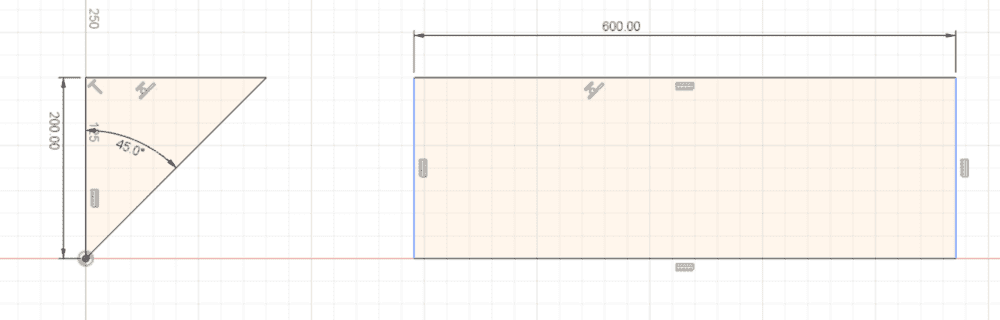
241352
 
on Phys.org
Welcome to the PF. :smile:

I moved your thread to the ME forum where you will probably get better responses to your fluid mechanics questions.

I'm assuming that the flume is long enough that the return reflection water wave is not a part of this calculation, right? How long is it?

Are you pre-weighting the wedge to reduce the power required to drive it down into the water? What weight wedge are you targeting? What accuracy do you need for the speed profile of the wedge pushing down into the water (and how does that relate to the accuracy of the wavefront that you generate)?

https://www.imperial.ac.uk/ImageCro...erialOct2010-001--tojpeg_1454350884608_x1.jpg
241370
 
Thanks Berkeman!

The flume is quite long, roughly 10m and we will be building an inclined plane on the far end to dampen out the waves so there is no return reflection.

We could pre-weight the wedge although I was going to assume no weight (essentially buoyant) and just seek the total amount of force required to push it down. I don't remember enough about physics to remember if its a 1:1 ratio for adding extra mass to the wedge (ie if it takes 100kg of force to drive the wedge down that fast and the wedge weighs 10kg, then I would need 90kg of down force). The one problem with weighing it down is I need to pull the wedge up at the same speed so there needs to be a balance.

I guess I don't quite know what accuracy we need. Probably close counts. If we are targetting 200mm/s and it ends up at 185mm/s I am sure its fine and we can measure that and calibrate it from there.

berkeman said:
Welcome to the PF. :smile:

I moved your thread to the ME forum where you will probably get better responses to your fluid mechanics questions.

I'm assuming that the flume is long enough that the return reflection water wave is not a part of this calculation, right? How long is it?

Are you pre-weighting the wedge to reduce the power required to drive it down into the water? What weight wedge are you targeting? What accuracy do you need for the speed profile of the wedge pushing down into the water (and how does that relate to the accuracy of the wavefront that you generate)?

https://www.imperial.ac.uk/ImageCro...erialOct2010-001--tojpeg_1454350884608_x1.jpg
View attachment 241370
 
russ_watters said:
Isn't this a consumer product you can just buy or have a manufacturer spec for you?
I don't think so. This is specific to that flume and I wouldn't think there would be too many if any wave generators on the market as its kind of a unique item.
 
ThiessenTillage said:
We could pre-weight the wedge although I was going to assume no weight (essentially buoyant) and just seek the total amount of force required to push it down. I don't remember enough about physics to remember if its a 1:1 ratio for adding extra mass to the wedge (ie if it takes 100kg of force to drive the wedge down that fast and the wedge weighs 10kg, then I would need 90kg of down force). The one problem with weighing it down is I need to pull the wedge up at the same speed so there needs to be a balance.
Here's a good review article about buoyancy. See if it helps you out with your force calculations. Remember to draw a free body diagram (FBD) of the wedge showing all of the vertical forces involved (gravity, buoyancy, etc.).

https://en.wikipedia.org/wiki/Buoyancy