Undergrad Calculate the Resultant Force Between 4 Points

Click For Summary
To calculate the resultant force between four anchor points for hanging two kayaks, it's essential to consider the distribution of weight and the angles involved. While it may seem straightforward to divide the weight evenly between the two sets of points, this only holds true if the kayaks are perfectly balanced with their centers of gravity aligned. In practice, the weight may not be evenly distributed, leading to scenarios where one rope bears the entire load. Additionally, dynamic forces will increase when maneuvering the kayaks, which could affect the stability of the setup. Proper positioning and awareness of these factors are crucial for safe and effective anchoring.
AmateurHour
Messages
4
Reaction score
0
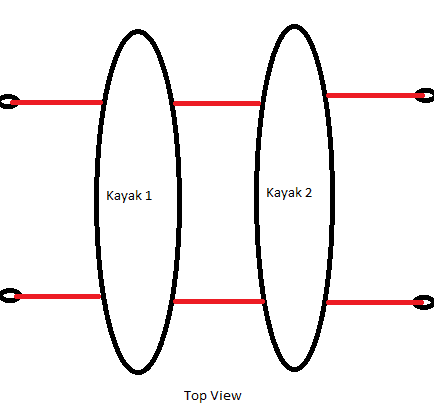
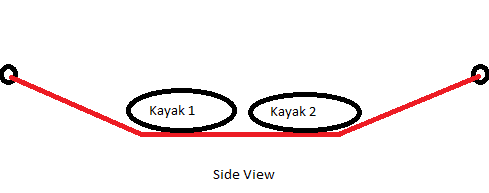
I am trying to figure out how to calculate the resultant force between 4 anchor points. Basically I want to hang two kayaks on two ropes suspended across a room. Below I have some crudely drawn images of the set up:
upload_2018-5-14_10-39-19.png


upload_2018-5-14_10-39-39.png

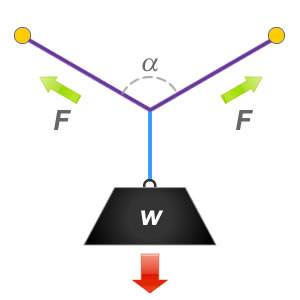
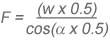
I found how to calculate the vector forces between two points as pictured below below but am wondering how it would work with four points. Is it as easy as calculating each set of two points with half the weight distributed to each set? Both kayaks should have a combined mass of less than 32kg.
vector-math-1.jpg

vector-formular.jpg

F is the resultant force exerted to each anchorage.
W is the weight of the load.
α is the internal angle between the two slings.
 

Attachments

  • upload_2018-5-14_10-39-19.png
    upload_2018-5-14_10-39-19.png
    1.5 KB · Views: 947
  • upload_2018-5-14_10-39-39.png
    upload_2018-5-14_10-39-39.png
    2.1 KB · Views: 972
  • vector-math-1.jpg
    vector-math-1.jpg
    5.5 KB · Views: 1,074
  • vector-formular.jpg
    vector-formular.jpg
    1.5 KB · Views: 508
Physics news on Phys.org
AmateurHour said:
Is it as easy as calculating each set of two points with half the weight distributed to each set?

Yes, it is. Just be aware that getting the kayaks in and out of there will involve higher forces while you are pulling and tugging, and maybe jerking.
 
  • Like
Likes AmateurHour
jrmichler said:
Yes, it is. Just be aware that getting the kayaks in and out of there will involve higher forces while you are pulling and tugging, and maybe jerking.
Thanks!
 
AmateurHour said:
Is it as easy as calculating each set of two points with half the weight distributed to each set?
The weight generally will not be evenly divided between the two ropes; you'd have to get the kayaks positioned with their centers of gravity exactly between the two ropes for an even division of the weight. Worst cas, all the weight will be on one rope while the other is doing nothing.
 
Thread 'What is the pressure of trapped air inside this tube?'
As you can see from the picture, i have an uneven U-shaped tube, sealed at the short end. I fill the tube with water and i seal it. So the short side is filled with water and the long side ends up containg water and trapped air. Now the tube is sealed on both sides and i turn it in such a way that the traped air moves at the short side. Are my claims about pressure in senarios A & B correct? What is the pressure for all points in senario C? (My question is basically coming from watching...

Similar threads

  • · Replies 4 ·
Replies
4
Views
2K
  • · Replies 12 ·
Replies
12
Views
3K
Replies
1
Views
4K
  • · Replies 28 ·
Replies
28
Views
3K
Replies
3
Views
1K
  • · Replies 17 ·
Replies
17
Views
2K
  • · Replies 15 ·
Replies
15
Views
3K
  • · Replies 14 ·
Replies
14
Views
1K
  • · Replies 13 ·
Replies
13
Views
2K
  • · Replies 11 ·
Replies
11
Views
1K