Calculate the size of fuses to use

  • Thread starter Thread starter yungman
  • Start date Start date
Click For Summary

Discussion Overview

The discussion revolves around selecting appropriate fuse sizes for a power amplifier design, focusing on the calculations and considerations involved in ensuring protection against excess current. Participants explore theoretical and practical aspects of fuse selection, including inrush current and the implications of wire gauge.

Discussion Character

  • Technical explanation
  • Debate/contested
  • Mathematical reasoning

Main Points Raised

  • One participant, Alan, seeks confirmation on his calculations for fuse sizes based on the amplifier's peak output voltage and load.
  • Another participant emphasizes the importance of using LaTeX for clarity in calculations and questions the appropriateness of the proposed fuse ratings given the calculated load current.
  • There is a discussion about the role of fuses primarily as protection for wire insulation rather than directly correlating to circuit draw, with one participant outlining a general design process for fuse selection.
  • Alan later decides on using an 8A fuse for the amplifier's supply rails, arguing that it will cover normal operation without blowing under typical conditions.
  • Concerns are raised about inrush surge current and its potential to cause nuisance blowing of fuses, with suggestions to use slow-blo fuses and inrush current limiters.
  • Participants discuss the specifics of snubber networks and their role in protecting switch contacts from inductive spikes, with some uncertainty expressed about the calculations involved in determining current limits.
  • One participant reflects on their experience of not having burnt a switch in four years, despite acknowledging a lack of rigorous scientific calculation.

Areas of Agreement / Disagreement

Participants express differing views on the appropriate fuse sizes and the calculations involved, with no consensus reached on the best approach to fuse selection or the specifics of inrush current management.

Contextual Notes

Some calculations and assumptions regarding current limits, wire gauge, and fuse ratings remain unresolved, with participants relying on personal experience and general practices rather than definitive guidelines.

Who May Find This Useful

Individuals interested in power amplifier design, fuse selection, and electrical safety standards may find this discussion relevant.

yungman
Messages
5,741
Reaction score
291
TL;DR
Calculate the size of the fuses to use
Hi

This is what Chinese saying "Old cat got his whiskers burn"! All these years, I never even have to worry power consumption to put in fuses. This is for the power amp I designed and I want to put in fuses for protection.

The peak output voltage is 36V driving a 3ohm load. Output is a sine wave. I have F1 as AC line input fuse and F2 & F3 are fuses for the +ve and -ve supply rail of the amp. Here is my calculation. I want to run it by you experts to make sure I am correct:
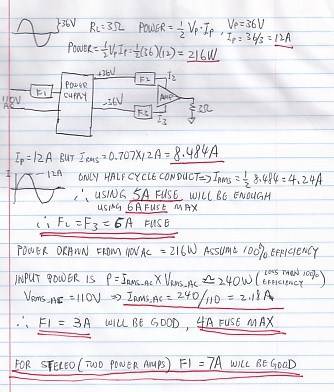
Fuse calculations.jpg
Please let me know am I right.

Thanks

Alan
 
Engineering news on Phys.org
Anyone? I just want to confirm, I am 90% sure, but just want to confirm.

thanks
 
Ack, please, please, please learn to post in LaTeX. It is very hard to decipher your work in pictures. I know you are very new here, and may not be familiar with this PF rule about posting in LaTeX. There is a "LaTeX Guide" link at the lower left of the Edit window. :wink:

Also, as I try to decipher your images, it looks like you calculate the load current as 12A max, but want to use a 3A-7A fuse?
 
berkeman said:
Ack, please, please, please learn to post in LaTeX. It is very hard to decipher your work in pictures. I know you are very new here, and may not be familiar with this PF rule about posting in LaTeX. There is a "LaTeX Guide" link at the lower left of the Edit window. :wink:

Also, as I try to decipher your images, it looks like you calculate the load current as 12A max, but want to use a 3A-7A fuse?
I forgot how to use latex! 12A is peak current, also it's only conduct 1/2 of the cycle. The negative half draws current from the negative supply that has it's own fuse(F3). So the peak current is only equal to 6A. then multiply by 0.707 to get 4.24A.

In another word, the total power is split between the +ve and -ve supply, each only has to provide half of the total power.

Thanks
 
Sorry, I haven't read your post in detail. But, a general comment that few outside of power electronics understand about fuses.

According to safety standards and common practice they are there to prevent fire or (maybe) insulation breakdown due to high temperature due to excess current. They are to protect against excess current in fault conditions and actually have little to do with normal circuit operation. How much current your circuit draws is only of peripheral relevance. The details are a bit too much to explain here but the normal (most common) design process goes like this:

1) My circuit draws x amps, and I need wires (and such) to reliably supply x amps without getting too hot or dropping too much voltage.

2) The wires I've chosen will overheat (above the temp. rating of the insulation) if they experience y amps of current.

3) I need to select a fuse (or other device) that can reliably pass x amps and will disconnect below y amps.

You choose fuses based on the wire size*, not your circuit draw. The wire size is selected based on the circuit(s) it needs to power. Wire size is selected to make stuff work normally. Fuses are selected to protect the wire insulation. Every EE that does this has their favorite table to help. But the safety inspectors don't care about your tables, they'll want to measure the temperature of the insulation in normal operation worst case conditions. Then the will create a reasonable high current fault, and see if you've protected it from bad consequences. They may just skip the first test, but not the second one.

My laptop charger might be drawing about 1 amp right now. But it's plugged into a circuit that has wire to support >20 amps and a circuit breaker that will allow 20 amps, but not so much more that the wire insulation, outlets, etc. will be damaged.

One of the most common, and not so easy, questions in equipment design is what wire size and fuse should I use. It is actually often a quite complex thermal problem. You can spot a pro if their first question is "what is the temperature rating of the wire insulation, and what's nearby that also makes heat".

* OK, sometimes fuses are (were?) selected to protect equipment, e.g. "rectifier fuses". But that's not common, and often, IMO, a fix for a bad or difficult design.
 
Last edited:
  • Like
Likes   Reactions: yungman and anorlunda
Thanks

I since decided to use 8A fuse for F2 and F3. The output stage has over 9 pairs of power transistor that easily supply 20A+. 8A fuse should cover all normal operation and will never blow under normal condition.

All my wires are 12 gauge, wire conductor is not going to be a problem. Speaker connection is 10gauge, it definitely will not over heat with 8A.

As for AC input fuse F1. From calculation, max power draw from each channel is 216W, so both channels is about 440W max. So say I have to be able to sustain 500W.

P=Irms X Vrms => Irms= P/Vrms = 500W/110V = 4.54545A. So a 5A fuse should do it.
 
Last edited:
yungman said:
As for AC input fuse F1. From calculation, max power draw from each channel is 216W, so both channels is about 440W max. So say I have to be able to sustain 500W.

P=Irms X Vrms => Irms= P/Vrms = 500W/110V = 4.54545A. So a 5A fuse should do it.
Don't forget inrush surge current.

Little details -- like charging the filter caps, or switching the power on at peak voltage when the core of the power transformer is already magnetized in the same direction -- can cause nuisance blowing without a slow-blo fuse.

Cheers,
Tom
 
  • Like
Likes   Reactions: yungman
Tom.G said:
Don't forget inrush surge current.

Little details -- like charging the filter caps, or switching the power on at peak voltage when the core of the power transformer is already magnetized in the same direction -- can cause nuisance blowing without a slow-blo fuse.

Cheers,
Tom
Thanks

I use slow-blo fuse and I have 2.5ohm 8A inrush current limiter for each transformer also. I did that more to protect the contacts of the power switch and I also put a 0.1uF in series with 10ohm resistor across the two terminals of the power switch to snub out the inductor spike from the transformer.
 
  • Like
Likes   Reactions: Tom.G and DaveE
yungman said:
I did that more to protect the contacts of the power switch and I also put a 0.1uF in series with 10ohm resistor across the two terminals of the power switch to snub out the inductor spike from the transformer.
Those are almost the "classic values"; 100 Ohm is more common -- though dependent on switch rating and load current and inductance. The 10 Ohm could allow 17 Amps thru the switch contacts if closed at the voltage peak.

Cheers,
Tom
 
  • Like
Likes   Reactions: yungman
  • #10
Tom.G said:
Those are almost the "classic values"; 100 Ohm is more common -- though dependent on switch rating and load current and inductance. The 10 Ohm could allow 17 Amps thru the switch contacts if closed at the voltage peak.

Cheers,
Tom
Are you talking about the snubber network of 10ohm in series with 0.1uF across the two terminals of the power switch? I thought that's only for inductive spike from the inductance of the transformers when the switch is opened.

Are you talking about when closing at the peak voltage (117Vrms X 1.414 = 165Vp) where the 0.1uF is charged to 165V and short out by the switch through the 10ohm?

I really don't know how to calculate exactly all the current. I know the thermistor limit the current, the inductance of the transformer also limit the in rush current. But on the secondary of the transformer, I have about 0.2F(yes 0.2 farads) of filter caps. I really don't even know how to start the calculation. All I can say is I have amps like this and it's been 4 years and never burn one switch yet! I know, it's not very scientific!
 
  • Informative
Likes   Reactions: Tom.G
  • #11
yungman said:
4 years and never burn one switch yet! I know, it's not very scientific!
In that case, I say the devil with "scientific" as you are obviously doing other things (that you have not mentioned) right!

Keep up the good work.

Cheers,
Tom
 

Similar threads

  • · Replies 29 ·
Replies
29
Views
20K
  • · Replies 7 ·
Replies
7
Views
3K
Replies
7
Views
3K
Replies
2
Views
2K
  • · Replies 12 ·
Replies
12
Views
3K
  • · Replies 41 ·
2
Replies
41
Views
7K
Replies
4
Views
2K
  • · Replies 34 ·
2
Replies
34
Views
9K
  • · Replies 1 ·
Replies
1
Views
7K
  • · Replies 16 ·
Replies
16
Views
13K