Calculate Volume Flow & Distance of Sprinkler Holes | DIY Garden Project

  • Thread starter Thread starter Pau Hernandez
  • Start date Start date
  • Tags Tags
    Calculations
Click For Summary
SUMMARY

This discussion focuses on calculating the volume flow and distance of water from a DIY sprinkler system. The user intends to create a sprinkler by drilling holes in a sealed tube connected to a water hose. Key insights include the understanding that the first hole will receive the majority of the water flow, but subsequent holes can still function effectively, as evidenced by boom sprayers. Resources such as Washington State University's agricultural irrigation calculators and the Drip Line Rate Calculator are recommended for accurate calculations.

PREREQUISITES
  • Basic understanding of fluid dynamics
  • Familiarity with irrigation systems
  • Knowledge of sprinkler design principles
  • Access to online irrigation calculators
NEXT STEPS
  • Research fluid dynamics principles related to flow rate and pressure loss
  • Explore Washington State University's irrigation calculators for practical applications
  • Learn how to use the Drip Line Rate Calculator for specific sprinkler designs
  • Investigate the design and functionality of boom sprayers in irrigation
USEFUL FOR

Garden enthusiasts, DIY project makers, and individuals interested in optimizing home irrigation systems will benefit from this discussion.

Pau Hernandez
Messages
13
Reaction score
3
Hello,

I do want to make a small sprinkler for my garden. As you can see it is a simple tube with one end sealed and the other end will be attached to the water hose. Now what I want to do is drill a couple holes to the sides of the tube and get a sprinkler like that. I would like to know how to calculate the volume flow through each hole and how far the water ray will shoot out of the tube. My logic says is that the first hole will get most of the water and with each hole the water ray will be weaker.

Here is a small drawing:
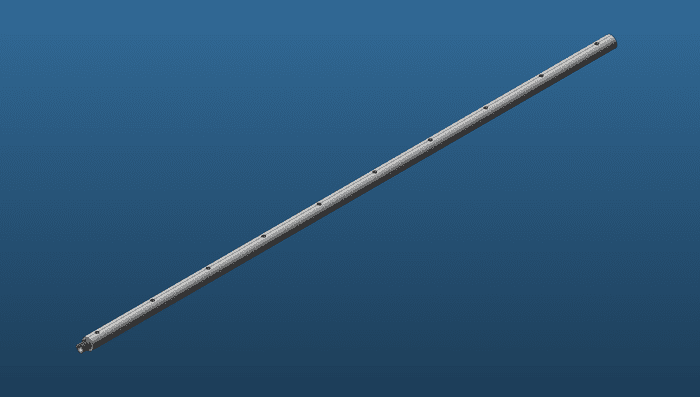
fJoYEpC.png
 
Engineering news on Phys.org
Pau Hernandez said:
My logic says is that the first hole will get most of the water and with each hole the water ray will be weaker.
Not necessarily so that the last hole is a dribble.
Otherwise boom sprayers would not function as demanded.

Agrifac_Sprayer_thumb.gif
 

Similar threads

  • · Replies 13 ·
Replies
13
Views
4K
  • · Replies 32 ·
2
Replies
32
Views
12K
  • · Replies 10 ·
Replies
10
Views
7K
  • · Replies 1 ·
Replies
1
Views
3K
  • · Replies 6 ·
Replies
6
Views
4K
  • · Replies 14 ·
Replies
14
Views
3K
  • · Replies 31 ·
2
Replies
31
Views
5K
  • · Replies 6 ·
Replies
6
Views
5K
Replies
9
Views
4K
Replies
4
Views
3K